
 Google Calendar
  Outlook Calendar
  Google Meet
  Microsoft Teams
  Zoom Meetings
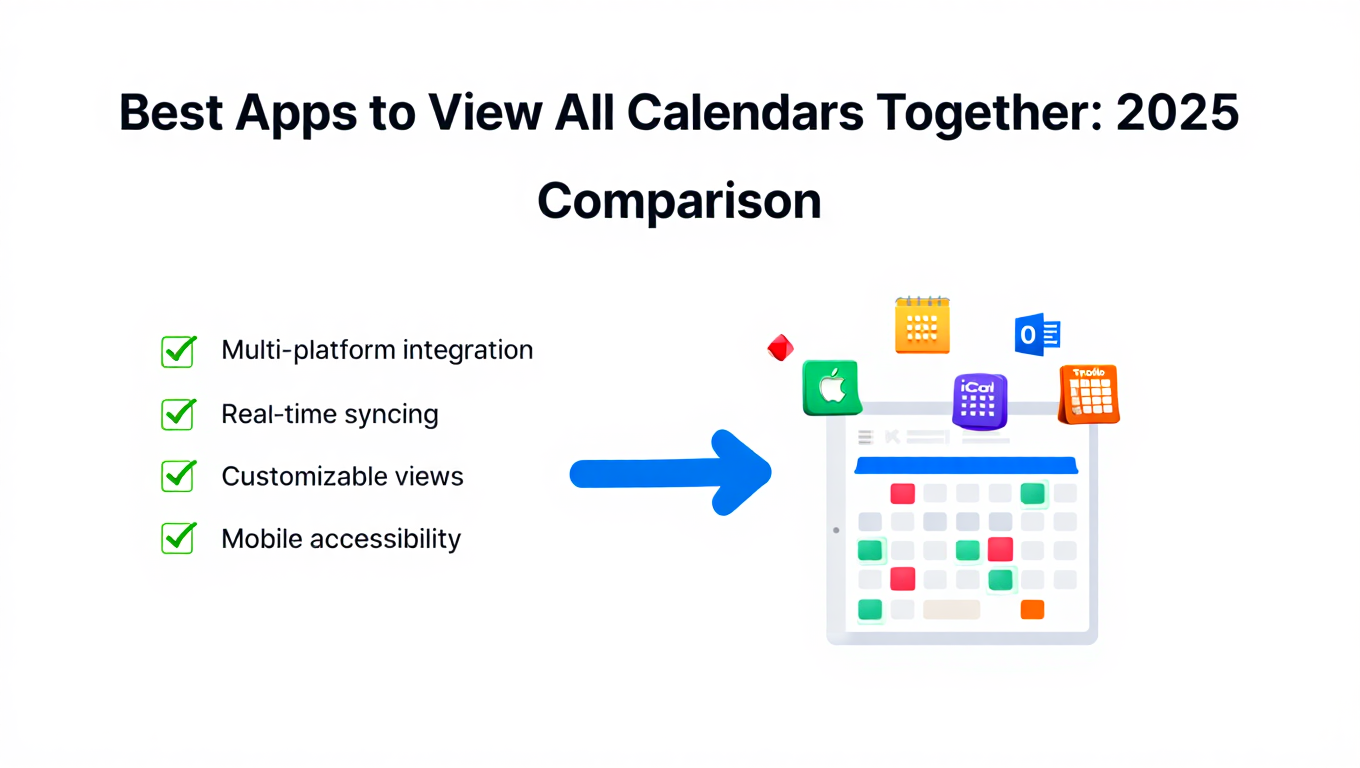
 Best Apps to View All Calendars Together: 2025 Comparison
Compare the best apps and tools to view all calendars together. Detailed analysis of features, limits, pricing, and which solution fits your needs.
Choosing the right tool to view all calendars together can feel like navigating a maze of similar-sounding features that deliver wildly different results. Every platform claims unified calendar viewing. Every service promises seamless synchronization. Yet somehow you still end up with read-only imports that update once daily, arbitrary 6-calendar limits, or interfaces so cluttered they create more problems than they solve.
The difference between marketing claims and actual functionality is substantial. Some calendar apps provide true unified views where you can view, edit, and manage all calendars together in real time. Others offer basic imports that display external calendars as static snapshots with 24-hour update delays. Understanding how to consolidate multiple calendars properly is essential for effective calendar management.
- Comprehensive comparison of native calendar apps (Google, Outlook, Apple)
- Analysis of third-party unified calendar solutions and their limitations
- Real-world testing of calendar connection limits and synchronization speeds
- Pricing breakdowns for free versus paid calendar management tools
- Decision framework for selecting the right solution for your needs
What to Look for in Apps That Let You View All Calendars Together
Before diving into specific product comparisons, understand the critical features that separate effective unified calendar solutions from superficial marketing claims.
Real-Time Synchronization vs. Periodic Updates
The synchronization frequency determines whether you see your actual schedule or an outdated approximation. Real-time synchronization (under 1-minute delays) means changes appear almost instantly. Near-real-time (under 5-minute delays) provides acceptable accuracy for most use cases. Periodic updates (hourly or daily) create dangerous gaps where your unified view displays incorrect information.
According to 2024 calendar management research, synchronization delays contribute to 45 minutes of wasted time weekly through double bookings and scheduling conflicts that could be prevented with current information. Learn more about preventing double bookings across multiple calendars.
Bidirectional Editing vs. Read-Only Viewing
When you view all calendars together, can you actually manage those calendars within the unified interface? Bidirectional editing allows you to create, modify, and delete events on any connected calendar, with changes syncing back to the source platform. Read-only viewing displays events but requires you to switch to the source platform for any modifications.
Read-only viewing defeats much of the purpose of unified calendar management. You gain visibility but sacrifice workflow efficiency because you still must access multiple platforms for actual calendar management.
Connection Limits and Scalability
How many calendars can you connect before hitting platform restrictions? Consumer-focused calendar apps typically support 5-10 calendars comfortably. Scheduling-first platforms that offer calendar viewing as a secondary feature often cap connections at 6 calendars or fewer. Purpose-built calendar management tools designed for power users should support unlimited connections.
Your needs today may involve 7-8 calendars, making a 10-calendar limit seem adequate. But what happens in six months when you take on two new clients, join a community board, and start coaching your child's team? Choosing a platform with artificial limits forces future migration to a more capable solution. Discover how to effectively manage 5+ calendars without limits.
Mobile and Cross-Platform Accessibility
Can you view all calendars together on your phone, tablet, and desktop with consistent functionality across devices? Some solutions work beautifully on desktop but provide limited mobile experiences. Others synchronize to native mobile calendar apps but lose advanced features in the translation.
Research shows that 80% of adults use smartphones for scheduling. If your unified calendar solution does not extend to mobile devices with full functionality, you will inevitably revert to fragmented calendar management when away from your desk.
Security and Privacy Standards
When connecting multiple calendars to a unified viewing platform, you grant that service access to your complete schedule across personal, professional, and confidential commitments. Verify that calendar aggregation tools implement enterprise-grade security, including encrypted data transmission, secure credential storage, and compliance with relevant privacy regulations.
Free consumer services often monetize through advertising or data analysis. Understand exactly how calendar providers fund their operations and what happens to your scheduling information.
- Synchronization Speed: Under 5 minutes for practical real-time viewing
- Editing Capability: Bidirectional sync allowing changes from unified view
- Connection Capacity: Support for current needs plus 50% growth buffer
- Platform Coverage: Supports all calendar services you actually use
- Mobile Parity: Full functionality on smartphone and tablet devices
- Security Standards: Encryption, secure storage, privacy compliance
Native Calendar Apps: Google, Outlook, and Apple Calendar
The three dominant native calendar platforms each offer built-in capabilities to view multiple calendars together, with varying degrees of effectiveness depending on your ecosystem commitment.
Google Calendar: Best for Google Ecosystem Users
Google Calendar excels when you operate primarily within Google Workspace and Gmail, offering seamless integration with other Google services and straightforward unified calendar viewing.
Strengths:
Google Calendar allows you to create up to 25 calendars within a single account and display all of them simultaneously through a checkbox-based visibility system. Each calendar appears in a distinct color, creating clear visual separation while maintaining unified timeline viewing.
The platform handles multiple Google accounts elegantly. You can add secondary Google accounts to your primary calendar view and see calendars from personal Gmail, work Google Workspace, and side project accounts all together in one interface.
Sharing and collaboration features are intuitive. When colleagues share their Google Calendars with you, those calendars appear in your "Other calendars" list and can be displayed alongside your own calendars with a single click.
Calendar integration with Gmail, Google Meet, Google Tasks, and Google Keep creates a cohesive productivity ecosystem. Meeting links generate automatically, event details pull from email context, and task deadlines appear on your calendar timeline.
Limitations:
Google Calendar's ability to view all calendars together breaks down when you need to incorporate calendars from outside the Google ecosystem. The platform supports ICS/iCal feed subscriptions for external calendars, but these imports are read-only and refresh approximately every 24 hours.
This means your unified view of a Microsoft Outlook calendar in Google Calendar may be outdated by an entire day, creating exactly the scheduling conflicts and visibility gaps that unified calendar viewing is meant to prevent.
Mobile functionality is strong within the Google ecosystem but limited when managing external calendar connections. The refresh delay problem compounds on mobile where you cannot manually force synchronization updates as easily as on desktop.
Color customization provides only a limited palette of preset options rather than full RGB color selection, making it challenging to create sophisticated color-coding systems when managing numerous calendars.
Best For:
Google Calendar is ideal for users who operate primarily within Google Workspace for professional work and Gmail for personal communication, with minimal need to view calendars from Microsoft, Apple, or specialized platforms together with Google calendars.
Microsoft Outlook: Best for Enterprise Environments
Outlook Calendar dominates corporate environments and offers powerful unified calendar viewing features, particularly in the desktop application, with tight integration to Microsoft 365 ecosystem services.
Strengths:
Outlook's overlay view provides true unified calendar visualization where multiple calendars merge into a single timeline with color-coded events. This overlay functionality supports up to 10 calendars simultaneously and works exceptionally well for comparing availability across team calendars, resource calendars, and personal schedules.
The calendar groups feature allows you to organize related calendars and toggle entire groups on and off with a single click. This capability streamlines switching between contexts (work view, personal view, comprehensive view) throughout your day.
Exchange Server and Microsoft 365 integration provides enterprise-grade calendar management with advanced features like delegate access, room booking, resource scheduling, and detailed free/busy sharing permissions. These capabilities exceed what consumer calendar platforms offer.
Desktop application power users appreciate extensive keyboard shortcuts, customizable views, and workflow automation through Quick Steps and rules. You can configure Outlook to handle complex calendar management scenarios that would require manual intervention in simpler platforms.
Limitations:
The 10-calendar overlay limit proves insufficient for professionals managing extensive calendar portfolios. While you can technically connect more calendars, viewing more than 10 simultaneously requires reverting to side-by-side view where each calendar occupies a narrow column, creating readability challenges.
External calendar integration through ICS subscriptions faces the same read-only and synchronization delay issues found in Google Calendar. Importing an iCloud calendar into Outlook creates a snapshot that updates periodically rather than a live view.
The web version of Outlook (Outlook.com) provides less robust unified calendar viewing compared to the desktop application. Some advanced features like calendar overlay are limited or unavailable depending on account type and licensing.
Mobile apps for Outlook on iOS and Android offer solid functionality but cannot replicate the full desktop experience. Power users accustomed to overlay views and calendar groups on desktop encounter limitations when managing calendars on mobile devices.
Best For:
Outlook Calendar is ideal for professionals in corporate environments using Microsoft 365, particularly those who need advanced features like delegate access, room booking, and extensive calendar sharing with granular permissions.
Apple Calendar: Best for Apple Ecosystem Loyalty
Apple Calendar delivers seamless synchronization across iPhone, iPad, and Mac devices through iCloud, with a clean interface that prioritizes simplicity over advanced power-user features.
Strengths:
Cross-device synchronization through iCloud works flawlessly within the Apple ecosystem. Changes made on your iPhone appear instantly on your Mac and iPad without configuration or thought. This seamless experience makes Apple Calendar attractive for users committed to Apple hardware.
The platform supports viewing unlimited calendars together without artificial caps, displaying all selected calendars in a unified color-coded view. Unlike Google's 25-calendar limit or Outlook's 10-calendar overlay restriction, Apple Calendar scales to whatever number of calendars you create.
Integration with other Apple services including Reminders, Maps, and Contacts creates useful automatic enhancements. Event locations become tappable links to Maps with travel time calculations. Contact names auto-complete when adding event attendees.
The interface design emphasizes clarity and removes complexity, making Apple Calendar approachable for users who want straightforward calendar management without overwhelming options.
Limitations:
External calendar support through account connections works reasonably well for Google and Microsoft accounts but provides less robust synchronization compared to native Apple calendars. You can connect these accounts and view their calendars, but some advanced features may not translate perfectly.
ICS calendar subscriptions offer flexible refresh intervals (as frequent as every 5 minutes) but remain read-only. This limitation means you gain visibility into external calendars but cannot edit those events within Apple Calendar.
Advanced power-user features are limited compared to Google Calendar and Outlook. You cannot create complex calendar sharing permissions, detailed availability rules, or sophisticated workflow automations within the Apple Calendar interface.
The platform lacks a proper web interface. If you occasionally work on Windows or need calendar access from a non-Apple device, you must use iCloud.com which provides only basic calendar functionality compared to the native applications.
Best For:
Apple Calendar is ideal for individuals and families committed to Apple devices who prioritize seamless cross-device synchronization and interface simplicity over advanced calendar management features.
Third-Party Unified Calendar Solutions
When native platform capabilities prove insufficient, third-party calendar aggregation services provide more powerful features to view all calendars together, though each takes a different approach to solving the unified calendar challenge.
CalendarBridge: Synchronization-Focused Solution
CalendarBridge positions itself as a comprehensive calendar synchronization platform that connects Google, Microsoft 365, Outlook, iCloud, and ICS calendars with bidirectional syncing capabilities.
How It Works:
Rather than creating a proprietary calendar interface, CalendarBridge synchronizes events between your existing calendar platforms. You connect your various calendar accounts, configure sync rules, and CalendarBridge copies events bidirectionally so each platform contains all events from all connected calendars.
This approach allows you to view all calendars together using whichever native platform you prefer (Google Calendar, Outlook, Apple Calendar) while CalendarBridge handles the synchronization infrastructure in the background.
Strengths:
Bidirectional synchronization means you can create and edit events on any connected platform, with changes propagating to all other platforms. This solves the read-only limitation of native ICS imports.
The Unified Calendar interface provides a single view of all connected calendars with edit capabilities, refreshing in real time rather than hourly or daily. You can view and manage events across all platforms without switching applications.
Batch sync creation streamlines setup when connecting multiple calendars with similar sync requirements. Rather than configuring each calendar pair individually, you can establish sync patterns and apply them to multiple calendars simultaneously.
Support for ICS calendar feeds with faster refresh rates than native platforms means even calendars that only provide read-only feeds stay more current in your unified view.
Limitations:
The synchronization approach creates duplicate events across platforms. If you connect Google Calendar and Outlook Calendar through CalendarBridge, an event created in Google appears in Outlook as a synchronized copy. This duplication uses calendar storage space and can create confusion about which is the "original" event.
Need better calendar management? CalendHub unifies all your calendars with smart scheduling and video conferencing.
Pricing structure based on the number of calendar connections means costs scale as your calendar management needs grow. Users managing extensive calendar portfolios face higher subscription costs.
The service requires ongoing synchronization to maintain accuracy. If CalendarBridge experiences downtime or your internet connection drops, synchronization stops and your unified view becomes outdated until connectivity restores.
Pricing:
CalendarBridge offers a free tier with limited sync pairs, with paid plans starting at approximately $4.99 per month for additional calendar connections and features.
OneCal: Calendar View and Sync Platform
OneCal provides both calendar synchronization similar to CalendarBridge and a dedicated Calendar View interface for viewing all calendars together in one place.
How It Works:
OneCal connects to your Google, Outlook, and iCloud calendars, providing bidirectional synchronization between platforms and a unified Calendar View where you can see all connected calendars regardless of source platform.
The Calendar View feature allows you to view Outlook, iCloud, and Google Calendars together in one interface, hide synchronization clones to reduce clutter, and quickly join meetings from any calendar platform.
Strengths:
The clone-hiding feature addresses a common complaint with calendar synchronization services. When OneCal syncs an event across platforms, it can identify and hide the duplicate copies in the Calendar View, showing each event only once despite it existing in multiple source calendars.
Quick meeting join functionality detects video conference links (Zoom, Google Meet, Microsoft Teams) across all connected calendars and provides one-click access regardless of which platform hosts the original event.
The service emphasizes solving the specific pain points of professionals who must work across Google and Microsoft ecosystems due to different organizations using different platforms.
Limitations:
Platform support focuses primarily on the major players (Google, Microsoft, Apple) with less emphasis on niche calendar services or specialized scheduling tools. If you use less common calendar platforms, OneCal may not support connections.
Calendar View acts as another interface to learn rather than leveraging the native platform interfaces you already know. This creates a learning curve and means you split time between the OneCal interface and native platform applications.
Documentation and support resources are less extensive than enterprise-focused competitors, which can make troubleshooting configuration issues more challenging for non-technical users.
Pricing:
OneCal offers free and paid tiers, with pricing starting around $4-5 monthly for full synchronization features and unlimited calendar connections.
Morgen: Calendar and Task Manager Combination
Morgen combines unified calendar viewing with task management, positioning itself as a comprehensive time management platform rather than pure calendar synchronization.
How It Works:
Morgen connects to Google Calendar, Outlook Calendar, Apple Calendar, and other platforms, displaying all calendars together in a custom interface that also incorporates task lists from Todoist, Microsoft To Do, and other task management services.
The platform emphasizes time blocking and calendar-based task scheduling, allowing you to drag tasks onto your calendar to convert them into scheduled work blocks.
Strengths:
Integration between calendars and tasks addresses a common pain point where commitments live in separate systems. Morgen surfaces task deadlines alongside calendar events, providing more complete schedule visibility.
Time zone handling is particularly robust, designed for professionals working with international teams. You can view your schedule in multiple time zones simultaneously and see when proposed meeting times align with reasonable working hours across regions.
Keyboard shortcuts and power-user features appeal to efficiency-focused professionals who want to manage calendars and tasks without touching the mouse.
The ability to view all calendars together from multiple accounts (multiple Google accounts, Outlook plus Google, etc.) removes the ecosystem lock-in found in native applications.
Limitations:
The combined calendar-and-task interface creates complexity that may overwhelm users who simply want unified calendar viewing without task management integration.
Morgen requires learning a new interface rather than enhancing the native calendar applications you already use. This represents a more significant workflow change than synchronization services that work behind the scenes.
Mobile apps exist but provide a subset of desktop functionality, particularly around advanced keyboard shortcuts and multi-window workflows that power users rely on.
The task management integration, while powerful, means you are committing to Morgen's approach rather than maintaining flexibility to use your preferred task management system independently.
Pricing:
Morgen offers a free tier with limited features and paid plans starting at $9 per month for full calendar connections and advanced features.
CalendHub: Unlimited Calendar Viewing for Power Users
CalendHub takes a fundamentally different approach by focusing exclusively on calendar viewing and management rather than trying to combine calendars with scheduling, task management, or other productivity features.
How It Works:
CalendHub connects to unlimited calendar sources across Google, Microsoft, Apple, and other platforms, providing a true unified view designed specifically for professionals who need to view all calendars together without artificial restrictions.
The platform is built from the ground up for power users managing 10, 15, 20+ calendars simultaneously, rather than adapting a scheduling-first tool to accommodate calendar viewing as a secondary feature.
Strengths:
Unlimited calendar connections eliminate the artificial caps found in competitors. While scheduling platforms like Calendly restrict users to 6 calendars maximum, CalendHub removes this constraint entirely, allowing you to connect as many calendars as your workflow requires.
The calendar-first design philosophy means every feature prioritizes calendar viewing and management rather than scheduling automation. The interface, synchronization infrastructure, and feature set all optimize for users whose primary need is viewing all calendars together.
Support teams understand complex calendar management scenarios because the platform attracts users with sophisticated calendar portfolios. You receive assistance from people who specialize in calendar visibility challenges rather than generalist support handling diverse product features.
Scalability is baked into the platform architecture. As your responsibilities grow and your calendar portfolio expands from 8 calendars to 15 to 22, CalendHub continues functioning identically without requiring workflow changes or upgrades to higher-tier plans with higher connection limits.
Limitations:
As a specialized calendar management platform, CalendHub does not attempt to be an all-in-one productivity suite. If you want calendar viewing, task management, email, and project management in a single application, you will need to use CalendHub alongside other tools.
The focus on power users means the platform may offer more capability than casual users with simple calendar needs require. Someone managing only 3-4 calendars might find native platform features or simpler tools more appropriate.
Pricing:
CalendHub pricing is designed to remain cost-effective even for power users managing extensive calendar portfolios, avoiding the per-connection fees that make competing solutions expensive at scale.
- Choosing based on current calendar count without planning for growth
- Assuming "calendar viewing" features are equivalent across platforms
- Overlooking mobile experience if you manage calendars on the go
- Ignoring synchronization delays that make unified views unreliable
- Selecting scheduling tools for calendar management (different use cases)
Specialized Calendar Tools Worth Considering
Beyond comprehensive unified calendar platforms, several specialized tools address specific calendar management scenarios.
Fantastical: Premium Apple-Focused Calendar
Fantastical positions itself as a premium alternative to Apple Calendar with natural language event creation and enhanced calendar viewing features.
The application provides beautiful unified views of multiple calendars with sophisticated design and smooth animations. Natural language parsing allows you to type "lunch with Sarah next Tuesday at 1pm" and Fantastical creates the appropriately scheduled event automatically.
However, Fantastical works best within the Apple ecosystem and costs $4.99 monthly or $39.99 annually for full features. Users managing primarily non-Apple calendars or requiring cross-platform access may find the premium pricing difficult to justify.
Calendar.com: Scheduling with Calendar Viewing
Calendar.com combines appointment scheduling features with the ability to view up to 10 connected calendars together in a unified interface.
The platform targets professionals who need both inbound scheduling (allowing others to book time on your calendar) and personal calendar management. However, the 10-calendar connection limit and scheduling-first feature priority make it less suitable than dedicated calendar management platforms for power users.
Teamup: Shared Team Calendars
Teamup specializes in shared calendar viewing for teams, groups, and organizations, allowing multiple people to view and contribute to centralized calendars together.
Rather than aggregating individual calendars into unified personal views, Teamup creates shared calendars that multiple users access with customizable permission levels. This makes it excellent for team scheduling, event coordination, and resource management, but less suitable for personal unified calendar viewing across multiple accounts. For personal calendar consolidation, explore our guide on synchronizing all calendars in one view.
Native Features vs. Third-Party Solutions: Decision Framework
Determining whether native platform features or third-party solutions better serve your needs to view all calendars together depends on specific criteria.
Choose Native Platform Features When:
Your calendar portfolio lives primarily in one ecosystem (Google Workspace, Microsoft 365, or Apple iCloud). You manage fewer than 8 calendars total. Occasional synchronization delays (several hours) are acceptable. You prefer using familiar native interfaces over learning new applications. Your calendar management needs are unlikely to grow significantly.
Native platforms provide adequate unified calendar viewing within these constraints at no additional cost beyond your existing ecosystem subscriptions.
Choose Third-Party Synchronization Services When:
You actively use multiple ecosystems daily (Google for personal, Outlook for work). You need bidirectional editing across platforms, not just read-only viewing. Real-time or near-real-time synchronization is critical. You prefer viewing calendars in native applications but need better synchronization. Your calendar count ranges from 8-15 calendars.
Services like CalendarBridge and OneCal provide the synchronization infrastructure to make native applications work together more effectively.
Choose Dedicated Calendar Platforms When:
You manage 15+ calendars across multiple organizations and projects. Connection limits in other solutions restrict your actual workflow. Calendar management itself is a significant part of your professional responsibilities. You need unlimited scalability as responsibilities grow. Real-time visibility across all calendars is mission-critical.
Platforms like CalendHub that focus exclusively on calendar management provide the unlimited capacity and specialized features that power users require.
Comparison Table: All Solutions at a Glance
Real-World Use Cases: Which Solution Fits Your Situation
Abstract comparisons help, but practical scenarios clarify which solutions work best for common calendar management situations.
Scenario 1: Corporate Professional (Single Ecosystem)
You work for a large corporation using Microsoft 365. You have a primary work calendar, several shared team calendars, resource calendars for conference rooms, and a personal Microsoft calendar. Total count is 7 calendars, all within the Microsoft ecosystem.
Best Solution: Microsoft Outlook native features provide everything you need. The overlay view handles 7 calendars comfortably, synchronization is real-time within Exchange, and you gain access to enterprise features like delegate access and resource booking.
Scenario 2: Consultant (Multiple Clients)
You consult for five different clients, each providing a shared project calendar. You also maintain a personal Google Calendar, a family iCloud calendar, and a side business calendar. Total count is 8 calendars across Google, Microsoft, and Apple platforms.
Best Solution: A third-party synchronization service like CalendarBridge or OneCal solves the cross-platform challenge. Connect all 8 calendars, allow bidirectional sync, and view everything together in your preferred native application.
Scenario 3: Executive Assistant (Extensive Management)
You manage calendars for three executives, coordinate with five different department heads whose calendars you monitor, maintain your own calendar, and track company-wide events and resource bookings. Total count is 15+ calendars across primarily Microsoft platforms with some Google calendars.
Best Solution: CalendHub provides the unlimited capacity you need without hitting the 10-calendar overlay limit in Outlook. The calendar-first design and power-user focus align with your professional calendar management responsibilities.
Scenario 4: Solopreneur (Simple Needs)
You run a small business with a work Google Calendar and a personal Google Calendar. You occasionally need to view a shared calendar from a coworking space you use. Total count is 3 calendars, all within Google.
Best Solution: Google Calendar native features provide everything you need at no cost. Display all 3 calendars simultaneously, enjoy real-time synchronization, and leverage familiar Google interfaces.
Scenario 5: Remote Team Leader (Hybrid Platform)
You lead a remote team where half the members use Google Workspace and half use Microsoft 365. You need to view your own calendar, your manager's calendar, five team member calendars, and two shared project calendars. Total count is 10 calendars across Google and Microsoft.
Best Solution: Consider whether you prefer synchronization (CalendarBridge/OneCal to sync everything to your preferred native app) or a unified interface (Morgen or CalendHub to view everything in a dedicated calendar platform). The choice depends on whether you prefer familiar native apps with synced data or learning a new specialized interface.
Making Your Decision: Implementation Roadmap
Once you have identified which category of solution best matches your needs, follow this systematic implementation approach.
Week 1: Audit and Documentation
List every calendar you currently access across all platforms and accounts. Document how frequently each calendar changes, whether you need edit access or read-only viewing is sufficient, and which calendars are mission-critical versus occasional reference.
This audit often reveals that you are monitoring calendars you no longer need, providing an opportunity to simplify before implementing a unified viewing solution.
Week 2: Trial and Testing
Most third-party calendar platforms offer free trials or freemium tiers. Test the top 2-3 solutions that match your scenario and verify that features work as advertised with your actual calendars.
Create test events, modify them from different platforms, delete them, and observe synchronization speed. Check whether the mobile experience matches your needs. Evaluate whether the interface makes it genuinely easier to view all calendars together or simply moves complexity to a different location.
Week 3: Migration and Setup
Commit to your chosen solution and perform full implementation. Connect all necessary calendars, configure synchronization settings, establish color-coding conventions, and customize the interface to match your workflow.
Set up mobile access and verify that the unified calendar view remains functional across all devices you use throughout your day.
Week 4: Workflow Optimization
Observe how the new unified calendar viewing system affects your actual work patterns. Identify friction points, configuration adjustments, or additional customization that would improve the experience.
Establish regular calendar maintenance practices to keep the system running smoothly, such as weekly reviews to verify synchronization accuracy and monthly audits to remove obsolete calendars.
Common Questions About Apps to View All Calendars Together
Is it better to use native calendar features or third-party apps?
Native features work well when you operate primarily in one ecosystem (all Google, all Microsoft, or all Apple). Third-party apps become necessary when you need to view calendars together from multiple platforms or when you exceed the connection limits of native applications.
Do calendar synchronization services create duplicate events?
Many synchronization services do create duplicates by copying events across platforms. Advanced services like OneCal offer "clone hiding" to display each event only once in unified views despite the event existing in multiple source calendars.
How much should I pay for calendar management tools?
Pricing ranges from free (native platform features) to $4-10 monthly for third-party synchronization and viewing platforms. Evaluate cost based on time saved. If unified calendar viewing saves you 30 minutes daily by eliminating platform switching, a $5 monthly cost represents a $300+ annual time value at typical professional billing rates.
Can I view all calendars together on my phone?
Yes, but implementation varies. Native apps (Google Calendar, Outlook, Apple Calendar) provide excellent mobile unified viewing within their ecosystems. Third-party synchronization services typically sync data to native mobile apps rather than providing proprietary mobile applications. Dedicated calendar platforms like CalendHub offer full mobile functionality.
What happens if a calendar synchronization service goes down?
Your source calendars remain unaffected. The synchronization stops, which means changes made after the service went down will not propagate to other platforms until service restores. This is why choosing reliable, established services matters more than selecting based purely on feature lists or pricing.
Conclusion: Choose the Right Tool to View All Calendars Together
The optimal solution depends entirely on your specific calendar portfolio, platform ecosystem, and scalability requirements.
For users operating within a single ecosystem with under 8 calendars, native platform features provide adequate unified viewing at no additional cost. Google Calendar, Outlook, and Apple Calendar each offer competent unified calendar viewing for their respective platforms.
For professionals working across multiple platforms with moderate calendar counts (8-15 calendars), third-party synchronization services like CalendarBridge or OneCal solve cross-platform challenges while allowing you to continue using familiar native applications.
For power users managing extensive calendar portfolios (15+ calendars) across multiple organizations, clients, and projects, dedicated calendar management platforms become necessary. Solutions like CalendHub that eliminate artificial connection limits and focus exclusively on calendar viewing rather than bundling scheduling or task management features provide the unlimited scalability that sophisticated calendar management demands.
The calendar management market reached $5.5 billion in 2024 and continues growing at nearly 5% annually, driven primarily by increasing complexity in professional scheduling and the need to view all calendars together across fragmented platform ecosystems. This growth reflects widespread recognition that effective calendar management directly impacts productivity, professional reputation, and work-life balance.
Start your evaluation by accurately assessing your current calendar count and projected growth over the next 12-24 months. Test whether native platform features meet your needs before assuming you require third-party solutions. When native features prove insufficient, prioritize platforms that align with your actual use case rather than chasing feature lists optimized for different scenarios.
Calendar management is too fundamental to professional effectiveness to accept fragmented visibility, artificial connection limits, or outdated synchronization. Invest the time to implement proper unified calendar viewing, and reclaim the mental energy currently wasted on juggling multiple platforms and calendars throughout your day.
Ready to Simplify Your Schedule?
Join thousands of professionals who have unified their calendars and reclaimed their time with CalendHub's intelligent scheduling platform.
Related Articles
Best Apps to View All Calendars in One Place (2025 Review)
Compare the top apps for viewing all calendars in one place. Detailed reviews of features, limits, and pricing to help you choose the right solution.
Best Calendar Aggregator Tools Ranked for 2025
Compare the top calendar aggregator tools in 2025. See which platforms offer unlimited connections, real-time sync, and true aggregation for professionals.
Best Calendar Consolidation App: Top 7 Solutions for 2025
Compare the best calendar consolidation apps of 2025. Find the perfect solution to merge work, personal, and team calendars into one unified view.