
 Google Calendar
  Outlook Calendar
  Google Meet
  Microsoft Teams
  Zoom Meetings
 Calendly Alternative for Consultants: Unlimited Calendars for Multiple Clients
Consultants managing 8+ client calendars cannot use Calendly's 6-calendar limit. CalendHub provides unlimited calendar connections built for multi-client consulting.
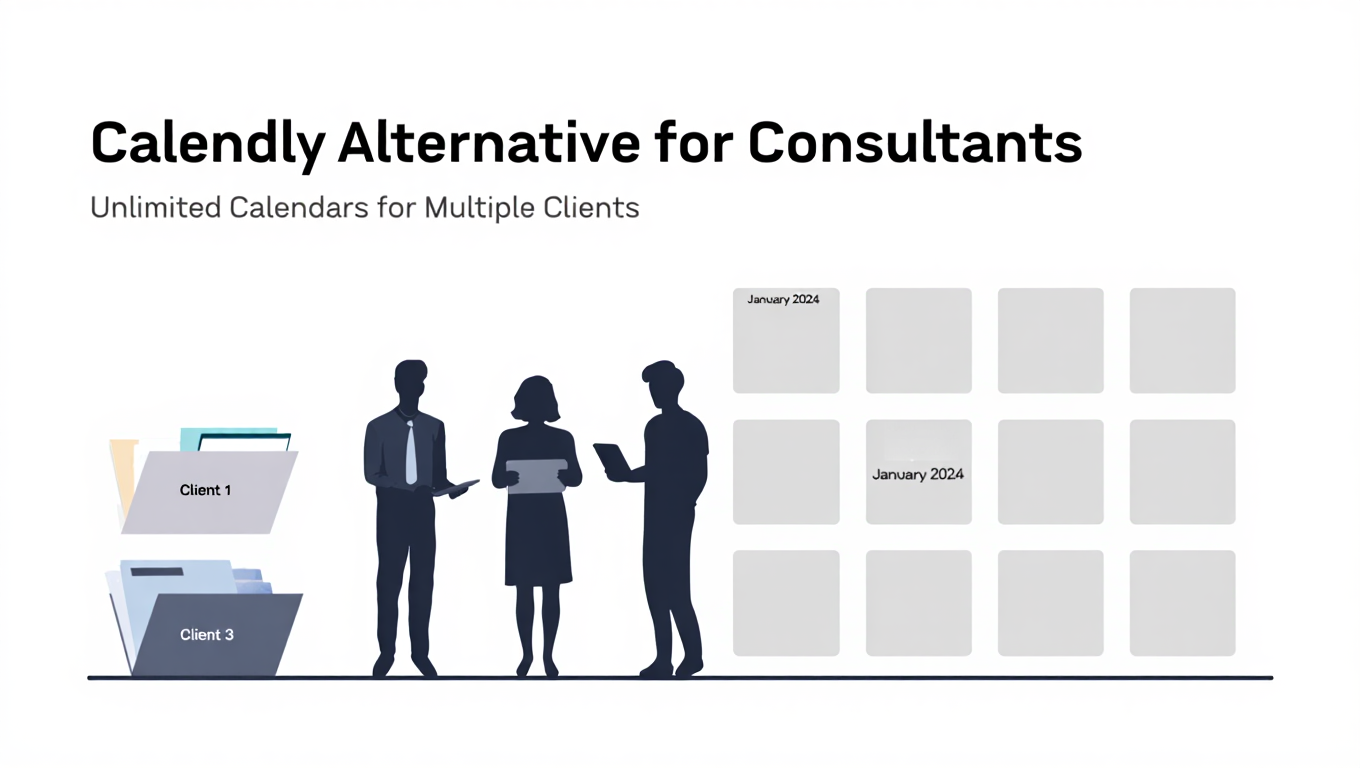
You just signed your eighth consulting client. Excellent news for your business. Impossible news for your Calendly account. Eight client calendars plus your personal calendar and organizational calendars puts you well beyond Calendly's six-calendar maximum limit.
For management consultants, fractional executives, and professional service providers managing multiple client engagements simultaneously, Calendly's calendar restriction is not a minor inconvenience. It is a fundamental incompatibility between the tool's design assumptions and how multi-client consulting actually works.
- Why Calendly's 6-calendar limit prevents consultants from managing all client calendars
- How CalendHub's unlimited calendar connections solve multi-client scheduling challenges
- Real consultant scenarios where calendar restrictions create business problems
- Specific features consultants need beyond basic appointment scheduling
- Best practices for managing 10-15 client calendars effectively
Why Consultants Cannot Use Calendly with Multiple Client Calendars
Consultants managing multiple simultaneous client engagements accumulate calendar connections rapidly. Each client typically provides access to their organizational calendar system for coordination and scheduling visibility. This creates an immediate conflict with Calendly's six-calendar restriction.
A management consultant serving eight clients needs eight client calendars for proper coordination. Add your own organizational calendar, a personal calendar, and perhaps a business development calendar, and you need eleven calendar connections minimum. Calendly caps at six calendars regardless of which plan you purchase, including Enterprise plans starting at $15,000 annually.
Calendar management is cited as the single biggest interoperability and productivity issue for consultants managing multiple client calendars according to 2024 research on consultant productivity. When your scheduling system cannot see all your client commitments, it cannot prevent conflicts across your full engagement portfolio.
This limitation forces consultants into untenable workarounds.
Manually excluding client calendars from Calendly means checking those calendars outside your scheduling system before confirming availability. This manual process introduces errors, wastes billable time on scheduling coordination, and increases double-booking risk across excluded calendars.
Choosing which clients get calendar priority creates professional credibility problems when scheduling conflicts arise from clients whose calendars were not connected due to Calendly's limit.
Maintaining multiple Calendly accounts to work around the six-calendar limit costs more, creates fragmented booking experiences for clients, and introduces coordination complexity between separate accounts.
Reverting to manual calendar management defeats the purpose of using scheduling automation and returns consultants to the inefficient calendar coordination they sought to eliminate.
The scheduling software market grew from $546.1 million in 2025 with projections reaching $1,518.4 million by 2032 at a 15.7% annual growth rate. This expansion reflects consultants and professionals demanding tools that match actual multi-client complexity rather than artificial restrictions.
Cannot connect all client calendars due to six-calendar maximum limit. Must manually check excluded client calendars outside scheduling system. Increased double-booking risk across clients not connected to Calendly. Time wasted coordinating between connected and non-connected calendars. Reduced professional credibility when calendar conflicts occur. Inefficient workarounds that negate scheduling automation benefits.
CalendHub: The Calendly Alternative Built for Multi-Client Consultants
CalendHub.com eliminates calendar connection restrictions specifically to serve consultants, fractional executives, and professionals managing multiple simultaneous client engagements. The platform provides unlimited calendar connections without artificial caps that force consultants to choose which clients to exclude.
Unlike Calendly's scheduling-first design with basic calendar viewing, CalendHub implements calendar-first architecture. This fundamental design difference matters significantly for consultants who spend substantial time working directly with calendars across multiple client engagements rather than just booking occasional appointments.
Unlimited client calendar connections allow connecting every client calendar regardless of how many clients you serve. Eight clients? Connect eight client calendars. Fifteen clients? Connect fifteen client calendars. CalendHub imposes zero restrictions on calendar count.
Real-time cross-calendar conflict detection prevents double-bookings across your entire client portfolio. When someone attempts to book time with you, CalendHub checks every connected calendar including all client calendars, organizational calendars, and personal calendars simultaneously.
Unified calendar view displays all client commitments in a single interface rather than forcing you to toggle between calendar systems or manually check calendars excluded from your scheduling tool. This comprehensive visibility is essential for consultants managing complex multi-client schedules.
Client-specific scheduling configurations enable different availability rules, booking windows, and event types for different clients based on engagement agreements and priority levels.
Calendar-first performance maintains fast synchronization and reliable conflict detection even with 15-20 connected calendars. The platform was architected specifically for power users managing numerous calendars rather than casual users with one or two calendar connections.
While CalendHub offers instant calendar integration without setup complexity, professional support assists consultants with sophisticated multi-client calendar configurations when needed.
- Unlimited Client Calendars: Connect every client calendar without six-calendar restriction
- Calendar-First Design: Built for calendar management, not just appointment booking
- Multi-Client Focus: Designed specifically for consultants with complex engagement portfolios
- Unified Calendar View: See all client commitments in single comprehensive interface
- Sophisticated Configurations: Client-specific availability and scheduling rules
- Power User Performance: Fast reliable sync with 15+ connected calendars
Real Consultant Scenarios Where Calendly's Calendar Limit Fails
Understanding specific consultant situations where Calendly's six-calendar restriction creates problems illustrates why unlimited calendar platforms like CalendHub are essential for multi-client consulting.
Management Consultant with Eight Client Engagements
Sarah is a management consultant specializing in operational improvement. She maintains ongoing engagements with eight mid-market companies, each requiring 15-20 hours monthly of strategic work.
Calendar requirements include eight client calendars for coordination with client leadership teams, her consulting firm's organizational calendar for internal meetings, a personal calendar for non-billable time, and a business development calendar for prospect meetings. Total calendar count is eleven calendars minimum.
Calendly's 6-calendar limitation forced Sarah to connect only six of her eight client calendars. She must manually check the two excluded client calendars before confirming any booking. This manual process has caused three double-bookings in the past quarter, damaging her professional credibility with those clients.
CalendHub solution allows Sarah to connect all eight client calendars plus organizational and personal calendars without restriction. Automated conflict detection across all eleven calendars prevents double-bookings across her complete engagement portfolio. She eliminated manual calendar checking entirely while serving all clients equally through unified scheduling visibility.
Fractional CMO Managing Multiple Companies
David works as a fractional Chief Marketing Officer for five growth-stage companies. Each company requires 25-30 hours monthly including leadership team participation, department meetings, and strategic sessions.
Calendar requirements include five company calendars, one for each organization's calendar system. Each company provides Microsoft 365, Google Workspace, or other calendar access. Additionally, David maintains a personal calendar and a calendar for his fractional executive practice. Total calendar count is seven calendars minimum.
Calendly's limitation meant David could only connect calendars for five companies but needed to support seven total calendars. He chose to exclude his fractional executive practice calendar and personal calendar from Calendly, manually checking both before confirming bookings. This workaround caused several scheduling conflicts between company commitments and personal obligations.
CalendHub solution enables David to connect all five company calendars plus his practice and personal calendars without hitting limitations. The unified calendar view displays commitments across all five companies simultaneously, preventing scheduling conflicts between competing leadership team meetings. Calendar-specific booking rules allow different availability windows for different companies based on his engagement agreements.
Strategy Consultant with Client and Internal Calendars
Maria is a strategy consultant at a mid-sized consulting firm serving twelve active client accounts with varying engagement intensities.
Calendar requirements include twelve client calendars for coordination with client stakeholders, her consulting firm's internal calendar for team meetings and administrative commitments, a personal calendar for work-life balance, and a professional development calendar for training and certifications. Total calendar count is fifteen calendars minimum.
Calendly's limitation created an impossible situation. Maria needed fifteen calendar connections but Calendly restricts to six maximum. She attempted maintaining two separate Calendly accounts to work around the limit but this created fragmented client experiences and coordination complexity between accounts.
CalendHub solution provides unlimited calendar connections that accommodate all twelve client calendars plus internal, personal, and professional development calendars. Maria maintains a single unified scheduling system with complete visibility across her entire professional scope. Client-specific event types route different clients to appropriate calendars while checking all fifteen calendars for conflicts.
Boutique Agency Owner with Multiple Service Lines
James owns a boutique digital marketing agency serving eight retainer clients across three distinct service lines. Each service line operates somewhat independently with specialized teams.
Calendar requirements include eight client calendars for client coordination, three service line calendars for internal team coordination, his agency's main organizational calendar, a new business calendar for prospect meetings, and a personal calendar. Total calendar count is fourteen calendars minimum.
Calendly's limitation meant James could only connect six of his fourteen needed calendars. He prioritized the six highest-revenue clients but this created visible service quality differences between connected and non-connected clients. Clients whose calendars were excluded experienced more scheduling friction and conflicts.
CalendHub solution allows James to connect all eight client calendars plus service line, organizational, new business, and personal calendars without restriction. All clients receive equal scheduling quality with automated conflict detection. Service line specific availability rules prevent client meetings from consuming time needed for internal team coordination.
Essential Features Consultants Need Beyond Unlimited Calendars
While unlimited calendar connections solve the fundamental restriction that prevents consultants from using Calendly, comprehensive multi-client calendar management requires additional sophisticated features.
Client-Specific Scheduling Configurations
Consultants typically maintain different availability rules, booking windows, and event types for different clients based on engagement agreements and priority levels.
Client-specific availability windows allow offering premium clients access to broader scheduling availability while restricting other clients to specific days or time blocks. A retainer client paying for 40 hours monthly might access your full calendar while project clients see limited windows.
Engagement-based event types create different meeting types for different clients. Strategic planning sessions for one client, operational reviews for another, and status updates for a third client all configure independently with appropriate durations and buffer times.
Calendar-specific booking rules determine which client bookings appear on which calendars. High-priority client meetings might go to your primary organizational calendar while routine client check-ins route to a secondary calendar.
Platforms like CalendHub provide granular control over client-specific configurations while maintaining unified conflict detection across all calendars.
Unified Cross-Client Calendar Visibility
Managing multiple client engagements simultaneously requires seeing all commitments in a single comprehensive view rather than toggling between separate calendar systems.
Consolidated calendar display shows commitments across all client calendars, organizational calendars, and personal calendars in one interface. This unified view prevents scheduling conflicts and provides accurate availability assessment across your complete professional scope.
Color-coded calendar organization differentiates between different calendar types and clients. Visual distinction between Client A commitments, Client B commitments, personal time, and internal meetings enables rapid calendar parsing when managing fifteen calendar connections.
Calendar filtering and grouping allows temporarily hiding specific calendar subsets to focus on particular clients or time periods while maintaining conflict detection across all calendars.
Consider that CalendHub's calendar-first design prioritizes comprehensive calendar viewing and management rather than treating calendars as simple availability sources for scheduling.
Advanced Conflict Prevention Across Client Portfolios
Consultants face more complex conflict scenarios than professionals with simple calendars. Multi-client scheduling requires sophisticated conflict detection beyond basic time overlap checking.
Cross-calendar buffer enforcement maintains appropriate time between meetings across different client calendars. A meeting ending on Client A's calendar should respect buffer time before a meeting starting on Client B's calendar even though they are separate calendar systems.
Need better calendar management? CalendHub unifies all your calendars with smart scheduling and video conferencing.
Travel time consideration between meetings at different physical locations prevents back-to-back bookings when clients are in different offices or cities.
Multi-calendar workload limits restrict total daily or weekly meeting hours across all client calendars to prevent overcommitment. You might limit total client meetings to 25 hours weekly regardless of how those hours distribute across eight client calendars.
Priority-based conflict resolution provides rules for how to handle scheduling requests when calendar conflicts occur across different priority clients.
Client Calendar Analytics and Insights
Understanding how your time distributes across different clients and calendar categories helps consultants optimize engagement portfolios and identify scheduling patterns.
Time allocation tracking across client calendars shows actual hours committed to each client versus engagement agreements. A client contracted for 20 monthly hours whose calendar shows 28 hours of commitments indicates scope creep.
Meeting distribution analysis identifies which clients consume disproportionate scheduling coordination time or generate excessive low-value meetings.
Calendar efficiency metrics track buffer time utilization, back-to-back meeting frequency, and calendar fragmentation across your multi-client portfolio.
Platforms built for calendar power users provide these analytical capabilities while Calendly focuses primarily on basic appointment booking.
- Unlimited calendar connections for all current and future clients
- Real-time conflict detection across complete client portfolio
- Client-specific availability rules and booking configurations
- Unified calendar view showing all client commitments simultaneously
- Advanced buffer and travel time enforcement across calendars
- Calendar analytics tracking time allocation across clients
- Performance with 15-20 connected calendars without degradation
How Consultants Should Evaluate Calendly Alternatives
Selecting the right Calendly alternative for multi-client consulting requires evaluating platforms based on consultant-specific needs rather than general scheduling features.
Verify True Unlimited Calendar Support
Confirm that unlimited calendars means genuinely unlimited without hidden caps or performance degradation at higher calendar counts.
Test with your actual calendar count by connecting the real number of client and organizational calendars you currently manage. Some platforms market unlimited calendars but experience sync delays or reliability issues beyond 10-12 connections.
Validate cross-platform calendar support including Google Calendars from multiple accounts, various Microsoft 365 organizational calendars, iCloud calendars, and Exchange systems. Consultants often work across different client calendar platforms requiring robust multi-platform support.
Check calendar connection workflow for ease of adding new client calendars when you acquire new engagements. Consultants need rapid calendar onboarding without technical complexity when starting new client relationships.
Assess Calendar Management vs Scheduling Focus
Determine whether the platform prioritizes comprehensive calendar management or focuses primarily on appointment scheduling with basic calendar viewing.
Calendar-first platforms like CalendHub.com provide sophisticated calendar viewing, organization, and management capabilities with scheduling built on robust calendar infrastructure. These platforms excel for consultants who spend significant time working directly with calendars across multiple clients.
Scheduling-first platforms emphasize appointment booking with calendars serving primarily as availability sources and conflict checking. These work adequately for simple scheduling but lack comprehensive calendar management for multi-client consulting complexity.
Consultants managing eight to fifteen client calendars benefit more from calendar-first architecture than scheduling-first tools with calendar features added as afterthoughts.
Test Multi-Client Conflict Detection
Validate that the platform detects conflicts across different calendar types and client systems reliably without false negatives that cause double-bookings.
Create test conflicts between Google Calendar events and Outlook calendar events from different client systems. Verify the platform prevents booking times that conflict across different calendar platforms.
Test buffer time enforcement across calendar boundaries by scheduling meetings on different client calendars with buffer requirements. Confirm buffers are respected across calendar system boundaries.
Validate real-time synchronization by creating calendar events and immediately checking whether the platform reflects updated availability. Delayed sync can cause conflicts if calendar changes do not propagate quickly.
Evaluate Client-Specific Configuration Capabilities
Assess whether the platform supports differentiated configurations for different clients based on engagement agreements and priority levels.
Client-specific availability should allow offering different booking windows to different clients. Your highest-priority retainer client might access broader availability than project clients with limited ongoing commitments.
Per-client event types enable different meeting durations, buffer times, and scheduling rules for different client engagements based on their specific needs.
Calendar-specific routing determines which client calendars receive which types of bookings automatically based on rules you configure.
Platforms like CalendHub provide granular client-specific configurations while maintaining unified management across unlimited calendars.
Compare Pricing for Multi-Client Use Cases
Analyze how pricing scales with consultant-specific features rather than just seat count or general scheduling capabilities.
Unlimited calendar access should not require enterprise-tier pricing. Platforms like CalendHub provide unlimited calendar connections without forcing consultants into $15,000 annual enterprise plans just to connect all client calendars.
Per-consultant pricing works better than per-seat pricing for independent consultants and small consulting firms. Evaluate whether the pricing model matches your consulting practice structure.
Feature bundling should include consultant-specific capabilities like client-specific configurations, advanced conflict detection, and calendar analytics rather than requiring premium tiers for essential multi-client features.
Best Practices for Managing Multiple Client Calendars
Successfully managing eight to fifteen client calendars requires systematic practices beyond just connecting unlimited calendars to your scheduling platform.
Implement Consistent Calendar Naming Conventions
Establish standardized naming for client calendars to maintain clarity when viewing numerous calendar connections simultaneously.
Prefix-based naming like "Client - [Company Name]" or "Engagement - [Client Name]" provides consistent organization. When viewing fifteen calendars, systematic naming enables rapid identification of which calendar corresponds to which client.
Priority indicators in calendar names signal high-priority clients versus routine engagements. "Priority - Client A" versus "Standard - Client B" provides visual distinction in unified calendar views.
Engagement type descriptors differentiate between retainer clients, project clients, and hourly clients through naming conventions that reflect the relationship structure.
Use Calendar Color Coding Strategically
Color coding across unlimited calendar connections provides visual differentiation essential for parsing complex multi-client schedules.
Client category colors assign consistent colors to different client types. Retainer clients might use blue, project clients green, internal meetings orange, and personal commitments gray.
Priority-based coloring uses color intensity or specific hues to signal client priority levels. High-priority clients get bold colors while routine clients use muted tones.
Calendar system differentiation applies different color schemes to Google calendars versus Outlook calendars versus iCloud calendars for rapid visual identification of calendar platform.
Platforms like CalendHub support sophisticated color coding across unlimited calendars while maintaining performance with numerous color-coded connections.
Establish Client-Specific Availability Boundaries
Different clients require different availability based on engagement scope, payment terms, and relationship priority.
Retainer client availability might offer 8am to 6pm Monday through Friday for clients paying for significant monthly hours and priority access.
Project client restrictions limit availability to specific days or time windows for clients with limited ongoing commitments or lower priority.
Emergency access protocols define which clients can book outside normal availability for urgent issues versus clients limited to standard scheduling windows.
Clear client-specific availability boundaries prevent calendar overload while ensuring high-priority clients receive appropriate access.
Monitor Calendar Distribution and Balance
Track how your time allocates across different client calendars to identify imbalances and prevent overcommitment.
Weekly calendar audits review upcoming commitments across all client calendars to verify total hours align with engagement agreements and capacity limits.
Client time tracking compares actual calendar commitments per client against contracted hours to identify scope creep or underutilization.
Calendar fragmentation assessment examines how meetings distribute throughout days and weeks. Excessive fragmentation with constant context switching between different client calendars reduces productivity.
Calendar analytics features in platforms built for unlimited calendar management provide these insights automatically rather than requiring manual tracking.
Maintain Regular Calendar Hygiene
Managing unlimited client calendars effectively requires ongoing maintenance rather than one-time setup.
Quarterly calendar reviews identify which client calendars remain active and needed versus engagements that concluded and should be disconnected.
Permission audits verify calendar sharing settings remain appropriate and client calendar access stays current as engagements evolve.
Calendar sync validation confirms all client calendars continue synchronizing correctly without errors or delays that could cause scheduling conflicts.
Systematic calendar hygiene prevents unlimited calendars from becoming cluttered and disorganized over time.
When Consultants Should Switch from Calendly to Unlimited Calendar Platforms
Specific trigger points indicate when consultants should migrate from Calendly to platforms offering unlimited calendar support like CalendHub.
Immediate switch required when you currently serve seven or more clients and need more than six calendar connections, experience regular double-bookings from manually checking excluded calendars, or spend excessive time coordinating between connected and non-connected calendar systems.
Plan migration within 30 days when you have five to six current clients with growth expected to exceed six clients within a month, recently signed new clients that push you over the six-calendar limit, or face increasing scheduling friction from working around Calendly's calendar restriction.
Strategic evaluation within 90 days applies when you currently manage four to five clients but expect portfolio growth within a quarter, recognize calendar management as a productivity bottleneck in your consulting practice, or want to establish scalable systems before hitting calendar limits.
Waiting until you are significantly over Calendly's six-calendar limit creates rushed migration under pressure rather than planned transition. Consultants currently at five client calendars should evaluate unlimited calendar platforms now before client number six or seven forces an emergency switch.
The scheduling software market reached $546.1 million in 2025 with projected growth to $1,518.4 million by 2032. This growth reflects consultants and professionals demanding tools built for actual multi-client complexity rather than artificial restrictions that assume simple scheduling needs.
- Current Client Count: Seven or more clients requiring calendar connections
- Growth Trajectory: Expected to exceed six clients within 30-90 days
- Scheduling Problems: Regular double-bookings or manual calendar checking
- Time Waste: Excessive hours coordinating between multiple calendar systems
- Professional Impact: Client relationships damaged by scheduling conflicts
- Scalability Concerns: Current system cannot grow with client portfolio
Why CalendHub Dominates for Multi-Client Consulting
CalendHub.com provides the most comprehensive solution for consultants who outgrew Calendly's six-calendar restriction and need true unlimited calendar support built for multi-client complexity.
The platform eliminates calendar connection restrictions entirely. Connect eight client calendars, twelve client calendars, or twenty client calendars without artificial caps. CalendHub imposes zero limits on calendar connections regardless of pricing tier.
Calendar-first architecture means the platform was designed specifically for comprehensive calendar management rather than adding calendar features as afterthoughts to scheduling functionality. This fundamental design decision creates superior performance, more intuitive calendar interactions, and better multi-client calendar handling for consultants managing numerous simultaneous engagements.
Client-specific configurations enable different availability rules, booking windows, and event types for different clients based on engagement agreements. High-priority retainer clients access different scheduling availability than project clients without maintaining separate scheduling systems.
Unified calendar visibility displays all client commitments simultaneously in a single comprehensive interface. No toggling between calendar systems. No manually checking calendars excluded from your scheduling tool. Complete visibility across your entire consulting portfolio.
Professional support assists with sophisticated multi-client calendar configurations when needed. While CalendHub offers instant calendar integration without technical setup, dedicated support ensures consultants with complex needs get expert guidance.
Real-time conflict detection across unlimited calendars prevents double-bookings regardless of which calendar system received the original commitment or which client the conflict spans.
Making the Decision to Switch from Calendly
Consultants managing multiple simultaneous client engagements face a clear decision when they hit Calendly's six-calendar limit. Continue working around artificial restrictions with incomplete calendar visibility and increased double-booking risk, or migrate to a platform built specifically for multi-client consulting complexity.
CalendHub eliminates the calendar restrictions that prevent consultants from using Calendly effectively. Unlimited calendar connections, calendar-first design, client-specific configurations, and unified calendar visibility address exactly the problems consultants encounter when managing eight to fifteen client calendars simultaneously.
Your scheduling platform should enable professional growth rather than constraining it with arbitrary limitations. When you serve ten clients, you need software that connects ten client calendars seamlessly without forcing you to choose which four clients to exclude from automated scheduling.
Built specifically for consultants who manage multiple simultaneous client engagements requiring more than six calendar connections. Connect unlimited client calendars without restrictions. Get client-specific scheduling configurations. Experience unified calendar visibility across your complete consulting portfolio. Eliminate double-bookings with real-time conflict detection across all calendars. Start with instant integration requiring zero technical configuration.
Next Steps for Consultants Evaluating Unlimited Calendar Platforms
Document your current and projected client calendar requirements. Count each client calendar you currently manage plus calendars you will need for clients in your pipeline. If your total exceeds six calendars or will exceed six within 90 days, Calendly cannot serve your multi-client consulting needs.
Test CalendHub with your actual client calendar count. Connect the real number of calendars you manage across your consulting practice and verify the platform handles your complexity without performance degradation or reliability issues.
Evaluate whether calendar-first design matches your consulting workflow better than scheduling-first platforms. Consultants spending significant time working with calendars across multiple clients benefit more from comprehensive calendar management than basic appointment booking.
Your consulting practice deserves scheduling infrastructure that scales with client portfolio growth without artificial restrictions. Choose platforms like CalendHub that eliminate calendar limits and provide sophisticated multi-client calendar management designed specifically for how consultants actually work.
Ready to Simplify Your Schedule?
Join thousands of professionals who have unified their calendars and reclaimed their time with CalendHub's intelligent scheduling platform.
Related Articles
How 5 Professionals Solved the Calendly 6 Calendar Limit and Reclaimed Their Time
Real stories from consultants, entrepreneurs, and executives who hit Calendly's 6-calendar limit and found permanent solutions that eliminated scheduling chaos.
Calendly 6 Calendar Limit: The Permanent Solution for 2025
Calendly's 6-calendar limit forces professionals to choose which calendars to exclude. Discover the permanent solution that eliminates scheduling limits.

Calendly Alternative Unlimited Calendars: Break Free from the 6-Calendar Limit
Hit Calendly's 6-calendar limit? CalendHub offers unlimited calendar connections with zero restrictions for professionals managing multiple client calendars.