
 Google Calendar
  Outlook Calendar
  Google Meet
  Microsoft Teams
  Zoom Meetings
 The Hidden Cost of Missing Meetings Due to Different Calendars in 2025
Discover the career and financial damage caused by missed meetings from calendar fragmentation. Real stories and statistics reveal the true professional cost.
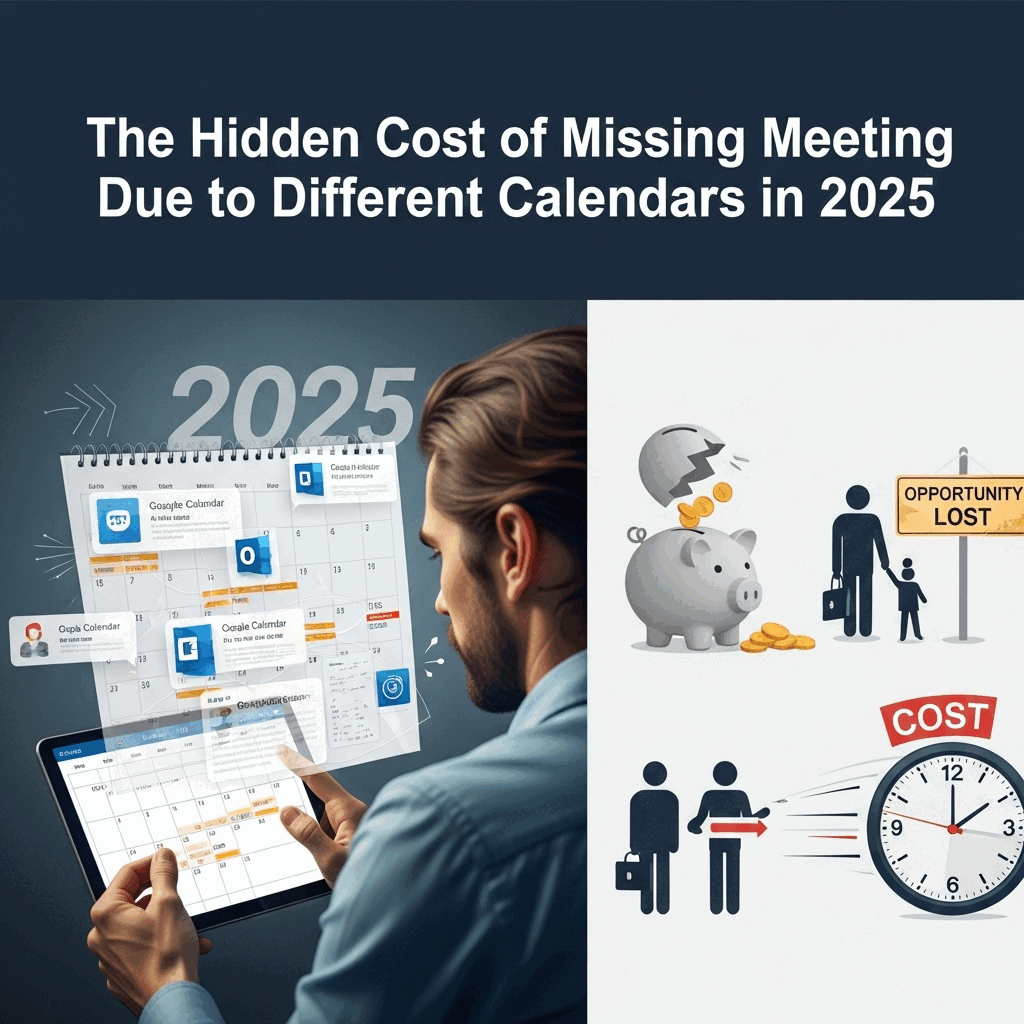
Sarah had been working toward a promotion for eighteen months. Her manager scheduled a critical one-on-one to discuss her advancement. The invitation went to her Outlook calendar, but Sarah was checking her Google Calendar when a friend asked about lunch availability. She scheduled lunch at the exact time her manager wanted to meet.
When Sarah missed the meeting her manager had scheduled, the promotion conversation never happened. Six weeks later, the position went to a colleague. Sarah eventually learned what happened, but by then, the damage was done. One missed meeting, caused by checking the wrong calendar, cost her a $15,000 salary increase and set her career back by at least a year.
Stories like Sarah's play out daily across professional environments. When people miss meetings different calendars fail to synchronize, the consequences extend far beyond the immediate embarrassment. The costs are measurable, significant, and often permanent.
- 1 in 3 professionals report that missed meetings directly impact performance reviews and career growth
- More than 10% of workers contemplated leaving their jobs after missing important meetings with managers
- Organizations lose $532 billion annually to meeting-related inefficiencies, with missed meetings contributing significantly
- Remote workers are 30% more likely to miss meetings than in-office employees due to calendar fragmentation
- About 1 in 8 employed Americans have missed meetings because of calendar mismanagement
What Happens When You Miss Meetings Different Calendars Create
The immediate consequence of missing a meeting is obvious. You were not there when people expected you. But the ripple effects extend much further and last much longer than most professionals realize.
Missing a meeting sends a clear message about priorities. Colleagues interpret your absence as disrespect for their time. Clients see unreliability. Managers question your organizational skills and commitment. Even when the cause is technical, a calendar synchronization failure between different platforms, people rarely attribute missed meetings to technology problems. They attribute them to you.
Research from 2024 reveals that 1 in 3 employed Americans said missed one-on-one meetings with managers directly affected their growth and performance evaluations. This is not about hurt feelings. This is about measurable career damage that shows up in reviews, compensation decisions, and promotion opportunities.
The statistics get more alarming. More than 1 in 10 professionals contemplated getting a new job or feared they were about to be laid off after missing meetings with their managers. Another 5% were ready to quit entirely. When you miss meetings different calendars should have helped you track, you trigger genuine career crises that can take months or years to overcome.
The Financial Cost of Calendar Fragmentation
The economic impact of missed meetings operates at both individual and organizational levels. For individuals, missed meetings directly correlate with reduced earnings and slower career progression.
Research from Harvard Business Review shows that calendar-dependent workers who effectively manage their schedules earn more and receive better performance ratings than those who struggle with calendar management. Over 3 in 4 calendar-dependent individuals reported feeling very to extremely productive at work. This productivity translates directly into better compensation and more opportunities.
When you miss meetings different calendars prevent you from tracking properly, you disconnect from this high-performing group. Instead of being known for reliability and organization, you become known for the opposite. This reputation damage has a measurable financial cost through missed promotions, smaller raises, and fewer opportunities for high-visibility projects.
Organizations bear even larger costs. Companies in the United States lose $37 billion annually to unproductive meetings according to Atlassian research, with meeting-related inefficiencies costing the broader economy an estimated $532 billion per year. While not all of this waste comes from missed meetings, the contribution is significant.
The average organization wastes 24 billion hours annually on inefficient meetings. When you calculate the value of professional time, meetings cost companies between $43,008 and $56,448 per manager every year. Each missed meeting multiplies this waste by requiring rescheduling, repeating information, and dealing with the consequences of delayed decisions.
When you miss meetings different calendars create conflicts around, you force rescheduling that affects everyone invited. If a meeting had six attendees, your absence might waste five other people's time as they wait, realize you are not coming, and disperse. Then someone must coordinate schedules again to reschedule, consuming even more time from everyone involved.
The cost multiplies further when the missed meeting involves clients or external partners. A missed client meeting might cost your company the deal entirely. Research indicates that sales professionals who miss meetings with prospects reduce their close rates by 35% or more. The prospect interprets the missed meeting as a preview of poor service and chooses a competitor instead.
How Missing Meetings Damages Professional Relationships
Beyond the direct financial costs, missed meetings erode the professional relationships that drive career success. Trust, once damaged, takes substantial time and effort to rebuild.
Your colleagues operate on assumptions about your reliability. When you consistently appear for meetings, people trust that you will follow through on commitments. This trust makes collaboration easier. People include you in important discussions because they know you will show up. They share critical information because they trust you will be present to receive it.
When you miss meetings different calendars fail to coordinate, you break that trust. Colleagues begin to doubt your commitment. They start scheduling important discussions without you, assuming you might not attend anyway. They stop sharing information proactively because past experience suggests you might not be engaged.
This social cost is difficult to measure but profound in impact. Professional success depends heavily on relationships, reputation, and social capital. When you miss meetings, you spend that social capital without receiving any benefit in return. Eventually, the account runs empty.
Managers, in particular, interpret missed meetings as a signal about your priorities and competence. If you miss a one-on-one with your manager, you communicate that you do not value their time or the relationship. Even when the cause is a technical problem where different calendars failed to sync properly, managers rarely see it that way. They see someone who did not show up when expected.
The research confirms this perception problem. One-third of professionals report that missed meetings with managers directly impacted their performance evaluations. Your technical explanation about calendar fragmentation does not change how your manager scores your organizational skills or reliability.
Real Stories of Career Damage From Missed Meetings
Sarah's story opened this article, but she is far from alone. Professional environments are filled with people whose careers took unexpected turns because they missed meetings different calendars should have prevented.
Michael was a sales executive at a technology company. He juggled three calendars: Outlook for work, Google Calendar for personal appointments, and his iPhone's native calendar for quick additions on the go. The systems did not sync reliably, but Michael thought he had it under control.
A major prospect requested a meeting to discuss a $2 million contract. The invitation came via email, and Michael accepted it on his phone while traveling. The meeting registered in his iPhone calendar but never synced to his work Outlook calendar. When the prospect's team arrived at the conference room Michael had booked, he was not there. He was in a personal appointment that his Outlook calendar showed as free time.
By the time Michael realized his mistake and raced back to the office, the prospect had left. They never rescheduled. The deal went to a competitor. Michael's company lost $2 million in revenue, and Michael lost his job six weeks later during a restructuring that targeted underperforming salespeople.
Jennifer had a different experience but equally painful outcome. As a project manager, she coordinated multiple teams across different departments. Each department used different calendar systems. Engineering used Google Calendar. Marketing used Outlook. Operations used Apple Calendar. Jennifer tried to manage it all by manually checking each system before scheduling coordination meetings.
She missed a critical stakeholder meeting because it was in her marketing Outlook calendar, but she had been checking her engineering Google Calendar when she scheduled a conflicting workshop. The stakeholder meeting was meant to address concerns that had been brewing for weeks. When Jennifer did not appear, stakeholders interpreted it as disrespect for their concerns.
The project lost executive support. Funding was reduced. The scope was cut. Jennifer was reassigned to a less strategic initiative. Her career momentum stalled. All because she missed a meeting different calendars prevented her from seeing when she checked the wrong system.
Why Calendar Problems Affect Remote Workers More Severely
Remote work has transformed professional life over the past few years, but it has also intensified the consequences when people miss meetings different calendars create confusion around.
Statistics show that 13% of remote employees miss meetings compared to 10% of in-office workers. This 30% increase in missed meetings stems from several factors unique to remote work environments.
In-office workers benefit from environmental cues. They see colleagues gathering for a meeting and remember they should attend. They walk past conference rooms with familiar faces and realize a meeting is starting. They have casual conversations in hallways where someone mentions an upcoming meeting, triggering their memory.
Remote workers have none of these environmental reminders. When you miss meetings different calendars fail to display properly, nobody is walking past your desk asking why you are not in the conference room. The meeting happens without you, and you might not realize your absence until hours later when someone sends a confused message asking where you were.
The calendar fragmentation problem intensifies for remote workers because they manage more complex schedules. In-office workers have clear separation between work time and personal time. When you are in the office, work happens. When you are home, personal life happens. The physical separation makes calendar management simpler.
Remote workers blur these boundaries constantly. You might have a work meeting, followed by a home maintenance appointment, followed by another work meeting, followed by picking up your kids. All of these commitments compete for space in your schedule, and many remote workers use different calendar systems for work versus personal life.
This creates the exact conditions where professionals miss meetings different calendars should consolidate. Your work calendar shows you are free at 2pm because the dentist appointment is in your personal Google Calendar. You accept a work meeting for 2pm in your Outlook calendar. Now you have a conflict that neither calendar warned you about because you checked them separately.
Remote workers cannot rely on environmental cues to remember meetings. Your calendar must be perfectly accurate because it is your only source of truth about commitments. When different calendars fragment your schedule, the lack of physical office reminders means missed meetings carry even more severe consequences for remote professionals.
CalendHub.com specifically addresses this remote work challenge by providing unified calendar management that consolidates work and personal schedules into a single, reliable view. Remote workers can see every commitment regardless of which system created it, eliminating the fragmentation that causes missed meetings. Learn more about the best calendar aggregator tools available in 2025.
The Productivity Cost Beyond the Missed Meeting
When you miss meetings different calendars prevented you from tracking, the wasted time extends far beyond the duration of the meeting itself.
First, there is the meeting duration. If you missed a one-hour meeting, that is one hour of time from every attendee that produced zero value. A six-person meeting represents six person-hours of wasted time. At an average professional salary, that single missed meeting might cost the organization $500 to $1,000 in pure salary expense for time that accomplished nothing.
Need better calendar management? CalendHub unifies all your calendars with smart scheduling and video conferencing.
Then comes rescheduling. Someone must reach out to all attendees, find a new time that works for everyone, send updated invitations, and get confirmations. This coordination often takes 30 minutes to an hour of someone's time. In organizations where meetings involve senior executives or multiple departments, the rescheduling complexity can consume several hours.
The delay cost is often the largest component. Whatever decision or progress the meeting was meant to achieve gets postponed. If the meeting was meant to resolve a blocker preventing your team from moving forward, your team sits idle waiting for the rescheduled meeting. If the meeting was meant to approve a budget, spending decisions get delayed. If the meeting was with a client, the deal progresses slower than expected.
Research shows that employees spend an average of 392 hours per year in meetings. Managers and directors spend even more, averaging 13 hours per week in meetings. This represents over 20% of professional work time. When you miss meetings different calendars create scheduling conflicts for, you disrupt this already heavily scheduled time and force even more time into meeting-related activities.
The cognitive cost adds another layer. When you realize you missed an important meeting, you experience stress and anxiety. You spend mental energy worrying about the consequences, crafting apologies, and trying to recover. This distraction reduces your productivity for hours or sometimes days after the missed meeting.
How Your Calendar Tells Your Professional Story
Your calendar behavior communicates volumes about your professionalism, priorities, and competence. Colleagues and managers form opinions about you based partly on how reliably you manage your schedule and show up when expected.
When you never miss meetings, people perceive you as organized, reliable, and respectful. These perceptions open opportunities. Managers assign you to high-stakes projects because they trust you will execute dependably. Colleagues seek your collaboration because they know you will follow through. Clients want to work with you because you demonstrate respect for their time.
Your calendar tells a story about how you work, how you prioritize, communicate, and make decisions. In hybrid work environments and global teams, the small choices you make in scheduling and time management add up to a personal brand. That brand either works for you or against you.
When you frequently miss meetings different calendars prevent you from managing properly, you tell a different story. The narrative becomes one of disorganization, unreliability, and poor time management. Fair or not, people attribute your technical calendar problems to personal shortcomings.
This perception problem is especially acute because calendar management seems simple. Everyone uses calendars. Most professionals have managed calendars for years. When someone struggles with calendar management, colleagues do not typically think about complex technical challenges like synchronization failures between different platforms. They think the person is disorganized or does not care enough to show up.
The reality that you miss meetings different calendars create through technical fragmentation rather than personal failure does not change the perception. The outcome is what matters to colleagues waiting for you in a meeting you never joined.
The Opportunity Cost of Calendar Chaos
Beyond the direct costs and damaged relationships, calendar chaos carries significant opportunity costs. When you are fighting calendar fragmentation, you cannot focus on work that actually advances your career.
Professionals who master calendar management spend virtually zero time on scheduling administration. Their calendars work automatically. They know where they need to be and when. This frees up mental energy and actual time for strategic thinking, creative work, and relationship building.
When you constantly struggle to prevent missing meetings different calendars create, you consume that time and energy on administrative overhead. You spend time cross-checking calendars, manually updating platforms, apologizing for conflicts, and rescheduling disrupted meetings. This is time you could spend on work that actually matters for your career progression.
The opportunity cost also includes meetings you avoid scheduling because calendar management is too complex. If coordinating your schedule is difficult, you might skip proposing a brainstorming session that could have led to an innovative solution. You might not reach out to schedule coffee with a senior leader because figuring out when you are actually available feels overwhelming.
These missed opportunities accumulate over time. The conversation that never happened could have been the one that led to your next opportunity. The meeting you did not schedule might have been where you demonstrated capabilities that would have gotten you promoted.
The Reputation Recovery Timeline
Once you have missed important meetings and damaged your professional reputation, recovery takes substantial time. Understanding this timeline helps illustrate the true cost when you miss meetings different calendars create.
In the immediate aftermath, you can apologize and reschedule. This addresses the surface problem but does nothing to rebuild trust. Your colleagues accepted your apology, but they also updated their mental model of your reliability.
For the next month, every meeting you do attend works to counteract the missed meeting. Each time you show up on time and prepared, you make a small deposit in the trust account. But you need many successful meetings to offset the withdrawal that one missed meeting created.
Research on trust recovery suggests that rebuilding damaged professional relationships typically requires six months of consistent, reliable behavior. For six months, you cannot miss another meeting. You cannot be late. You cannot create any scheduling confusion. Every interaction must demonstrate flawless calendar management.
This is the hidden cost that most professionals underestimate. That one meeting you missed due to calendar fragmentation might require six months of perfect execution to fully overcome. During those six months, you are operating under a cloud of diminished trust that affects what opportunities come your way.
Implementing proper calendar consolidation might take two hours to set up properly. Recovering from a damaged reputation after missing important meetings takes six months of perfect behavior. The return on investment for calendar management is among the highest of any professional skill you can develop.
CalendHub.com provides the unified calendar infrastructure that makes perfect meeting attendance effortless. By consolidating all calendars into a single view, you eliminate the fragmentation that causes missed meetings, protecting your professional reputation without requiring constant vigilance.
Industry-Specific Impacts of Missing Meetings
Different industries experience the cost of missed meetings in unique ways, but every professional environment shows measurable damage when people miss meetings different calendars create conflicts for.
In sales environments, missed meetings with prospects have the most direct financial impact. Sales cycles depend on momentum. When a salesperson misses a meeting with a qualified prospect, that momentum breaks. Statistics show that sales professionals who miss prospect meetings reduce their close rates by over one-third. The opportunity cost of a single missed sales meeting might be tens or hundreds of thousands of dollars in lost revenue.
In consulting and professional services, billable hours drive revenue. When consultants miss meetings with clients, they damage relationships that determine whether clients renew contracts. The consulting industry depends heavily on trust and perceived competence. Missing a client meeting because you checked the wrong calendar system signals the opposite of competence.
In healthcare, missed meetings can affect patient care coordination. When care team members miss coordination meetings, care plans do not get updated, communications break down, and patient outcomes suffer. While healthcare providers use extensive systems to track patient appointments, internal coordination often relies on fragmented calendar systems that create the conditions for missed meetings.
In creative industries like advertising and media, missed meetings disrupt collaborative workflows. Creative work depends on spontaneous ideation and iterative feedback. When team members miss creative reviews or brainstorming sessions because of calendar problems, projects lose momentum, deadlines slip, and client satisfaction declines.
Technology companies, despite being at the forefront of calendar innovation, still struggle with the same problems. Engineers might use different calendar systems than product managers, who use different systems than executives. When people miss meetings different calendars prevent them from coordinating, product development slows, technical decisions get delayed, and competitive advantages diminish.
How Organizations Absorb the Cost
While individuals bear career consequences when they miss meetings different calendars create, organizations absorb enormous aggregate costs from calendar fragmentation across their workforce.
Large organizations might have thousands of employees each managing multiple calendars. If just 1% of employees miss one important meeting per month due to calendar problems, that represents hundreds of missed meetings annually. Each missed meeting triggers rescheduling overhead, delays decisions, and reduces productivity.
The aggregate financial impact becomes staggering. Organizations lose $532 billion annually to meeting-related inefficiencies. Reducing this waste by even 10% through better calendar management would save over $50 billion. For individual organizations, the savings potential scales with workforce size but remains significant even for small companies.
Beyond direct costs, organizations suffer reputation damage with clients and partners. When multiple employees from the same company miss external meetings due to poor calendar management, clients notice the pattern. This erodes confidence in the organization's operational competence and makes clients more likely to consider alternatives.
The opportunity cost for organizations mirrors the individual impact but at larger scale. Time that employees spend fighting calendar fragmentation is time not spent on revenue-generating work, strategic initiatives, or innovation. When you aggregate this lost productivity across thousands of employees, the impact on organizational performance and competitiveness becomes measurable in quarterly financial results.
The Path Forward Requires Systematic Solutions
Understanding the cost when people miss meetings different calendars create is the first step. The second step is implementing systematic solutions that prevent calendar fragmentation from damaging careers and organizations.
Individual discipline helps but cannot solve the structural problem. When your professional life requires using multiple calendar platforms, perfect manual coordination is impossible. You will eventually check the wrong calendar at the wrong time and create a conflict. The question is not whether it will happen, but when, and what it will cost when it does.
Technology provides the only reliable solution. Calendar consolidation tools that aggregate all your calendars into a unified view eliminate the root cause. Instead of switching between platforms and hoping you catch every conflict, you see your complete schedule in one place. Conflicts become immediately visible, and double bookings become impossible.
CalendHub.com delivers exactly this capability with professional-grade calendar consolidation across all major platforms. You can connect Google Calendar, Outlook, iCloud, and other calendar systems to create a single unified view that shows every commitment regardless of where it originated. This architectural approach solves calendar fragmentation permanently.
The implementation process is straightforward but requires commitment. You must identify all the calendar platforms you currently use, connect them through a consolidation tool, establish protocols for which calendar serves as your primary interface, and verify that synchronization works correctly. This initial setup might take a few hours, but it eliminates calendar-related career damage permanently.
Calculating Your Personal Cost of Calendar Chaos
To understand what calendar fragmentation is actually costing you, work through this personal cost calculation.
First, estimate how many meetings you have missed in the past year due to calendar problems. Be honest. Include the meeting you forgot about because it was in a calendar you did not check. Include the double booking where you had to cancel one commitment. Include the appointment that never synced from your mobile device.
For each missed meeting, estimate the direct cost. If it was a client meeting, what was the deal size at risk? If it was a meeting with your manager, how might it have affected your performance review? If it was a team coordination meeting, how much productivity was lost due to delays?
Next, calculate the time cost. Each missed meeting probably required 30 minutes to 2 hours of recovery effort between apologies, rescheduling, and catch-up. Multiply the number of missed meetings by your average recovery time to get total hours spent recovering from calendar failures.
Convert that time to dollars using your effective hourly rate. If you earn $100,000 per year and work 2,000 hours annually, your time is worth $50 per hour. If you spent 10 hours recovering from missed meetings, that is $500 in wasted time.
Finally, estimate the opportunity cost. What project did you not start because you were dealing with calendar chaos? What relationship did you not develop because you were too overwhelmed with scheduling to reach out? What promotion did you not pursue because calendar problems made you feel disorganized and unprepared?
These opportunity costs are harder to quantify but often larger than the direct costs. A single missed career opportunity could be worth tens or hundreds of thousands of dollars over your career lifetime.
Professional with $100,000 salary ($50/hour effective rate) who misses 4 meetings per year due to calendar fragmentation. Direct time cost includes 8 hours of recovery effort ($400). Reputation damage leads to smaller raise than expected, costing $2,000 in annual salary difference. Over a 5-year period, the cumulative cost exceeds $10,000. This assumes no major missed opportunities like lost promotions or client deals, which could multiply the cost by 10x or more.
When you calculate your personal cost of calendar chaos, the value of implementing proper calendar consolidation becomes clear. Spending a few hours setting up unified calendar management through CalendHub.com or similar solutions delivers enormous return on investment compared to the ongoing costs of fragmentation.
Why This Problem Will Only Get Worse Without Action
Calendar fragmentation is intensifying, not improving. As professional lives become more complex, the number of calendar systems most people use continues to increase.
You might have started with just a work calendar a few years ago. Then you added a personal calendar. Then your company implemented a new project management system with its own calendar. Then you started using a scheduling tool for external meetings that maintains another calendar. Now you are juggling four or five different calendar platforms, each showing a partial view of your schedule.
Remote and hybrid work accelerates this fragmentation. When you managed your schedule from a desk in an office, complexity was limited. Now you manage calendars across multiple devices, locations, and contexts. The opportunities to miss meetings different calendars create multiply with each additional platform and access point.
The solution is not to use fewer tools. Modern professional work requires multiple specialized platforms. The solution is to implement consolidation infrastructure that works regardless of how many underlying calendar systems you use.
This is why calendar consolidation tools represent such important infrastructure for professional success. They scale with complexity. As your calendar ecosystem grows more complicated, the consolidation layer continues to provide a unified view that prevents missed meetings and protects your professional reputation.
Taking Control of Your Calendar and Career
The cost when you miss meetings different calendars create is measurable, significant, and entirely preventable. Professional reputation, career advancement opportunities, productivity, and measurable financial outcomes all depend on showing up when expected.
Calendar chaos is not a personal failing. It is a technical problem created by fragmented platforms that were never designed to work together. Solving technical problems requires technical solutions, not just better personal discipline.
The professionals who thrive in 2025 are those who master the fundamentals while using technology to eliminate preventable failures. Calendar management is fundamental. The technology to eliminate calendar fragmentation exists today and is widely accessible.
Your next step is straightforward. Audit your current calendar ecosystem, identify the fragmentation points where you are vulnerable to missing meetings different calendars prevent you from seeing, and implement consolidation infrastructure that eliminates those gaps.
CalendHub.com provides professional-grade unified calendar management that brings all your calendars together in one reliable interface. The setup takes hours. The protection lasts your entire career. The return on investment is among the highest of any professional tool you will ever implement.
Your calendar is the foundation of professional success. When it works perfectly, you show up prepared for every commitment. When it breaks, you miss meetings that cost you opportunities, reputation, and measurable career advancement. The choice between calendar chaos and calendar mastery is entirely yours, but the stakes could not be higher.
Ready to Simplify Your Schedule?
Join thousands of professionals who have unified their calendars and reclaimed their time with CalendHub's intelligent scheduling platform.
Related Articles
Fix Calendar Chaos Multiple Accounts: Complete 2025 Recovery Guide
End calendar chaos from multiple accounts with this proven system. Transform your overwhelming schedule into an organized, stress-free calendar in under an hour.
Best Solutions to Stop Missing Meetings From Different Calendars in 2025
Compare proven solutions for calendar fragmentation. Discover which approach prevents missed meetings most effectively for your professional needs.

Too Many Calendars to Check: How 5 People Solved This Daily Struggle
Real stories from professionals who stopped checking multiple calendars. Discover their before/after routines and how they reclaimed hours every week.