
 Google Calendar
  Outlook Calendar
  Google Meet
  Microsoft Teams
  Zoom Meetings
 Fix Calendar Chaos Multiple Accounts: Complete 2025 Recovery Guide
End calendar chaos from multiple accounts with this proven system. Transform your overwhelming schedule into an organized, stress-free calendar in under an hour.
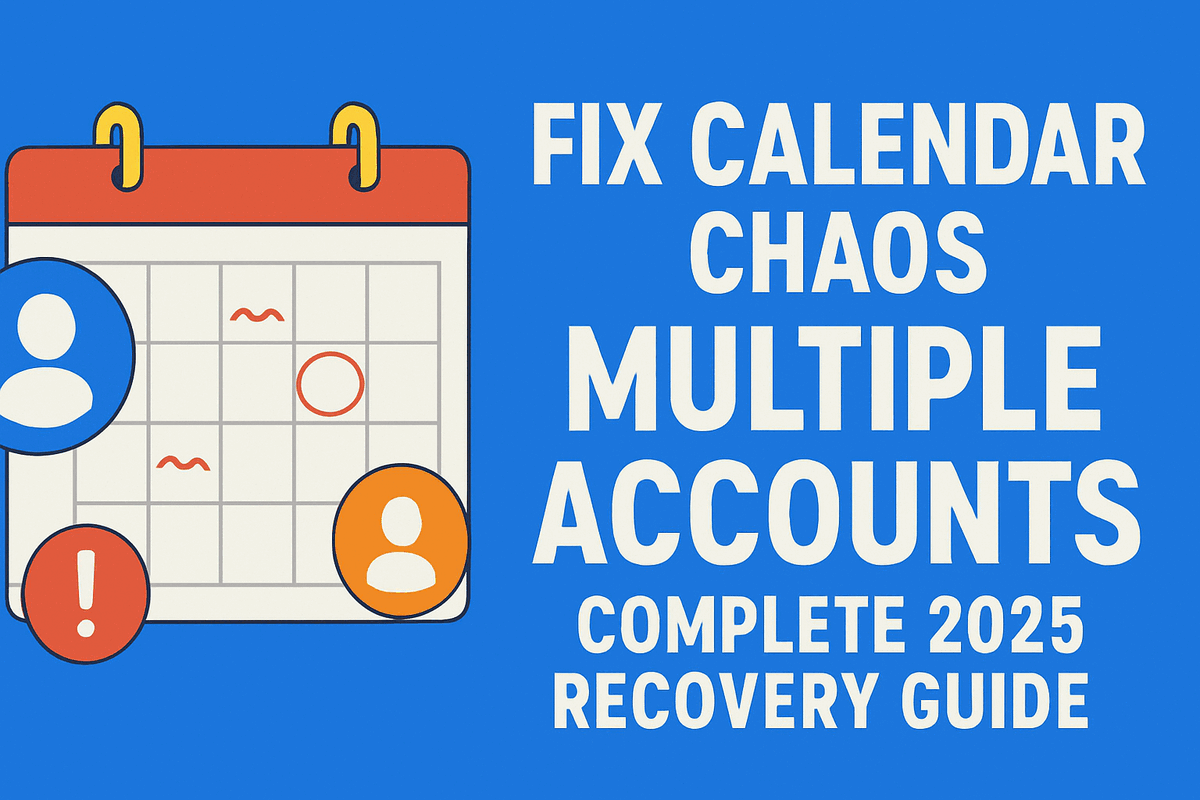
You just missed an important client meeting because it was on your work calendar, but you were looking at your personal one. Again. Meanwhile, your spouse is frustrated because you double booked family dinner with a networking event. Your phone is buzzing with three different calendar apps sending conflicting notifications, and you genuinely have no idea what your afternoon actually looks like.
If this sounds familiar, you are not alone. Calendar chaos with multiple accounts affects millions of professionals every single day, creating stress, damaging relationships, and tanking productivity.
- 82% of employees are at risk of burnout in 2025, with heavy workloads and scheduling overload as primary contributors
- 78% of professionals cite scheduling overload as a major source of meeting problems
- The average meeting starts six minutes late due to scheduling mix-ups and double booking issues
- Nearly 71% of employees consider meetings unproductive, often because of poor calendar management
The good news is that calendar chaos from multiple accounts is completely fixable. This guide will show you exactly how to transform your overwhelming, scattered schedule into a unified, organized system that gives you clarity and control.
What Is Calendar Chaos Multiple Accounts?
Calendar chaos multiple accounts is the overwhelming state of confusion and disorganization that occurs when you manage separate calendars across different platforms, apps, or purposes without a unified system to connect them.
This typically happens when you have work email calendars (Google Workspace, Microsoft 365), personal calendars (Apple Calendar, Gmail), family shared calendars, side business schedules, and volunteer commitments all living in separate digital spaces. Without synchronization, you lose visibility into your complete schedule, leading to missed appointments, double bookings, and constant anxiety about what you might be forgetting.
According to productivity research from Statista, 70% of individuals depend on digital calendars to navigate their daily lives, yet the majority struggle with multiple calendar management. The problem is not the calendars themselves, it is the lack of integration between them. Understanding why calendar chaos happens is the first step to fixing it.
Why Calendar Chaos With Multiple Accounts Happens
Before we fix the problem, you need to understand why calendar chaos develops in the first place.
Life Requires Multiple Calendars
Most professionals legitimately need separate calendars. Your employer provides a work calendar tied to your corporate email. Your personal life runs on a different platform. You may have client scheduling links, family shared calendars, or side project timelines. Each calendar serves a real purpose, but managing them separately creates fragmentation.
Calendars Do Not Talk to Each Other
The fundamental problem is that calendars from different accounts do not automatically synchronize. Your Google Calendar does not know about the dentist appointment in your Apple Calendar. Your Outlook work calendar cannot see your kid's soccer game on the family calendar. This creates blind spots where conflicts hide until it is too late.
You Constantly Context Switch
Research from RescueTime shows that context switching reduces productivity, energy, and creativity. When you need to check three different calendar apps to understand your day, you are context switching constantly. This mental drain makes it harder to plan effectively and easier to make mistakes. Learn more about how much time is wasted checking calendars.
Manual Syncing Fails
Many people try to manually copy events between calendars. This approach always fails eventually because it requires perfect discipline every single time. One forgotten transfer creates a conflict. One outdated event causes confusion.
The Complete System to Fix Calendar Chaos Multiple Accounts
Here is the proven step-by-step process to eliminate calendar chaos and create a unified scheduling system that actually works.
Step 1: Audit Your Current Calendar Situation
Start by documenting exactly what you are dealing with.
List every calendar you use:
- Work email calendar (Google Workspace, Microsoft 365, etc.)
- Personal email calendar
- Phone default calendar (iPhone Calendar, Samsung Calendar)
- Shared family calendars
- Client scheduling tools (Calendly, etc.)
- Project management calendar views
- Any other scheduling platforms
For each calendar, note:
- What platform or app it uses
- Who has access to it
- What types of events it contains
- How often you check it
This audit reveals the full scope of your calendar chaos with multiple accounts. Most people discover they are juggling 4-7 separate calendars without realizing it.
Step 2: Choose Your Primary Calendar Hub
You need to designate one calendar as your central source of truth. This is where you will see everything at a glance.
Your primary calendar should be:
- The one you check most frequently
- The platform that works best on all your devices
- The calendar connected to your main email account
- The system that offers the best integration options
For most professionals, this is either Google Calendar or Outlook Calendar because they offer robust syncing capabilities, work across platforms, and integrate with numerous tools.
Step 3: Implement Calendar Synchronization
Once you have chosen your primary calendar hub, set up two-way synchronization from your other calendars.
Synchronization options:
Native platform sync - Google Calendar and Outlook both offer built-in syncing with each other and with Apple Calendar. Enable these connections in your calendar settings.
Calendar subscription (one-way) - Most calendar platforms let you subscribe to other calendars via ICS feeds. This shows events from other calendars in your primary view, but changes only flow one direction.
Third-party sync tools - Services like OneCal, CalendarBridge, and Motion provide two-way synchronization between different calendar platforms, automatically creating blocking events so conflicts are visible everywhere.
Unified calendar platforms - Tools like CalendHub.com aggregate multiple calendars into a single interface without requiring manual syncing, showing your complete schedule from all accounts simultaneously.
Set up your sync to:
- Block out busy times across all calendars to prevent double bookings
- Update in real time so changes appear everywhere quickly
- Maintain privacy by controlling what details sync to which calendars
- Work automatically without manual intervention
Step 4: Establish a Color-Coding System
Visual organization is critical when viewing multiple calendars together.
Create a consistent color scheme:
- Work commitments - One consistent color (blue or green commonly)
- Personal appointments - Different color (orange or purple)
- Family events - Distinct color everyone recognizes (yellow or pink)
- Deep work blocks - Protected time in a standout color (red)
- Flexible tasks - Low priority color (gray or light tones)
Research shows that categories bring clarity to your calendar chaos. Your brain processes visual patterns faster than reading text, so color coding allows you to assess your day at a glance.
Most calendar apps let you assign colors to specific calendars or to individual event types. Set this up once, and every new event automatically appears in the correct color.
Step 5: Consolidate Duplicate and Redundant Events
As you bring calendars together, you will likely discover duplicate events that exist on multiple calendars.
Clean up your unified view:
- Delete duplicate entries that serve no purpose
- Keep duplicates that serve different functions (example: personal reminder of work event)
- Merge information from multiple entries into one comprehensive event
- Archive old calendars that no longer serve a purpose
This decluttering process immediately reduces visual noise and makes your organized calendar from multiple accounts easier to understand.
Step 6: Set Up Buffer Time and Boundaries
One reason calendar chaos creates stress is that schedules become packed with back-to-back commitments with no breathing room.
Need better calendar management? CalendHub unifies all your calendars with smart scheduling and video conferencing.
Build in protective buffers:
- Travel time blocks - Add 15-30 minutes before and after appointments that require travel
- Meeting recovery time - Schedule 5-10 minutes between video calls to prevent back-to-back exhaustion
- Deep work protection - Block 2-4 hour chunks for focused work at your peak energy times
- Personal boundaries - Block out family time, exercise, and personal commitments with the same importance as work meetings
According to 2024 productivity research, 76% of professionals feel drained on days with lots of meetings. Buffer time is not optional, it is essential for sustainable productivity.
Platforms like CalendHub.com make it easy to visualize when your schedule is too compressed and where you need to add breathing room.
Step 7: Create Calendar Management Routines
Ongoing organization requires simple daily and weekly habits.
Daily calendar routine (5 minutes each morning):
- Review your unified calendar for the entire day
- Verify no conflicts exist between calendars
- Confirm you have necessary information for each commitment
- Add or adjust buffer time if needed
- Set specific reminders for critical events
Weekly calendar routine (15 minutes each Sunday or Friday):
- Review the upcoming week across all calendars
- Identify and resolve any scheduling conflicts
- Add events from emails or messages you received
- Block time for your top 3 priorities for the week
- Communicate your availability to family and coworkers
These routines ensure calendar chaos from multiple accounts stays fixed. Without regular maintenance, fragmentation creeps back in.
Step 8: Establish Scheduling Protocols
Create clear rules for how new events get added to prevent future chaos.
Scheduling protocols to implement:
- All new events go through one system - Use your primary calendar or CalendHub.com to schedule everything, which then syncs everywhere
- Check before committing - Always verify your complete schedule before saying yes to new commitments
- Use scheduling links - Tools like Calendly, CalendHub, or Microsoft Bookings check your availability across calendars automatically
- Communicate calendar access - Share relevant calendar views with family, assistants, or team members who help you schedule
- Batch similar activities - Group related tasks on the same days to reduce context switching
The 2025 best practices research emphasizes that establishing clear communication protocols minimizes confusion and reduces scheduling errors. These rules make calendar organization automatic rather than requiring constant vigilance.
Advanced Strategies to Maintain Calendar Organization
Once you have eliminated the initial calendar chaos with multiple accounts, these advanced techniques keep your system optimized.
Use Calendar Views Strategically
Different views serve different purposes.
Day view - Use for detailed hourly planning when you need to see timing precisely.
Week view - Best for daily planning and identifying schedule density patterns.
Month view - Useful for long-term planning and ensuring adequate distribution of commitments.
Agenda view - Shows just events in chronological list format, useful for quick reference without time blocks.
Switch between views based on what you need to accomplish. Most professionals use week view as their default because it balances detail with broader context.
Implement Time Blocking Effectively
Time blocking is the practice of assigning specific calendar blocks to specific types of work, not just meetings.
According to 2025 productivity research, time blocking helps you take control of your schedule, improve time management, and reduce stress. Rather than hoping to find time for important work, you proactively protect it.
Time blocking best practices:
- Block your most important work during your peak energy hours
- Treat these blocks as seriously as external meetings
- Include preparation time before meetings and follow-up time after
- Block personal commitments like exercise and family time
- Use different calendar colors to distinguish work types
Set Up Multiple Reminders
With calendar chaos from multiple accounts eliminated, you can now set strategic reminders.
Multiple reminder strategy:
- One day before - For events requiring preparation or travel planning
- One hour before - For events requiring immediate preparation
- 15 minutes before - For video calls or appointments starting from your current location
- At event time - For time-sensitive tasks or deadlines
Research confirms that setting up multiple reminders for significant events ensures you have enough time to prepare and reduces the risk of missing important commitments.
Review and Optimize Regularly
Your schedule should serve your priorities, not control them.
Monthly optimization review:
- Analyze how you actually spent time versus how you planned to spend it
- Identify which types of commitments provided value and which did not
- Look for patterns of overcommitment or underutilization
- Adjust your scheduling protocols based on what you learn
The 2025 calendar management research emphasizes that regularly reviewing and adjusting your calendar is essential for staying on top of tasks and ensuring that your schedule remains aligned with priorities.
Common Calendar Chaos Mistakes to Avoid
Even with a good system, these mistakes can recreate calendar chaos with multiple accounts.
Mistake 1: Not Maintaining Sync Connections
Calendar syncing connections can break when you change passwords, update apps, or switch devices. Check your sync status monthly to ensure everything still connects properly.
Mistake 2: Overcomplicating Your System
Some people create such elaborate calendar systems with excessive categories, colors, and rules that maintenance becomes overwhelming. Keep it simple enough that you will actually maintain it.
Mistake 3: Failing to Block Personal Time
When work and personal calendars merge, work often crowds out personal time because work commitments feel more urgent. Actively protect personal boundaries by blocking them on your calendar.
Mistake 4: Using Too Many Tools
Calendar tool overload creates new chaos. You do not need five different scheduling apps. Choose a unified platform like CalendHub.com that consolidates multiple calendars, and a scheduling link tool for others to book time with you.
Mistake 5: Not Communicating Your System
If family members or coworkers do not understand your calendar system, they will continue creating conflicts. Share your calendar appropriately and explain how people should schedule time with you.
Tools to Fix and Prevent Calendar Chaos Multiple Accounts
The right tools make calendar organization with multiple accounts effortless rather than exhausting. Explore the best tools to fix calendar chaos for a comprehensive comparison.
Unified Calendar Platforms
CalendHub.com provides instant unified viewing of multiple calendar accounts from Google, Outlook, Apple, and other platforms without requiring migration or complex setup. You maintain your existing calendars while gaining complete visibility across all accounts in one interface. Compare the best calendar aggregator tools to find your ideal solution.
This approach solves calendar chaos from multiple accounts without forcing you to consolidate everything into a single platform, which often is not practical for people with work and personal account separation requirements.
Calendar Sync Services
Services like OneCal and CalendarBridge create two-way synchronization between different calendar platforms, automatically adding blocking events to prevent double bookings. These work well when you must maintain separate calendars but need conflict prevention.
Scheduling Link Tools
Calendly, Microsoft Bookings, and similar tools check your availability across connected calendars and let others book time without back-and-forth emails. This prevents others from creating conflicts in your schedule.
AI-Powered Calendar Assistants
Tools like Motion and Reclaim AI use artificial intelligence to automatically organize your calendar, suggesting optimal meeting times and protecting focus time based on your priorities and patterns.
How CalendHub Eliminates Calendar Chaos Multiple Accounts
While most solutions require you to migrate calendars, change platforms, or maintain complex syncing configurations, CalendHub.com takes a different approach.
CalendHub provides:
- Instant unified view across Google Calendar, Outlook, Apple Calendar, and other platforms
- No migration required - Keep your existing calendars exactly where they are
- Real-time updates showing your complete schedule from all accounts simultaneously
- Smart conflict detection alerting you to double bookings across any calendar
- Simple setup that connects calendars in minutes without technical complexity
- Privacy controls letting you choose what syncs where and who sees what
For professionals dealing with calendar chaos from multiple accounts, CalendHub.com transforms overwhelming fragmentation into organized clarity without the headache of complicated setup or forced platform consolidation.
Your Calendar Chaos Recovery Action Plan
You now have everything you need to fix calendar chaos with multiple accounts. Here is your step-by-step action plan.
This week:
- Complete your calendar audit (30 minutes)
- Choose your primary calendar hub or connect calendars to CalendHub.com
- Set up synchronization between your calendars
- Implement your color-coding system
- Remove duplicate events and archive old calendars
Next week:
- Add buffer time to your schedule
- Block your personal commitments and boundaries
- Set up your daily and weekly calendar review routines
- Create and communicate your scheduling protocols
- Set up strategic reminders for all commitments
Ongoing:
- Follow your daily 5-minute calendar review routine each morning
- Complete your weekly 15-minute planning session
- Check your sync connections monthly
- Review and optimize your schedule monthly
- Protect the calendar organization you have created
Conclusion: From Calendar Chaos to Calendar Clarity
Calendar chaos with multiple accounts creates unnecessary stress, damages your professional reputation, and steals time from what matters most. But it is completely solvable with the right system and tools.
The transformation from chaos to clarity does not require perfection. It requires a unified view of all your calendars, consistent routines to maintain organization, and the right tools to make management effortless rather than exhausting.
Platforms like CalendHub.com eliminate the technical complexity of managing multiple calendar accounts, giving you instant unified visibility without forcing you to change how you work. The result is a schedule that supports your priorities instead of controlling them.
Your calendar should reduce stress, not create it. It should help you show up fully for work, family, and personal commitments without constant anxiety about what you might be forgetting or where conflicts might be hiding.
Take action today to fix your calendar chaos from multiple accounts. Your future self will thank you for the clarity, confidence, and control that comes from finally having an organized schedule.
CalendHub.com provides instant unified viewing across all your calendar accounts without complex setup or forced migration. Connect your Google, Outlook, Apple, and other calendars in minutes and finally see your complete schedule in one place.
Stop juggling multiple calendar apps and start experiencing calendar clarity today.
Ready to Simplify Your Schedule?
Join thousands of professionals who have unified their calendars and reclaimed their time with CalendHub's intelligent scheduling platform.
Related Articles
The Hidden Cost of Missing Meetings Due to Different Calendars in 2025
Discover the career and financial damage caused by missed meetings from calendar fragmentation. Real stories and statistics reveal the true professional cost.
Best Solutions to Stop Missing Meetings From Different Calendars in 2025
Compare proven solutions for calendar fragmentation. Discover which approach prevents missed meetings most effectively for your professional needs.

Too Many Calendars to Check: How 5 People Solved This Daily Struggle
Real stories from professionals who stopped checking multiple calendars. Discover their before/after routines and how they reclaimed hours every week.