
 Google Calendar
  Outlook Calendar
  Google Meet
  Microsoft Teams
  Zoom Meetings
 How to Sync Multiple Calendars: End Calendar Chaos in 2025
Learn how to sync multiple calendars across Google, Outlook, and iCloud. Step-by-step guide to ending double bookings and unifying your schedule in 2025.
Sarah manages three different consulting businesses, each with its own Google Calendar. She also maintains a personal iCloud calendar her family uses for coordinating schedules, plus her corporate Outlook calendar from a board position she holds. That's five separate calendars across three different platforms.
Last Tuesday, she double booked a client presentation because her consulting calendar didn't reflect a board meeting from Outlook. Last week, she missed her daughter's school event because her personal calendar wasn't visible when she scheduled a client call. She spends nearly an hour each morning just checking all five calendars to understand her actual availability.
Sarah's calendar chaos is completely avoidable. With proper calendar synchronization, every event from every calendar appears everywhere, maintaining consistent availability and eliminating conflicts. No more double bookings. No more calendar checking marathons. No more choosing between professional calendars and personal commitments.
This comprehensive guide walks you through exactly how to sync multiple calendars in 2025, covering every major platform combination, common challenges, and professional best practices that save hours weekly.
- Why calendar synchronization matters more than basic calendar sharing
- Step-by-step setup for syncing Google, Outlook, and iCloud calendars
- How to configure privacy settings to protect sensitive information
- Solutions for common sync problems like duplicates and conflicts
- Advanced techniques for managing 10+ calendars without complexity
- Time-saving automation that eliminates manual calendar management
How Do You Sync Multiple Calendars?
Syncing multiple calendars means automatically replicating events across different calendar platforms and accounts in real time. When you create, update, or delete an event in any connected calendar, that change instantly propagates to all other synced calendars, ensuring consistent availability and preventing scheduling conflicts.
You sync multiple calendars using dedicated synchronization tools that connect to your various calendar accounts via official APIs, monitor for changes, and replicate events based on rules you configure. Unlike manual copying or basic calendar sharing, true synchronization maintains bidirectional updates where changes in any calendar affect all connected calendars automatically.
The fundamental mechanism works like this. The synchronization tool authenticates with each calendar platform (Google Calendar, Outlook, iCloud, etc.) using secure OAuth connections. It then monitors all connected calendars for any changes to events. When it detects a new event, modification, or deletion, it applies your configured sync rules and propagates the appropriate changes to other calendars. This happens continuously in real time, typically within 1-2 minutes of the original change.
Why Calendar Synchronization Matters More Than You Think
Before diving into the technical how-to, understanding why calendar synchronization transforms productivity helps clarify what you're trying to achieve.
The Hidden Cost of Calendar Fragmentation
Research from 2024 productivity studies shows that 82% of people lack an effective time management system, and 35% identify time management as their biggest productivity challenge. For professionals managing multiple calendars, these challenges multiply exponentially.
Without synchronization, you're running separate scheduling systems that never communicate. Your work calendar doesn't know about personal commitments. Your consulting business calendar can't see your corporate obligations. You become the manual integration point, constantly checking multiple calendars, mentally calculating availability, and hoping you haven't created conflicts.
The average professional managing multiple ventures spends over 4 hours per week just on calendar-related tasks. That's 208 hours per year, or more than five full work weeks, wasted on calendar chaos instead of productive work.
Double Bookings Damage Professional Reputation
Double bookings aren't minor inconveniences. They're professional failures with real consequences. When a client shows up for a meeting you didn't know was scheduled, or you miss an important call because conflicting calendars showed you available, you damage relationships and lose business.
Double bookings cost more than just the immediate meeting. They signal disorganization and lack of professionalism. They waste other people's time. They create rescheduling cascades where fixing one conflict creates others. In consulting and client services, double bookings directly correlate with customer churn.
Mental Load Compounds Daily
The cognitive burden of managing fragmented calendars is exhausting. You can't confidently commit to new meetings without first checking three, four, or five different calendars. You constantly second-guess whether you've captured all commitments. You worry about conflicts you might have missed.
This mental load reduces focus, increases stress, and contributes to burnout. Calendar synchronization eliminates this cognitive tax by maintaining a single source of truth across all platforms.
Calendar Limits Force Artificial Constraints
Popular scheduling tools like Calendly impose strict calendar limits. Their free plan allows just one connected calendar, and even paid plans have practical restrictions. For consultants managing multiple client calendars or executives juggling several business ventures, these artificial limits force impossible choices about which calendars to connect.
Calendar synchronization tools, especially calendar-first platforms like CalendHub.com, eliminate these arbitrary restrictions. You can sync 10, 15, 20+ calendars without hitting artificial limits, because the platform was built specifically for power users managing extensive calendar portfolios. For solutions to Calendly's 6-calendar limit or alternatives with unlimited calendars, explore our comparison guides.
Understanding Calendar Sync vs. Calendar Sharing vs. Calendar Aggregation
Before setting up synchronization, clarify the differences between similar-sounding concepts that solve different problems.
Calendar Sharing lets other people view your calendar. You can share your Google Calendar with a colleague so they see your availability. Calendar sharing is about visibility, not synchronization. Events stay in the original calendar. Nothing automatically replicates across different calendars or accounts. If you create a personal event, your work calendar doesn't show it unless you manually duplicate the event.
Calendar Aggregation (or overlay) displays multiple calendars in one view. Google Calendar and Outlook both offer this natively. You can view your work calendar, personal calendar, and shared team calendars side by side. However, events remain in their source calendars. If you book a meeting in your work calendar, your personal calendar doesn't show that time blocked. Aggregation provides unified viewing but doesn't maintain unified availability.
Calendar Synchronization automatically replicates events across different calendars and platforms. When you create an event in Calendar A, synchronization creates a corresponding event in Calendar B, Calendar C, and any other connected calendars. Modify the event anywhere, and the change propagates everywhere. Delete it once, and it disappears from all calendars. Synchronization maintains truly unified availability.
Most professionals dealing with multiple calendars need synchronization, not just sharing or aggregation. Synchronization ensures that booking time in any calendar blocks that time in all calendars, preventing double bookings and maintaining consistent availability.
What You Need Before Starting
Before setting up calendar synchronization, gather these prerequisites to ensure smooth implementation.
1. Inventory Your Calendars
List every calendar you need to synchronize:
- Personal calendars (Google, Apple iCloud, etc.)
- Work calendars (corporate Outlook, Google Workspace)
- Business calendars (if you run multiple businesses)
- Client-specific calendars (for consultants)
- Shared team calendars
- Project calendars
Knowing exactly what you're syncing prevents missed calendars and configuration mistakes.
2. Verify Calendar Access
Ensure you have proper access credentials for each calendar:
- Account usernames and passwords
- Permission to connect third-party applications
- Administrator approval if using corporate calendars (some organizations restrict external calendar connections)
- Two-factor authentication codes ready if enabled
Some corporate environments prohibit third-party calendar access for security reasons. Verify permission before proceeding.
3. Define Privacy Requirements
Determine what information should sync between calendars. Questions to answer:
- Should personal calendar events show full details on work calendars, or just block time as "busy"?
- Can client-specific information appear on other client calendars?
- Do family members with shared calendar access need to see confidential business meeting details?
- Which calendars require full bidirectional sync vs. one-way availability blocking?
Privacy requirements influence both tool selection and configuration.
4. Choose Your Synchronization Tool
Select a multiple calendar sync tool appropriate for your needs. For professionals managing 10+ calendars without artificial limits, CalendHub.com provides unlimited calendar connections with robust unified management. For simpler needs, tools like OneCal, CalendarBridge, or SyncThemCalendars offer various feature sets.
Factors for tool selection include:
- Number of calendars (some tools have limits)
- Platform support (Google, Outlook, iCloud, etc.)
- Privacy control requirements
- Budget
- Setup complexity tolerance
Refer to detailed tool comparisons if you haven't selected a solution yet.
5. Plan Your Primary Calendar
Even when syncing multiple calendars, designate one as your primary source of truth. This becomes your main calendar for creating events and managing your schedule. Other calendars sync to maintain consistency, but your primary calendar remains the canonical source. This simplifies mental models and reduces decision fatigue about where to create new events.
- Backup Your Calendars: Export calendar data before making sync changes in case something goes wrong
- Start with Test Calendars: If possible, test sync configuration with non-critical calendars first
- Clear Your Schedule: Set aside 30-60 minutes for initial setup without interruptions
- Document Your Configuration: Take notes on sync rules and settings for future reference
Step-by-Step: How to Sync Multiple Google Calendars
Google Calendar is the most common starting point for calendar synchronization. Here's exactly how to sync multiple Google Calendar accounts.
Method 1: Using a Dedicated Calendar Sync Tool (Recommended)
This method provides the most robust synchronization with bidirectional updates, privacy controls, and reliable operation.
Step 1: Sign Up for Calendar Sync Service
Create an account with your chosen calendar sync tool. For this example, we'll outline the general process applicable to most tools including CalendHub.com, OneCal, or CalendarBridge.
Navigate to the tool's website and complete the signup process. Most tools offer free trials, allowing you to test before committing to paid plans.
Step 2: Connect Your First Google Calendar
After signing in, look for an option like "Add Calendar" or "Connect Calendar." Select Google Calendar as the calendar type.
The tool will redirect you to Google's authentication page. Sign in with the Google account containing your first calendar. Google will display a permission request showing what access the tool needs. Review the permissions (typically read and write access to calendar events) and approve if comfortable.
After authentication, you'll return to the sync tool where you'll see your Google calendars listed. Select which specific calendars from this account to sync (you might have multiple calendars within one Google account).
Step 3: Connect Additional Google Calendars
Repeat the connection process for each additional Google Calendar account. Most tools let you connect multiple Google accounts by repeating the authentication flow.
For each account:
- Click "Add Another Calendar"
- Select Google Calendar
- Authenticate with the different Google account
- Select specific calendars to sync
If you're using the same browser, you may need to sign out of one Google account before connecting another, or use private/incognito browser windows to authenticate with different accounts simultaneously.
Step 4: Configure Sync Rules
After connecting all Google Calendar accounts, configure how they should sync. Key settings include:
Sync Direction:
- Bidirectional (recommended): Changes in any calendar sync to all others
- One-way: Changes flow from source to destination only
Event Details:
- Full sync: All event information (title, description, location, attendees) replicates
- Busy blocking: Events show as "busy" without details (good for privacy)
- Custom rules: Specific fields sync while others don't
Sync Timing:
- Real-time: Changes propagate immediately (within 1-2 minutes)
- Scheduled: Changes sync at intervals (less common for modern tools)
Privacy Controls:
- Event title masking (show generic "Busy" instead of actual titles)
- Location filtering
- Description stripping
Most professionals managing work/personal calendar splits use bidirectional sync with privacy controls that show work events on personal calendars as "busy" without details, while personal events fully sync to work calendars.
Step 5: Test Synchronization
Before trusting the system with real scheduling, test that everything works correctly:
- Create a test event in your first Google Calendar
- Wait 2-3 minutes for synchronization to process
- Check that the event appears in all connected calendars
- Modify the test event (change time or title)
- Verify the modification propagates to all calendars
- Delete the test event from one calendar
- Confirm it disappears from all calendars
If anything doesn't work as expected, review your sync configuration before proceeding.
Step 6: Monitor for Issues
For the first week, check daily that synchronization operates correctly:
- Are new events syncing properly?
- Do modifications propagate reliably?
- Are deletions handling correctly?
- Have any duplicate events appeared?
- Is sync happening fast enough?
Most quality calendar sync tools work reliably after initial configuration, but monitoring catches any edge cases specific to your setup.
Method 2: Using Google Calendar Native Features (Limited)
Google Calendar offers limited native synchronization through calendar sharing and importing, though this doesn't provide true bidirectional sync.
Calendar Sharing Approach:
- Open Google Calendar in your primary account
- Hover over the calendar you want to share in the left sidebar
- Click the three dots and select "Settings and sharing"
- Scroll to "Share with specific people"
- Add your other Google account email address
- Set permission level (usually "Make changes to events")
This lets you manage multiple account calendars from one interface but doesn't actually sync events between accounts. Events stay in their source calendars.
Calendar Import Approach:
- Export calendar from source Google account (Settings > Import & Export > Export)
- Import the ICS file into destination Google account (Settings > Import & Export > Import)
This creates a one-time copy of events but doesn't maintain ongoing synchronization. Changes in the source calendar don't propagate to the destination, making this impractical for active calendar management.
Why Native Methods Fall Short:
Google's built-in features help view multiple calendars but don't provide the bidirectional synchronization that prevents double bookings across accounts. For true calendar sync, dedicated tools remain necessary.
Step-by-Step: How to Sync Google Calendar and Outlook
Syncing across different calendar platforms (like Google and Microsoft Outlook) requires dedicated synchronization tools, as these platforms don't natively communicate.
Step 1: Choose Cross-Platform Sync Tool
Select a calendar sync tool with robust Google and Microsoft Outlook support. CalendHub.com, CalendarBridge, OneCal, and SyncThemCalendars all handle cross-platform synchronization well.
Cross-platform syncing requires tools that authenticate with both Google's and Microsoft's APIs, handle different event formats, and translate between platform-specific features.
Step 2: Connect Google Calendar
Follow the Google Calendar connection process outlined in the previous section:
- Add Google Calendar to your sync tool
- Authenticate with your Google account
- Authorize necessary permissions
- Select specific calendars to sync
Step 3: Connect Outlook Calendar
Add Microsoft Outlook calendar to the same sync tool:
- Click "Add Calendar" or "Connect Calendar"
- Select Microsoft Outlook, Microsoft 365, or Exchange (depending on your setup)
- Authenticate with your Microsoft account credentials
- Approve permissions for calendar access
- Select which Outlook calendars to sync (main calendar, shared calendars, etc.)
For corporate Microsoft Exchange servers, you may need specific server information or IT department assistance to establish the connection.
Step 4: Configure Cross-Platform Sync Rules
Cross-platform synchronization requires careful rule configuration to handle platform differences:
Event Field Mapping: Different platforms support different event fields. Configure how information maps:
- Location fields (Google supports richer location data)
- Attendee information
- Recurrence rules (different platforms handle repeating events differently)
- Reminder/notification settings
- Color coding and categories
Quality sync tools handle these differences automatically, but verify important fields sync correctly.
Conflict Resolution: Specify what happens when events conflict:
- Last write wins (most recent change takes precedence)
- Source calendar priority (one calendar is always authoritative)
- Manual resolution (you choose which version to keep)
Platform-Specific Features: Some features exist in one platform but not another (Outlook categories vs. Google Calendar colors). Decide how to handle these:
- Ignore platform-specific features
- Map to closest equivalent
- Preserve in original calendar but don't sync
Step 5: Handle Timezone Differences
Google Calendar and Outlook both support timezones, but ensure your sync tool properly handles timezone metadata. Test by:
- Creating an event in one calendar with a specific timezone
- Verifying it appears at the correct local time in the other calendar
- Changing your device timezone and confirming events still display correctly
This is critical if you travel frequently or work with globally distributed teams.
Step 6: Test Cross-Platform Sync
Thoroughly test cross-platform synchronization, as it's more complex than same-platform syncing:
- Create test event in Google Calendar, verify it appears in Outlook
- Create test event in Outlook, verify it appears in Google Calendar
- Modify event in Google Calendar, confirm changes appear in Outlook
- Modify event in Outlook, confirm changes appear in Google Calendar
- Test recurring events (these often reveal platform compatibility issues)
- Test all-day events
- Test events with multiple attendees
- Delete events from each platform and verify proper propagation
Cross-platform syncing is more prone to edge cases than same-platform syncing, so extensive testing prevents surprises.
Step-by-Step: How to Sync iCloud Calendar with Google and Outlook
Adding Apple iCloud calendar synchronization creates a truly unified system across all major platforms.
Step 1: Enable iCloud Calendar API Access
iCloud requires specific authentication setup before third-party tools can access calendars:
- Sign in to appleid.apple.com
- Navigate to Security section
- Generate an app-specific password for calendar access
- Save this password securely (you'll need it for authentication)
Apple requires app-specific passwords rather than your main Apple ID password for third-party application access, improving security.
Step 2: Connect iCloud Calendar to Sync Tool
In your calendar sync tool:
- Select "Add Calendar" or "Connect Calendar"
- Choose iCloud or Apple Calendar
- Enter your Apple ID email address
- Enter the app-specific password you generated
- Select which iCloud calendars to sync
Some sync tools use OAuth for iCloud authentication, while others require app-specific passwords and calendar URLs. Follow your specific tool's authentication process.
Step 3: Configure iCloud Sync Rules
Configure how iCloud calendar syncs with your previously connected Google and Outlook calendars:
Bidirectional Sync: Enable bidirectional syncing so changes in iCloud propagate to Google and Outlook, and vice versa.
Event Detail Levels: Decide whether personal iCloud events should show full details on work calendars, or just block time.
Need better calendar management? CalendHub unifies all your calendars with smart scheduling and video conferencing.
Family Sharing Considerations: If you use iCloud Family Sharing where family members can see your calendar, configure privacy controls to prevent work or client information from appearing on shared family calendars.
Step 4: Test Three-Way Synchronization
With Google, Outlook, and iCloud all connected, test comprehensive synchronization:
- Create event in Google Calendar, verify it appears in both Outlook and iCloud
- Create event in Outlook, verify it appears in both Google and iCloud
- Create event in iCloud, verify it appears in both Google and Outlook
- Modify event in any calendar, confirm changes propagate to all others
- Delete event from any calendar, ensure it removes from all calendars
Three-way synchronization creates more complex event flows, so thorough testing ensures reliability.
Step 5: Verify Apple Device Sync
iCloud calendar naturally syncs across all your Apple devices (iPhone, iPad, Mac). After setting up third-party synchronization, verify:
- Events created on iPhone appear in Google and Outlook (via iCloud sync)
- Events created in Google and Outlook appear on iPhone (via iCloud sync)
- Modifications on any device propagate everywhere
This creates seamless synchronization where calendar changes on your phone automatically sync to your laptop's Outlook and web-based Google Calendar.
Advanced: How to Sync 10+ Calendars Without Losing Your Mind
Managing extensive calendar portfolios (10, 15, 20+ calendars) requires advanced strategies beyond basic synchronization setup.
Strategy 1: Use a Calendar-First Platform
Tools designed for casual users impose calendar limits that restrict power users. Platforms built specifically for extensive calendar management, like CalendHub.com, eliminate arbitrary restrictions and provide interfaces optimized for numerous calendars.
Calendar-first platforms offer:
- Unlimited calendar connections (no 6-calendar limits)
- Visual dashboard showing all calendars status at a glance
- Bulk operations for managing multiple calendars simultaneously
- Advanced filtering to focus on relevant calendars
- Powerful unified calendar view combining all calendars
When managing 10+ calendars, the tool's scalability and interface design dramatically impact usability.
Strategy 2: Implement Calendar Hierarchy
Organize calendars hierarchically to maintain mental clarity:
Tier 1: Master Calendar Your primary calendar serving as the canonical source of truth. All events ultimately reflected here.
Tier 2: Business Calendars Separate calendars for each major business, client, or role. These sync bidirectionally with your master calendar.
Tier 3: Specialized Calendars Project-specific or temporary calendars that may have selective sync rules rather than full synchronization.
Hierarchical organization prevents calendar overload by creating clear relationships between calendars.
Strategy 3: Use Calendar Color Coding Consistently
When viewing unified calendars with events from 10+ sources, color coding becomes essential for quick visual parsing:
- Assign consistent colors to calendar categories (all client calendars in blue shades, personal in green, etc.)
- Use your sync tool's color preservation features to maintain colors across platforms
- Create a color legend document for reference
Consistent color coding lets you instantly identify event sources in crowded unified views.
Strategy 4: Implement Selective Sync Rules
Not every calendar needs to sync with every other calendar. For extensive portfolios, implement selective syncing:
- Personal calendar syncs with master calendar (full details)
- Client A calendar syncs with master calendar (full details) but NOT with Client B calendar
- Corporate board calendar syncs with master calendar (busy blocking only)
- Master calendar syncs availability to scheduling/booking page
Selective syncing maintains privacy boundaries while ensuring you see comprehensive availability.
Strategy 5: Regular Calendar Maintenance
With 10+ calendars, maintenance becomes critical:
Weekly Review:
- Check that all calendars still sync correctly
- Remove outdated calendars no longer needed
- Update sync rules for changed requirements
- Archive old events to improve performance
Monthly Audit:
- Review sync tool logs for errors
- Verify no duplicate events have accumulated
- Confirm privacy controls work as intended
- Update authentication credentials if needed
Proactive maintenance prevents small issues from becoming major problems.
Strategy 6: Leverage Calendar Sync Tool Features
Advanced calendar sync tools offer power-user features specifically for extensive portfolios:
Batch Sync Creation: Instead of setting up sync rules for each calendar pair individually, create multiple syncs simultaneously. CalendarBridge and CalendHub.com excel at batch operations.
Template-Based Configuration: Create sync rule templates and apply them to multiple calendars, ensuring consistency without repetitive configuration.
Centralized Monitoring: Dashboard views showing sync status for all calendars simultaneously, with alerts for failures or errors.
Unified Search: Search across all calendars from single interface rather than searching each calendar separately.
- Choose unlimited platform: CalendHub.com or similar built for extensive portfolios
- Implement hierarchy: Master calendar with selective sync to business calendars
- Automate maintenance: Use monitoring dashboards and alerts
- Document your setup: Maintain sync configuration documentation for troubleshooting
Troubleshooting Common Calendar Sync Problems
Even with proper setup, synchronization occasionally encounters issues. Here's how to resolve common problems.
Problem 1: Events Not Syncing
Symptoms: New events in one calendar don't appear in synced calendars, or syncing stops working entirely.
Diagnostic Steps:
- Check sync tool status page for service outages
- Verify calendar credentials haven't expired (re-authenticate if needed)
- Confirm sync rules still configured correctly
- Check whether only specific events or all events fail to sync
- Review sync tool error logs for specific failure messages
Common Causes and Solutions:
Expired Authentication: Calendar platform credentials expire periodically. Most sync tools send notifications when re-authentication needed. Go to your sync tool settings and re-authenticate with affected calendar platforms.
Changed Passwords: If you changed your Google, Microsoft, or Apple password, calendar sync tools lose access. Re-authenticate with new credentials.
Calendar Permissions Changed: Organization IT policies sometimes revoke third-party application access. Verify you still have permission to connect external tools to corporate calendars.
Sync Tool Service Outage: Check the sync tool's status page or contact support. Quality tools publish uptime information and incident reports.
Sync Rules Misconfigured: Review your sync configuration. You may have accidentally changed settings that prevent events from syncing.
Problem 2: Duplicate Events Appearing
Symptoms: The same event appears multiple times in calendars, sometimes creating dozens of duplicates.
Diagnostic Steps:
- Identify which calendars show duplicates
- Determine whether duplicates appeared suddenly or accumulated gradually
- Check if duplicates have identical details or slight variations
- Review sync tool configuration for multiple sync rules affecting same calendars
Common Causes and Solutions:
Sync Loop: Poorly configured synchronization can create loops where events sync repeatedly. Calendar A syncs event to Calendar B, which recognizes it as new and syncs back to Calendar A, creating a duplicate, which then syncs again.
Quality sync tools prevent loops with duplicate detection algorithms, but configuration mistakes can break protection. Review your sync rules to ensure you haven't created circular synchronization patterns.
Multiple Sync Tools: Running multiple calendar sync tools simultaneously can cause duplication. If you're testing different tools, ensure you've fully disconnected previous tools before connecting new ones.
Manual Duplication: Sometimes users manually create events in multiple calendars before sync was configured, then enable syncing, creating duplicates of already-manually-replicated events.
Solution Approach:
- Pause or disable all calendar synchronization temporarily
- Manually remove duplicate events from all calendars
- Re-enable synchronization with corrected configuration
- Monitor for 24 hours to ensure duplicates don't reappear
Some sync tools offer duplicate cleanup utilities that can automatically detect and remove duplicate events.
Problem 3: Sync Delays Too Long
Symptoms: Events take 15+ minutes to appear in synced calendars, making synchronization impractical for active scheduling.
Diagnostic Steps:
- Test sync speed by creating event and timing how long until it appears elsewhere
- Determine whether delays affect all calendars or specific ones
- Check sync tool documentation for expected sync intervals
- Review sync tool subscription level (some limit sync speed to paid tiers)
Common Causes and Solutions:
Tool Limitations: Some calendar sync tools only sync every 15-30 minutes rather than real-time. Verify your tool's sync interval. Tools like OneCal, CalendarBridge, and CalendHub.com offer real-time syncing (1-2 minutes), while others may be slower.
Platform API Limitations: Calendar platforms themselves sometimes throttle API requests. Google Calendar and Outlook generally support fast synchronization, but some less common platforms may have slower API response times.
Network Issues: Internet connectivity problems can delay synchronization. Verify your network connection is stable.
High Event Volume: If you're syncing calendars with thousands of events, initial synchronization may take longer. Ongoing sync should be faster after initial setup completes.
Solution Approach: If sync delays make your current tool impractical, consider switching to a tool that offers real-time synchronization. Most modern calendar sync tools sync within 1-2 minutes, so significant delays usually indicate tool limitations rather than inherent technical constraints.
Problem 4: Deleted Events Not Removing Everywhere
Symptoms: You delete an event from one calendar, but it persists in synced calendars.
Diagnostic Steps:
- Check sync tool configuration for deletion propagation settings
- Verify whether issue affects all deleted events or specific ones
- Determine if deletion works in one direction but not another
- Review sync tool logs for error messages related to deletions
Common Causes and Solutions:
One-Way Sync Configuration: If you configured one-way synchronization, deletions may not propagate backward. One-way sync only flows from source to destination. Deleting an event in the destination calendar doesn't affect the source, and the event will re-sync from source.
Solution: Configure bidirectional sync if you need deletions to propagate in all directions.
Insufficient Permissions: Your sync tool may have read-only access to some calendars, preventing it from deleting events. Re-authenticate with full read/write permissions.
Deletion Protection: Some sync tools offer deletion protection features that prevent automatic deletion propagation, requiring manual confirmation. Check your sync tool settings for deletion protection options.
Recurring Event Complexity: Deleting a single instance of a recurring event sometimes creates synchronization confusion. Some sync tools delete all instances, while others only delete the specific instance. Test how your tool handles recurring event deletions.
Problem 5: Timezone Issues
Symptoms: Events appear at wrong times after syncing, or times change when viewing from different locations.
Diagnostic Steps:
- Create test event with explicit timezone in one calendar
- Check what timezone appears in synced calendar
- Verify your device/computer timezone settings are correct
- Test viewing events from different timezones
Common Causes and Solutions:
Missing Timezone Metadata: Some calendar sync tools don't properly preserve timezone information when syncing events. This causes events to appear at different local times than intended.
Solution: Use sync tools that properly handle timezone metadata. Verify this during initial testing, especially if you travel or work across timezones.
All-Day Event Confusion: All-day events don't have specific timezones, which can cause confusion when syncing. An all-day event created in Pacific timezone might appear shifted by several hours in Eastern timezone.
Solution: Be consistent about how you create all-day events, and verify your sync tool handles them correctly.
Device Timezone vs. Event Timezone: Ensure your devices have correct timezone settings. If your computer thinks it's in Pacific timezone but you're actually in Eastern, events will display incorrectly regardless of proper synchronization.
Calendar Sync Security and Privacy Best Practices
Calendar synchronization requires granting third-party applications access to your schedule information. Implementing security and privacy best practices protects sensitive information.
Best Practice 1: Evaluate Sync Tool Security
Before connecting calendars, research your sync tool's security practices:
- Data Encryption: Verify the tool uses end-to-end encryption for data in transit and at rest
- Security Certifications: Look for SOC 2, ISO 27001, or similar security certifications
- Privacy Policy: Read how the tool handles your calendar data (storing, processing, sharing)
- Data Retention: Understand how long the tool retains calendar information
- Compliance: If you're in regulated industries, verify GDPR, HIPAA, or other compliance
Enterprise-focused tools like CalendarBridge typically have stronger security documentation than consumer-focused tools.
Best Practice 2: Use Granular Privacy Controls
Configure privacy controls to limit information exposure:
Event Detail Masking: Sync personal events to work calendars as "busy" blocks without revealing event titles, locations, or details. This maintains availability synchronization while protecting privacy.
Selective Calendar Sync: Don't sync every calendar everywhere. Personal calendars may not need to sync with client-specific calendars. Configure selective syncing based on privacy requirements.
Keyword-Based Filtering: Some sync tools let you filter events based on keywords. Events containing "personal" or "confidential" might skip certain sync targets.
Best Practice 3: Regular Permission Audits
Periodically review what applications have calendar access:
Google Calendar: Settings > Settings for my calendars > [Calendar Name] > Access permissions for events
Microsoft Outlook: Account > Privacy > Manage permissions
iCloud: Apple ID > Security > App-Specific Passwords
Remove access for tools you no longer use.
Best Practice 4: Use App-Specific Passwords
When available, use app-specific passwords rather than main account passwords for calendar sync tools. This limits security exposure if the sync tool is compromised.
Apple iCloud requires app-specific passwords. Google and Microsoft offer this as an option.
Best Practice 5: Enable Two-Factor Authentication
Enable two-factor authentication (2FA) on all calendar accounts:
- Google accounts
- Microsoft accounts
- Apple ID
- Any other calendar platforms
2FA dramatically reduces risk of account compromise even if passwords are leaked.
Best Practice 6: Monitor Sync Activity
Regularly review calendar sync activity:
- Check sync tool logs for unusual patterns
- Monitor for unexpected event creations or modifications
- Set up alerts for sync errors or authentication failures
- Review which calendars are syncing and whether all are still needed
Most quality sync tools provide activity logs and monitoring dashboards.
Measuring Success: How to Know Calendar Sync Is Working
After implementing calendar synchronization, measure success to quantify benefits and identify remaining issues.
Metric 1: Time Spent on Calendar Management
Before synchronization, track weekly hours spent:
- Checking multiple calendars
- Preventing double bookings
- Manually copying events between calendars
- Rescheduling conflicts
After implementation, measure the same activities. Quality calendar sync should reduce calendar management time by 70-90%, saving 3-4 hours weekly for professionals managing multiple calendars.
Metric 2: Double Booking Incidents
Track how many times double bookings occur:
- Before sync implementation
- During first month after implementation
- After three months
Effective synchronization should eliminate double bookings entirely, or reduce them by 95%+ for complex calendar portfolios.
Metric 3: Sync Reliability
Monitor synchronization reliability:
- Percentage of events that sync successfully
- Average sync delay (time from event creation to appearance in all calendars)
- Number of sync errors or failures
Target metrics:
- 99%+ successful sync rate
- Under 2 minutes average sync delay
- Zero sync failures in normal operation
Metric 4: Cognitive Load Reduction
While harder to quantify, pay attention to:
- Confidence in committing to new meetings (can you say yes without checking multiple calendars?)
- Stress level around scheduling
- Mental burden of tracking multiple calendars
- Trust in your synchronization system
Successful calendar sync significantly reduces cognitive load and scheduling anxiety.
Metric 5: Professional Perception
Track stakeholder feedback:
- Do clients notice fewer rescheduling requests?
- Do team members comment on improved availability visibility?
- Have you received fewer complaints about scheduling conflicts?
Improved professional perception validates that calendar synchronization delivers external benefits, not just internal efficiency.
Advanced Calendar Sync Techniques for Power Users
Once you've mastered basic calendar synchronization, advanced techniques optimize further.
Technique 1: Rule-Based Conditional Syncing
Instead of syncing all events from all calendars everywhere, implement conditional rules:
- Events with "Client" in title sync to master calendar with full details, but to personal calendar as busy blocks only
- All-day events don't sync to certain calendars (preventing personal holidays from appearing on client calendars)
- Events marked with specific categories skip syncing entirely
- Meeting with external attendees sync everywhere; internal meetings only sync to work calendars
Advanced sync tools like CalendarBridge and CalendHub.com support sophisticated conditional rules.
Technique 2: Automated Calendar Hygiene
Configure automation to maintain calendar cleanliness:
- Automatically delete events older than 2 years across all calendars
- Remove tentative meetings after they've passed
- Clean up placeholder events that were never confirmed
- Archive completed recurring events
Some calendar sync tools offer automation features, or you can use separate calendar management tools alongside synchronization.
Technique 3: Integration with Scheduling Tools
Connect calendar sync to scheduling and booking tools:
- Calendar sync maintains unified availability across all calendars
- Scheduling tools (like Calendly, Cal.com, or CalendHub's built-in scheduling) check unified availability
- Booked meetings automatically appear in all calendars via synchronization
This creates seamless flow from availability checking to booking to calendar synchronization.
Technique 4: Geographic and Timezone-Based Sync Rules
For frequent travelers, implement location-aware syncing:
- When in home timezone, full sync across all calendars
- When traveling internationally, only critical calendars sync to mobile devices (reducing data usage and notification overwhelm)
- Events created in different timezones automatically adjust while maintaining correct meeting times
This requires sync tools with advanced rule engines and timezone intelligence.
Technique 5: Backup and Disaster Recovery
Implement calendar backup alongside synchronization:
- Regular automated exports of all calendars
- Backup storage separate from sync tool and calendar platforms
- Documented recovery procedures if sync goes wrong
- Test recovery process periodically
Calendar sync tools maintain synchronized calendars, but separate backups protect against catastrophic failures or accidental mass deletions.
When Calendar Sync Isn't Enough
Calendar synchronization solves availability consistency, but some calendar challenges require additional tools and strategies.
Challenge: Calendar Analytics
Calendar sync maintains unified schedules but doesn't analyze how you spend time. For time analysis and optimization, consider:
- Time tracking tools that integrate with calendars
- Calendar analytics tools showing meeting load, focus time, and time allocation
- AI-powered scheduling assistants like Reclaim.ai that optimize calendar arrangement
CalendHub.com and similar platforms often include analytics alongside synchronization.
Challenge: Team Scheduling
Syncing your personal calendars is different from coordinating team schedules across multiple people. For team coordination:
- Shared team calendars
- Meeting scheduling tools that check multiple people's availability
- Round-robin scheduling for distributed teams
- Buffer time automation between meetings
Calendar sync ensures your individual availability is accurate. Team scheduling tools then use that accurate availability to coordinate groups.
Challenge: Task and Project Integration
Calendars track time-based commitments but not task lists and project deadlines. For comprehensive time management:
- Task management tools with calendar integration
- Project timelines synced to calendars
- Automatic task scheduling based on calendar availability
- Deadline tracking alongside meeting scheduling
Tools like ClickUp, Asana, and Todoist integrate with calendars to bridge task and time management.
Challenge: Intelligent Scheduling Optimization
Calendar sync maintains consistent schedules but doesn't optimize arrangement. For AI-powered optimization:
- Automatic focus time blocking
- Meeting clustering (grouping meetings together)
- Buffer time insertion
- Energy-aware scheduling (important meetings during peak hours)
AI scheduling tools like Reclaim.ai and Motion optimize calendar arrangement after synchronization ensures accuracy.
Conclusion: Take Control of Calendar Chaos Today
Calendar chaos isn't inevitable. Every double booking, every hour spent checking multiple calendars, every conflict that damages your professional reputation is avoidable with proper calendar synchronization.
The average professional managing multiple calendars wastes over 200 hours annually on calendar-related tasks. That's five full work weeks that could be spent on productive work instead. The mental burden compounds daily, creating stress, reducing focus, and contributing to burnout.
Calendar synchronization eliminates this waste. When properly implemented, synchronization:
- Prevents double bookings by maintaining unified availability
- Reduces calendar management time by 70-90%
- Eliminates the mental load of tracking multiple schedules
- Protects professional reputation by ensuring reliable scheduling
- Scales to any number of calendars without additional complexity
Your Next Steps:
Inventory your calendars: List every calendar you need to synchronize across all platforms and accounts
Choose appropriate tool: For professionals managing 10+ calendars, calendar-first platforms like CalendHub.com provide unlimited connections without artificial restrictions. For simpler needs, tools like OneCal, CalendarBridge, or SyncThemCalendars offer various feature sets.
Implement synchronization: Follow the step-by-step processes outlined in this guide for your specific platform combinations
Configure privacy controls: Protect sensitive information with appropriate detail masking and selective sync rules
Test thoroughly: Verify synchronization works correctly before trusting it with real scheduling
Monitor and maintain: Regular audits ensure continued reliable operation
Don't let arbitrary calendar limits constrain your professional life. While tools like Calendly restrict how many calendars you can effectively manage, calendar-first platforms eliminate these artificial restrictions. CalendHub.com was built specifically for consultants, executives, and professionals who refuse to be limited by arbitrary caps on calendar connections.
Stop wasting hours checking multiple calendars. Stop risking double bookings that damage client relationships. Stop bearing the mental burden of fragmented scheduling systems.
Implement proper calendar synchronization today and reclaim those 200+ hours annually for work that actually moves your business forward. Your schedule, your sanity, and your professional reputation will thank you.
Ready to eliminate calendar chaos permanently? Explore CalendHub.com's unlimited calendar management platform built for professionals managing complex, multi-calendar environments without restrictions.
Ready to Simplify Your Schedule?
Join thousands of professionals who have unified their calendars and reclaimed their time with CalendHub's intelligent scheduling platform.
Related Articles
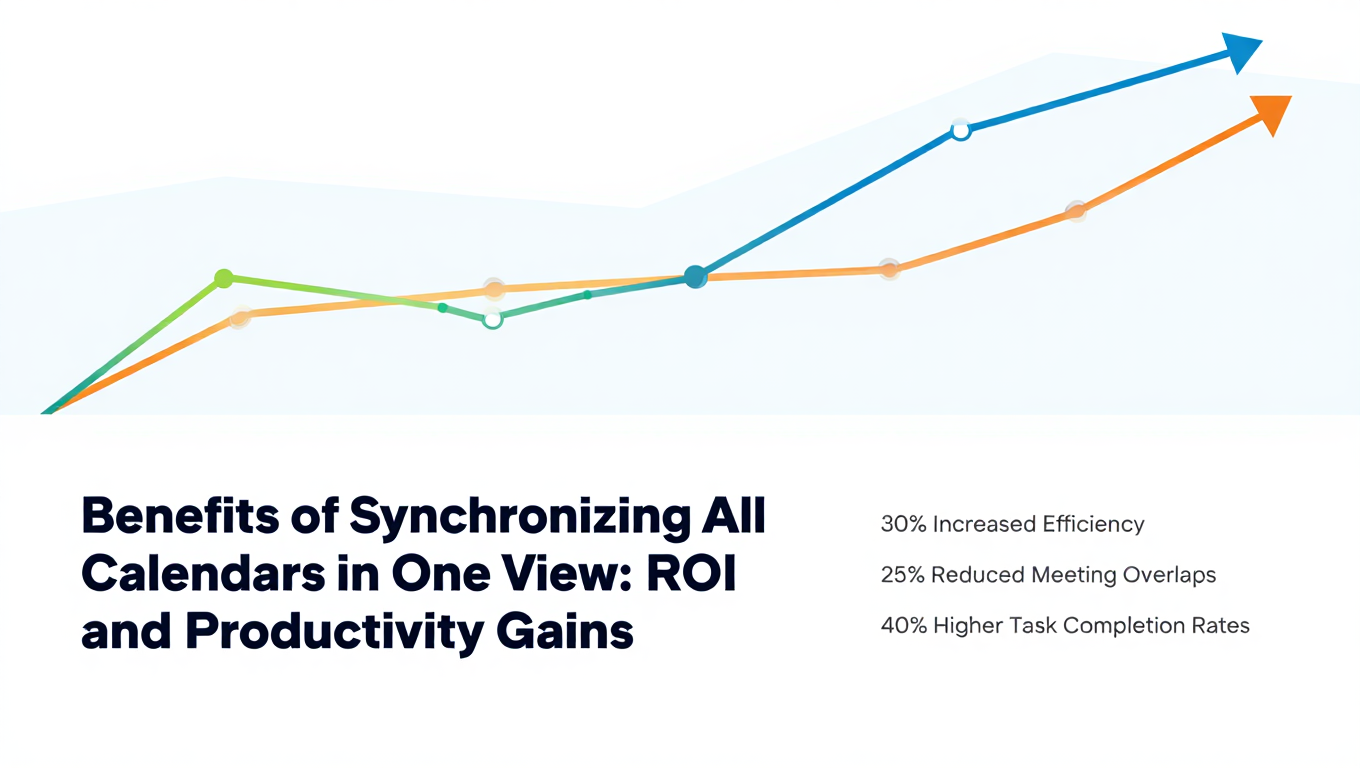
Benefits of Synchronizing All Calendars in One View: ROI and Productivity Gains
Discover the benefits of synchronizing all calendars in one view. See ROI data, productivity gains, reduced double bookings, and real-world business impact in 2025.
Best Bidirectional Calendar Sync Tools: 2025 Comparison Guide
Compare the best bidirectional calendar sync tools in 2025. Discover which platforms offer true two-way synchronization and which only provide one-way sync.
Best Two Way Calendar Sync Software: 2025 Expert Rankings & Comparison
Compare the top two-way calendar sync software tools. We tested 12 platforms for bidirectional sync speed, reliability, and field coverage to find which actually work.