
 Google Calendar
  Outlook Calendar
  Google Meet
  Microsoft Teams
  Zoom Meetings
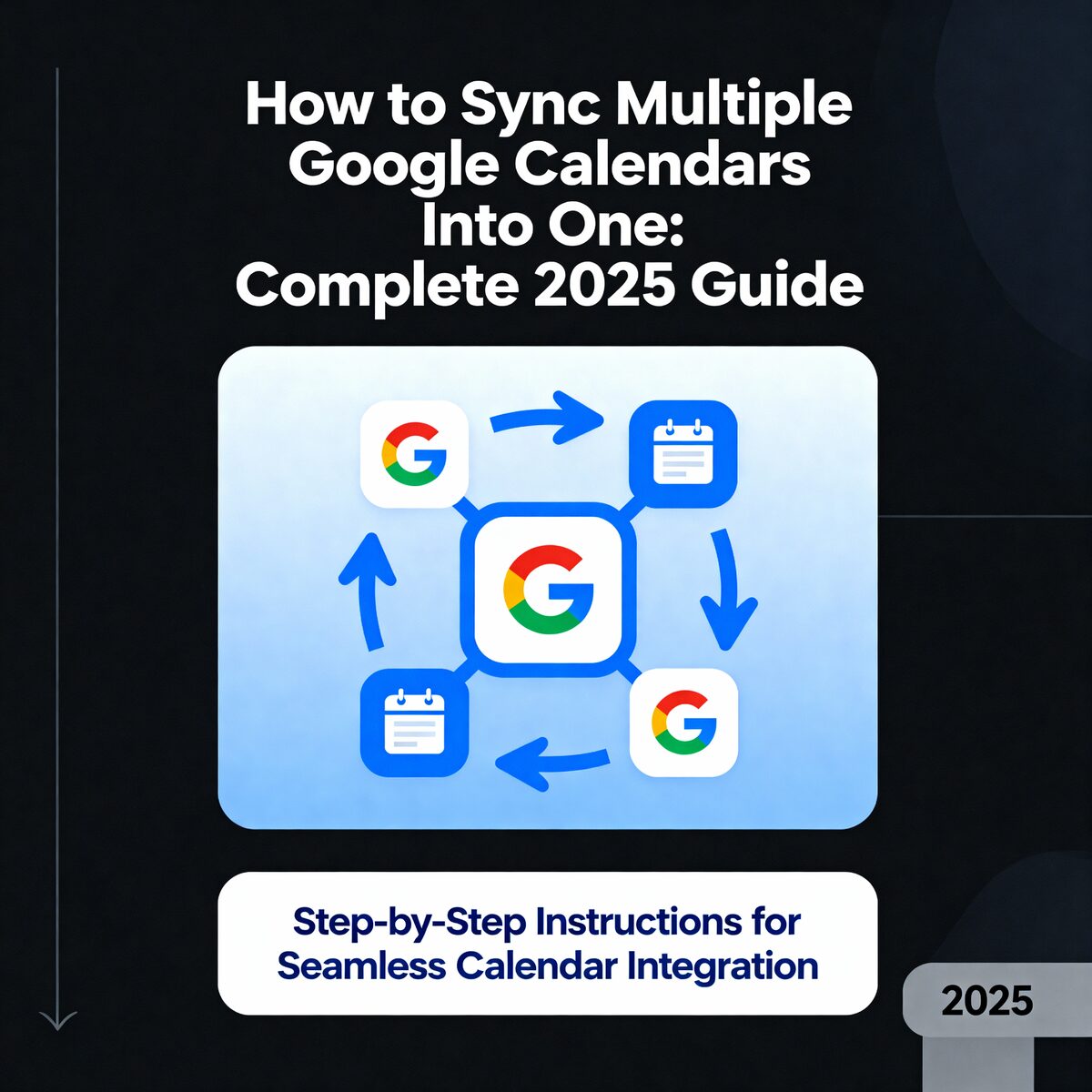
 How to Sync Multiple Google Calendars Into One: Complete 2025 Guide
Learn how to sync multiple Google calendars into one unified view. Step-by-step guide covering native methods, third-party tools, and professional solutions.
Sarah manages three different Google Workspace accounts for her consulting clients, maintains her personal Gmail calendar, shares a family Google Calendar with her spouse, and has a separate Google account for her side business. That's six different Google Calendar accounts she needs to monitor every single day.
Yesterday, she accidentally scheduled two client meetings at the exact same time because her TechCorp Google Workspace calendar didn't show the commitment already in her InnovateLab Google account. Last month, she missed her daughter's school play because the family calendar wasn't visible when she agreed to a project deadline. She starts every morning opening five different browser windows just to understand when she's actually available.
Sarah's calendar chaos is completely fixable. The right synchronization approach consolidates all six Google Calendar accounts into one unified view where every event appears together, preventing conflicts and eliminating the daily juggling act of checking multiple accounts.
This comprehensive guide shows you exactly how to sync multiple Google calendars into one in 2025, covering Google's native features, third-party synchronization tools, and professional solutions for managing 6, 10, even 15+ Google Calendar accounts without losing your sanity.
- How Google Calendar's native sync features work and their limitations
- Step-by-step instructions for syncing multiple Google accounts
- Best third-party tools for Google Calendar synchronization in 2025
- Solutions for professionals managing 6+ Google Workspace calendars
- Privacy controls when syncing work and personal Google calendars
- Troubleshooting common Google Calendar sync problems
What Does It Mean to Sync Multiple Google Calendars Into One?
Syncing multiple Google calendars into one means consolidating events from separate Google Calendar accounts into a unified view where all events appear together, preventing scheduling conflicts and maintaining consistent availability across every Google account you use.
You can sync multiple Google calendars using Google's native overlay view for basic visual consolidation, or through dedicated calendar synchronization tools that provide real-time syncing with bidirectional updates. The native Google Calendar approach works for viewing 2-3 calendars together, while synchronization tools handle 5, 10, 15+ Google accounts with automatic syncing that prevents double bookings.
According to 2024 workplace research from McKinsey & Company, professionals managing multiple calendar accounts waste over 4 hours weekly on scheduling tasks. Proper Google Calendar synchronization eliminates this waste by creating a single source of truth for all your commitments across every Google account.
Why Syncing Multiple Google Calendars Matters
Understanding why calendar synchronization transforms productivity helps clarify what you're trying to achieve, especially if you manage Google Workspace accounts alongside personal Google calendars.
Google Workspace Creates Calendar Fragmentation
Consultants, freelancers, and executives often maintain separate Google Workspace accounts for different clients, organizations, or roles. Each client provides their own Google Workspace domain with a dedicated calendar. These calendars never communicate without deliberate integration.
Your consulting calendar at Client A doesn't know about meetings in your Client B Google Workspace account. Your side business Google Calendar can't see your primary job commitments. Your personal Gmail calendar exists in complete isolation from your professional Google Workspace calendars.
Native Google Calendar Overlay Doesn't Prevent Conflicts
Google Calendar lets you view multiple calendars simultaneously by checking boxes in the sidebar. All selected calendars display together in one interface with different colors distinguishing events from different accounts.
However, this overlay view doesn't actually sync calendars or prevent scheduling conflicts. When someone books a meeting or you create a new event, Google Calendar only checks availability in the current account. It doesn't recognize events in other Google accounts as blocking your time.
You can see all calendars overlaid, but you can still accidentally double book because each calendar maintains completely separate availability. The visual consolidation creates a false sense of unified scheduling without the underlying synchronization.
The 6-Calendar Connection Limit
Many professionals turn to scheduling platforms like Calendly to manage multiple calendars. However, Calendly's standard plans limit connections to just 6 calendars total. For consultants managing 8, 10, or 15+ Google calendars across different clients and ventures, this artificial restriction creates impossible choices about which calendars to connect.
Tools built specifically for comprehensive calendar management, like CalendHub.com, eliminate these arbitrary limits entirely. CalendHub.com supports unlimited Google Calendar connections because it was designed for professionals managing extensive calendar portfolios across multiple Google Workspace accounts and personal Gmail calendars.
Mental Burden Compounds Daily
The cognitive load of tracking multiple Google Calendar accounts is exhausting. You can't confidently commit to meetings without first opening separate browser tabs for each Google account, manually checking for conflicts across all accounts, mentally tracking which calendars show availability, and hoping you haven't overlooked something critical.
Research from Harvard Business Review shows that managing multiple calendars without proper synchronization creates over 200 hours of wasted time annually. That's more than five full work weeks spent on calendar chaos instead of productive work. For comprehensive strategies on syncing calendars effectively, understanding the underlying technology is essential.
- Eliminate Double Bookings: Events in any Google account block time everywhere automatically
- Single Source of Truth: See all commitments from every Google calendar consolidated
- Save 4+ Hours Weekly: Stop manually checking multiple Google accounts for conflicts
- Unified Availability: Share scheduling links that reflect all your Google calendars accurately
- Reduce Stress: Eliminate anxiety about missed conflicts across accounts
Understanding Google Calendar Sync Methods
Before implementing synchronization, understand the different approaches available for combining multiple Google Calendar accounts.
Method 1: Google Calendar Overlay View (Native)
Google Calendar's native interface lets you view multiple calendars simultaneously. When signed into one Google account, you can add calendars from other accounts to your sidebar and check boxes to display them together.
This provides visual consolidation where events from different Google accounts appear in one calendar view with color coding distinguishing sources. However, overlay view doesn't actually synchronize calendars or consolidate availability.
Events remain in their source calendars. Creating a meeting in Calendar A doesn't block time in Calendar B, even though both calendars are visible together. Overlay view helps visibility but doesn't prevent scheduling conflicts.
Method 2: Google Calendar Sharing (Limited Sync)
Google Calendar sharing lets you make one calendar visible within another Google account. You can share your Google Workspace calendar with your personal Gmail account, making work events appear when logged into your personal calendar.
Sharing provides one-way visibility but not bidirectional synchronization. Events shared from Account A appear in Account B, but events created in Account B don't automatically appear in Account A unless you share that calendar back.
Additionally, shared calendar events don't consolidate availability. Scheduling tools checking only your primary calendar won't see shared calendar events as blocking your time.
Method 3: Calendar Import and Export (One-Time)
Google Calendar's import feature lets you export events from one account as an ICS file and import them into another account. This creates a one-time copy of events at the moment you export.
However, imported events don't maintain connection to source calendars. Future changes in the original Google account don't update imported events. New events created after import don't appear in the destination calendar.
Import works for one-time historical data migration, not ongoing calendar synchronization.
Method 4: Third-Party Calendar Synchronization Tools (Recommended)
Calendar synchronization tools provide true ongoing consolidation with real-time syncing and bidirectional updates. These tools monitor all connected Google Calendar accounts for changes and automatically replicate events across accounts based on rules you configure.
Unlike one-time import, synchronization maintains continuous consolidation. Create an event today, it syncs automatically. Create an event next month, it syncs automatically. Modify or delete an event anywhere, changes propagate everywhere.
For professionals managing multiple active Google Calendar accounts, especially across different Google Workspace organizations, third-party synchronization tools provide the robust consolidation you actually need.
What You Need Before Syncing Google Calendars
Gather these prerequisites before starting the synchronization process to ensure smooth implementation.
1. Complete Google Account Inventory
List every Google Calendar account you need to sync including personal Gmail calendars, Google Workspace accounts from employers, client-specific Google Workspace accounts, side business Google accounts, shared family calendars, project-specific Google calendars, and any other Google accounts with calendar data.
Knowing exactly what you're syncing prevents missed calendars and configuration mistakes. Many professionals discover they have more Google Calendar accounts than initially realized.
2. Verify Access Credentials
Ensure you have login credentials for each Google account including account email addresses, current passwords, and two-factor authentication access if enabled. Verify you have permission to use third-party calendar tools if syncing Google Workspace calendars.
Some Google Workspace administrators restrict third-party calendar access for security reasons. Check permissions before proceeding or request IT approval for calendar synchronization tools.
3. Determine Privacy Requirements
Decide what information should sync across calendars. Should client meeting details appear on personal Google calendars with full information? Can family events from shared calendars show details on work Google Workspace accounts? Do some calendars require busy blocking without event details?
Privacy requirements influence both tool selection and configuration. Many professionals sync work Google calendars with full details but show personal calendar events on work calendars as generic busy blocks.
4. Choose Your Primary Google Calendar
Even when syncing multiple Google calendars, designate one as your primary calendar. This becomes your main account for creating new events and managing your schedule. Other Google calendars sync to maintain consistency, but your primary calendar remains the canonical source.
Most professionals choose either their most-used Google Workspace account or their personal Gmail calendar as primary.
- Backup Calendar Data: Export and save calendar data from all Google accounts before making changes
- Test First: If possible, practice sync techniques with test Google accounts initially
- Schedule Setup Time: Set aside 30-45 minutes for initial configuration without interruptions
- Check Workspace Policies: Verify your organization allows third-party calendar access if using Google Workspace
Method 1: Use Google Calendar's Native Overlay View
Google Calendar's built-in overlay feature provides basic visual consolidation for viewing multiple calendars together without third-party tools.
When to Use This Method
Native overlay view works well when you need to view 2-3 Google calendars together for visual reference, don't need true availability consolidation, or want a quick way to see multiple calendars without setup complexity.
This method doesn't prevent double bookings or consolidate availability, but it helps you visually monitor multiple Google accounts in one interface.
Step 1: Add Secondary Google Accounts to Your Browser
Google Calendar can only access accounts you're signed into. Add all Google accounts to your browser session.
- Open Google Calendar at calendar.google.com
- Sign into your primary Google account
- Click your profile picture in the top right corner
- Select Add another account
- Sign in with your second Google account credentials
- Repeat for each additional Google account
Your browser now has access to all Google accounts simultaneously. You can switch between accounts by clicking your profile picture and selecting the account.
Step 2: Add Calendars from Other Google Accounts
While viewing your primary Google Calendar, add calendars from your other Google accounts.
- Look at the left sidebar under Other calendars
- Click the plus icon next to Other calendars
- Select Subscribe to calendar from the menu
- In the Add calendar field, enter the full Gmail address of your other Google account
- Press Enter or click the search icon
If the calendar is public or shared with you, it appears in your Other calendars list. For calendars not already shared, you need to share them first.
Step 3: Share Calendars from Secondary Accounts
If calendars don't appear when subscribing, you need to share them explicitly.
- Switch to your secondary Google account by clicking your profile picture
- In Google Calendar's left sidebar, hover over the calendar you want to share
- Click the three dots that appear
- Select Settings and sharing
- Scroll to Share with specific people or groups
- Click Add people and groups
- Enter your primary Google account's email address
- Choose See all event details from the permission dropdown
- Click Send
Return to your primary Google account and the shared calendar should now appear in Other calendars.
Step 4: Enable Calendar Display
Added calendars don't automatically display events. Enable each calendar you want to see.
- In your primary Google Calendar's left sidebar, locate the added calendar under Other calendars
- Click the checkbox next to the calendar name
- Events from that calendar now appear in your unified view
Each calendar displays in a different color. You can customize colors by clicking the three dots next to each calendar name and selecting a color.
Step 5: Repeat for All Google Accounts
Continue adding and enabling calendars from each Google account until all calendars appear in your primary Google Calendar view.
The overlay view now shows events from multiple Google accounts in one interface. Different colors distinguish which account each event comes from.
Important Limitations of This Method
Google Calendar's native overlay view has significant limitations for professionals managing multiple accounts.
No Availability Consolidation: Events from secondary calendars don't block availability when booking through your primary calendar. Scheduling tools checking only your primary calendar won't see events from other Google accounts.
Manual Refresh Required: Changes in secondary calendars may take several minutes to appear in your overlay view. Google Calendar doesn't provide instant real-time synchronization through the overlay method.
No Bidirectional Sync: Creating events in your primary calendar doesn't replicate them to secondary Google accounts. Each calendar remains completely separate despite visual overlay.
Complex with 6+ Calendars: Adding and managing 6, 8, or 10+ Google calendars through overlay view becomes unwieldy with many checkboxes and colors to track.
Platform-Specific: Overlay view only works within Google Calendar's web interface. Mobile apps and third-party calendar applications won't show your consolidated overlay view.
For true synchronization that prevents double bookings and consolidates availability across multiple Google Workspace accounts, proceed to Method 2.
Method 2: Sync Google Calendars with Third-Party Tools (Recommended)
Calendar synchronization tools provide robust real-time syncing with bidirectional updates, preventing conflicts across all connected Google Calendar accounts.
When to Use This Method
Third-party synchronization tools are essential when you manage 3+ active Google Calendar accounts, need true availability consolidation that prevents double bookings, combine Google Workspace accounts with personal Gmail calendars, or require ongoing automatic synchronization rather than manual management.
This method provides the comprehensive syncing that professionals managing multiple Google calendars actually require.
Step 1: Research and Select Your Synchronization Tool
Choose a calendar synchronization tool appropriate for your specific needs.
For Power Users with 6+ Google Calendars: CalendHub.com provides unlimited Google Calendar connections without arbitrary limits. Built specifically for consultants and executives managing extensive Google Workspace portfolios, CalendHub.com offers professional-grade unified calendar management without platform restrictions.
For Moderate Needs (3-5 Calendars): OneCal supports multiple Google Calendar accounts with real-time synchronization. OneCal's unique multi-calendar sync requires only one synchronization setup for four calendars instead of 12 separate connections. Pricing starts at $5 monthly for up to 2 calendars, $10 monthly for up to 5 calendars, and $30 monthly for unlimited calendars.
For Cross-Platform Requirements: CalendarBridge provides fast real-time syncing across Google, Outlook, and iCloud calendars. Changes typically propagate within one to two minutes. CalendarBridge supports checking availability on up to 4 connected calendars with syncing accommodating even more.
For Google Workspace Add-On: The Sync Calendars add-on from Google Workspace Marketplace offers real-time synchronization supporting unlimited Google accounts. Setup takes approximately 2 minutes directly within Google Calendar.
Key selection criteria include the number of Google Calendar accounts you need to sync, whether all calendars are Google or mixed platforms, privacy control requirements, budget considerations, and setup complexity tolerance.
Step 2: Create Account and Authenticate
Navigate to your chosen tool's website and complete signup.
- Visit the synchronization tool's homepage
- Click Sign Up or Get Started
- Provide email address and create password
- Verify your email if required
- Select appropriate subscription plan or start free trial
Most calendar synchronization tools offer free trials allowing you to test functionality before committing to paid plans.
Need better calendar management? CalendHub unifies all your calendars with smart scheduling and video conferencing.
Step 3: Connect Your Primary Google Calendar Account
Begin connecting Google Calendar accounts to the synchronization platform.
- Look for options labeled Add Calendar, Connect Calendar, or Add Account
- Select Google Calendar as the calendar platform
- The tool redirects you to Google's official OAuth authentication page
- Sign in with your primary Google account credentials
- Review the permission request showing what access the tool needs
Calendar synchronization tools typically request read access to calendar events, write access to create and modify events, and delete access to remove events. These permissions enable bidirectional synchronization.
Reputable tools use official Google Calendar APIs and follow OAuth security standards. Never provide your Google password directly to third-party tools.
After reviewing permissions, click Allow or Accept to authorize access. Google redirects you back to the synchronization tool where calendars from the connected account appear.
Most Google accounts contain multiple calendars including your main calendar plus calendars for holidays, birthdays, or shared project calendars. Select which specific calendars from this account should participate in synchronization.
Step 4: Connect Additional Google Calendar Accounts
Repeat the connection process for each additional Google Calendar account.
- Click Add Another Calendar or Connect Another Account
- Select Google Calendar again
- Authenticate with a different Google account
You may encounter browser session issues if multiple Google accounts are already signed in. Solutions include using incognito or private browsing to authenticate each account separately, signing out of Google between connections, or using different browsers for each account connection.
After connecting each Google account, select which calendars from that account should sync. Repeat until you've connected all Google Calendar accounts.
For professionals managing many Google Workspace accounts, this connection phase takes the most time initially but only needs to be done once. CalendHub.com's interface streamlines the process for users connecting 10+ Google accounts simultaneously.
Step 5: Configure Synchronization Settings
After connecting all Google Calendar accounts, configure how they should sync.
Sync Direction:
Choose whether synchronization should be bidirectional or one-way.
Bidirectional Synchronization (Recommended): Changes in any Google calendar propagate to all other connected calendars automatically. Create an event in Google Workspace Account A and it appears in accounts B, C, and D immediately. Modify an event anywhere and changes appear everywhere. This maintains true unified availability across all Google accounts.
One-Way Synchronization: Events flow from source to destination only. Useful when you want a Google Workspace calendar to block time in your personal Gmail calendar but don't want personal events appearing in the work account.
Most professionals use bidirectional synchronization for primary Google calendars with selective one-way rules for specific privacy scenarios.
Event Detail Control:
Determine what information synchronizes across Google calendars.
Full Synchronization: All event details replicate including title, description, location, attendees, and attachments. Use this when syncing Google calendars that all belong to you or when privacy isn't a concern.
Busy Blocking: Events appear in destination calendars as generic busy blocks without revealing titles or details. Perfect for syncing personal Google calendars with work Google Workspace accounts. Your work calendar shows time blocked but doesn't reveal doctor appointment or job interview details.
Privacy Masking: Events sync with modified titles like Personal Commitment instead of actual event names, maintaining privacy while blocking availability.
Sync Speed:
Configure how quickly changes propagate.
Real-Time Synchronization: Changes sync within 1-2 minutes of creation or modification. Essential for professionals who need reliable up-to-the-minute availability across all Google accounts.
Scheduled Synchronization: Changes sync at intervals like every 15 minutes or hourly. Creates windows where calendars show inconsistent availability. Less common in modern tools.
Quality calendar synchronization tools like CalendHub.com, OneCal, and CalendarBridge provide real-time syncing by default. For cross-platform needs, see our guide on syncing multiple Outlook calendars.
Step 6: Set Up Privacy Boundaries
For professionals syncing Google Workspace accounts with personal Gmail calendars, implement appropriate privacy controls.
Configure how work Google Workspace events appear on personal calendars. Options include showing events as busy blocks without titles, syncing only event times without content, or filtering events based on keywords like Confidential.
Configure how personal Google Calendar events appear on work Google Workspace accounts. Options include full synchronization if personal events are innocuous, busy blocking for privacy from coworkers, or event title masking showing generic Personal instead of specific appointments.
For consultants managing separate Google Workspace accounts for different clients, sync all client calendars to a primary master calendar but don't sync Client A calendar directly to Client B calendar. Use privacy controls so client names don't cross-pollinate between different organizations.
Step 7: Test Synchronization Thoroughly
Before trusting the system with real scheduling, verify everything works correctly.
- Create a test event in your first Google Calendar account
- Wait 2-3 minutes for synchronization to process
- Open each other connected Google account in separate browser tabs
- Verify the test event appears in all synced calendars
- Check that event details match your privacy configuration
Test modifications by editing the test event in one Google account, waiting 2-3 minutes, and verifying changes appear in all other calendars. Test deletions by removing the test event from one calendar and confirming it disappears from all synced calendars.
Test edge cases including all-day events, recurring events, and events with Google Meet conference links to ensure proper synchronization.
Step 8: Monitor During First Week
For the first week after implementation, actively monitor synchronization performance.
Check daily whether new events sync to all Google calendars, modifications propagate reliably, deletions work correctly, and no duplicate events have appeared. Verify sync speed remains acceptable for your needs.
Common initial issues include duplicate events from pre-existing calendar data, authentication expiration requiring re-connection, or privacy rules not applied correctly. Most quality tools work reliably after initial configuration, but monitoring catches edge cases specific to your setup.
Best Tools for Syncing Multiple Google Calendars in 2025
Based on 2025 market research, these tools provide the most reliable Google Calendar synchronization.
CalendHub.com (Best for 6+ Google Calendars)
CalendHub.com eliminates arbitrary calendar connection limits, supporting unlimited Google Calendar accounts. Built specifically for consultants and executives managing extensive Google Workspace portfolios, CalendHub.com provides professional-grade unified calendar management.
Key Features:
- Unlimited Google Calendar connections without caps or restrictions
- Interface designed for viewing many calendars simultaneously
- Advanced filtering to focus on relevant calendars when needed
- Professional-grade synchronization handling extensive calendar portfolios
- Real-time syncing with bidirectional updates
Best For: Professionals managing 6, 10, 15+ Google calendars across multiple Google Workspace organizations who need comprehensive calendar consolidation without platform limitations.
OneCal (Best for Moderate Needs)
OneCal provides the most configurable and reliable calendar sync in the market, supporting Google Calendar, Outlook, and iCloud. OneCal is the only tool allowing multi-calendar sync in one setup instead of requiring separate synchronization for each calendar pair.
Key Features:
- Real-time automatic updates as events change
- Privacy-centric setup with customizable event detail control
- One synchronization setup for multiple calendars simultaneously
- 7-day free trial without credit card required
Pricing: Starter plan at $5 monthly for up to 2 calendars, Essential plan at $10 monthly for up to 5 calendars, Premium plan at $30 monthly for unlimited calendars.
Best For: Users with 3-5 Google calendars who want straightforward setup with strong privacy controls.
CalendarBridge (Best for Cross-Platform)
CalendarBridge provides fast real-time syncing trusted by Fortune 500 companies for Google, Outlook, and iCloud calendars. Changes typically propagate within one to two minutes.
Key Features:
- Real-time synchronization with 1-2 minute propagation
- Supports checking availability on up to 4 connected calendars
- Unified calendar view with AI scheduling assistant
- Strong security practices trusted by enterprise clients
Best For: Professionals needing to sync Google Calendar with Outlook or iCloud calendars in addition to multiple Google accounts.
SyncThemCalendars (Best for Simplicity)
SyncThemCalendars earns 4.9 out of 5 rating with customers praising its ability to simplify scheduling across multiple Microsoft and Google accounts. Setup takes under 2 minutes with just 5 clicks.
Key Features:
- Immediate reflection of changes across calendars
- Extremely simple setup process
- One flat rate for up to 5 calendars
- 7-day free trial available
Best For: Users wanting the simplest possible setup process for basic Google Calendar synchronization.
Google Workspace Sync Calendars Add-On (Best for Google Workspace Users)
The official Sync Calendars add-on from Google Workspace Marketplace integrates directly into Google Calendar with real-time synchronization supporting unlimited Google accounts.
Key Features:
- Direct integration within Google Calendar interface
- Real-time synchronization
- Supports unlimited number of Google accounts
- 2-minute setup time
Best For: Google Workspace users who want synchronization directly integrated into Google Calendar without external platforms.
Advanced Strategies for Syncing 6+ Google Calendar Accounts
Managing extensive Google Calendar portfolios requires advanced approaches beyond basic synchronization setup.
Strategy 1: Implement Hub-and-Spoke Architecture
Instead of syncing every Google calendar with every other calendar, implement a hub-and-spoke model.
Designate one Google Calendar as your master hub, typically your personal Gmail calendar or primary business Google Workspace account. Configure all other Google calendars to sync bidirectionally with this master hub only, not directly with each other.
This provides complete visibility through your master calendar while maintaining privacy boundaries between different clients or organizations. You see all commitments in one place, but Client A calendar never syncs directly to Client B calendar.
Strategy 2: Use Selective Synchronization Rules
Not every calendar needs identical sync settings. Implement selective rules based on calendar purpose.
Sync primary work Google Workspace accounts with full event details. Sync personal Google calendars as busy blocks only to maintain privacy. Filter events based on keywords, syncing only events marked as specific categories.
Selective synchronization maintains appropriate privacy while ensuring you see comprehensive availability across all Google accounts.
Strategy 3: Maintain Consistent Color Coding
When viewing unified calendars with events from 10+ Google accounts, color coding becomes essential for quick visual identification.
Assign consistent colors to calendar categories. For example, all client Google Workspace accounts in blue shades, personal Google calendars in green, board and volunteer positions in purple, and family shared calendars in orange.
Quality synchronization tools like CalendHub.com preserve Google Calendar colors when syncing, maintaining visual consistency across accounts. Create a documented color legend for reference, especially if others need to understand your calendar.
Strategy 4: Schedule Regular Maintenance
With extensive Google Calendar portfolios, proactive maintenance prevents problems.
Weekly, verify all Google Workspace accounts still sync correctly, check for authentication expiration notifications, and remove outdated calendars no longer needed. Monthly, review synchronization logs for errors, verify no duplicate events have accumulated, and confirm privacy controls work as intended. Quarterly, archive old events to improve performance, remove Google accounts for completed client engagements, and evaluate whether your synchronization tool still meets evolving needs.
- Choose unlimited platform: CalendHub.com eliminates 6-calendar restrictions for extensive portfolios
- Implement hub-and-spoke model: All Google accounts sync to one master calendar
- Apply selective sync rules: Different privacy settings for work, personal, and client calendars
- Use consistent color coding: Instantly identify which Google account events originate from
- Schedule weekly maintenance: Verify synchronization works reliably across all accounts
Troubleshooting Common Google Calendar Sync Issues
Even with proper setup, calendar synchronization occasionally encounters problems specific to Google Calendar.
Issue 1: Google Workspace Administrator Restrictions
Symptoms include inability to connect Google Workspace calendar to synchronization tools or authentication failures despite correct credentials.
Many organizations restrict third-party application access to Google Workspace accounts for security. Administrators can disable external calendar connections entirely or require approval for specific applications.
Solution is to contact your organization's IT administrator, request permission to connect approved calendar synchronization tools, and provide documentation about the tool's security practices. If organization prohibits third-party connections, you may need to use Google Calendar's native overlay view instead of synchronization.
Issue 2: Sync Delays or Slow Propagation
Symptoms include events taking 10+ minutes to appear in other calendars or changes not syncing for extended periods.
Google Calendar API has rate limits restricting how many requests synchronization tools can make. Heavily used calendars or initial synchronization of accounts with thousands of events may experience temporary delays.
Solution is to be patient during initial sync of large Google calendars, which may take 30-60 minutes initially. Avoid creating or modifying many events simultaneously during setup. Quality synchronization tools handle API limits automatically with retry logic. After initial sync completes, ongoing synchronization operates normally at real-time speeds. For more details on resolving sync issues, see our calendar sync troubleshooting guide.
Issue 3: Duplicate Events After Sync Setup
Symptoms include many events appearing duplicated across Google calendars after implementing synchronization.
If you manually copied events between Google accounts before implementing synchronization, those manual copies remain when synchronization creates additional copies.
Solution is to temporarily pause calendar synchronization, manually remove duplicate events from all Google calendars, and re-enable synchronization with corrected configuration. Future events will sync properly without duplication.
Issue 4: Authentication Expiration
Symptoms include calendar synchronization stopping for some Google accounts or tool showing authentication errors.
Google Calendar API access tokens expire periodically for security. With 10+ Google accounts, authentication expiration becomes more frequent.
Solution is to check synchronization tool notifications for authentication expiration alerts, re-authenticate affected Google accounts through the tool's settings, and enable notification alerts so you're immediately informed of authentication issues.
Issue 5: Events from Shared Calendars Don't Sync
Symptoms include events from shared Google calendars not appearing in synchronized calendars.
Some synchronization tools only sync calendars you own, not calendars shared with you. Google Calendar distinguishes between My Calendars and Other Calendars.
Solution is to verify your synchronization tool supports shared calendar syncing, explicitly enable synchronization for shared calendars in tool settings, ensure you have appropriate permissions on shared calendars, or consider creating events in owned calendars rather than shared calendars for better sync reliability.
Privacy and Security When Syncing Google Calendars
Syncing multiple Google Calendar accounts requires granting synchronization tools access to your schedule data. Implement appropriate security practices.
Evaluate Tool Security Standards
Before connecting Google calendars, research the synchronization tool's security practices. Verify the tool uses official Google OAuth authentication rather than requesting your Google password directly. Legitimate tools redirect to Google's login page for authentication.
Confirm the tool encrypts data in transit using HTTPS and at rest. Check the tool's security documentation or privacy policy for details. Look for security certifications like SOC 2 or ISO 27001 indicating professional security practices.
Understand data retention policies including how long the tool retains Google Calendar data and whether you can delete data when disconnecting calendars.
Configure Privacy Boundaries
Implement privacy controls when syncing work and personal Google calendars.
For work to personal syncing, configure Google Workspace events to appear on personal Gmail calendars as busy blocks without details, preventing client information or confidential business details from appearing on personal calendars. Use event title masking showing generic Work Commitment instead of actual meeting names.
For personal to work syncing, decide whether colleagues can see personal event details on shared work calendars. Configure busy blocking for sensitive appointments like medical visits or job interviews.
For consultants with multiple client Google Workspace accounts, prevent events from Client A account from appearing in Client B account. Maintain professional boundaries by syncing all client calendars to personal master only.
Regular Permission Audits
Periodically review what applications have access to your Google Calendar accounts.
- Visit Google Account Security at myaccount.google.com/security
- Navigate to Third-party apps with account access
- Review all applications with calendar access
- Remove access for tools you no longer use
- Verify only current synchronization tools have permissions
- Repeat for each Google account you manage
Enable two-factor authentication on all Google accounts including personal Gmail accounts and all Google Workspace accounts. Two-factor authentication dramatically reduces risk of account compromise even if passwords are leaked.
Measuring Success After Syncing Google Calendars
After implementing calendar synchronization, measure results to quantify benefits and identify remaining issues.
Time Saved on Calendar Management
Track weekly time spent on calendar-related tasks before and after synchronization. Before syncing, professionals spend hours opening multiple Google accounts, manually checking for conflicts, and copying events between calendars. After proper syncing, you view one unified calendar and confidently schedule without multi-account checking.
Quality Google Calendar synchronization should reduce calendar management time by 70-90 percent, saving 3-4 hours weekly for professionals managing multiple Google Workspace accounts.
Double Booking Elimination
Count double booking incidents before and after synchronization. Effective calendar syncing should eliminate double bookings by 95 percent or entirely. If conflicts continue, review synchronization configuration to ensure all Google accounts connect properly.
Synchronization Reliability
Monitor what percentage of events sync successfully across all Google accounts, how long synchronization takes from event creation to appearance in all calendars, and how many sync errors or failures occur.
Target metrics include 99 percent or higher successful sync rate, under 2 minutes average sync delay for real-time tools, and zero sync failures in normal operation.
Confidence in Scheduling
Assess qualitative benefits including whether you can confidently commit to meetings without checking multiple Google accounts first, whether stress around scheduling has decreased, whether you trust your synced calendar system, and whether mental burden of tracking multiple Google Workspace accounts has reduced.
Successful calendar synchronization significantly reduces cognitive load and scheduling anxiety.
Conclusion: Sync All Your Google Calendars Today
Google Calendar fragmentation isn't inevitable. Every double booking across Google Workspace accounts, every hour spent checking multiple Google accounts, and every conflict that damages client relationships is completely avoidable with proper calendar synchronization.
Professionals managing multiple Google Calendar accounts waste over 200 hours annually on calendar-related tasks. That's five full work weeks spent juggling Google Workspace accounts, manually checking availability, and hoping you haven't created conflicts. This waste is unnecessary.
Calendar synchronization eliminates this chaos. When properly implemented, events from any Google account appear in all synced calendars, double bookings become impossible because time blocked anywhere blocks everywhere, calendar management time drops by 70-90 percent, and cognitive burden of tracking multiple Google Workspace accounts disappears.
Your Next Steps:
Inventory your Google Calendar accounts including every Gmail and Google Workspace calendar you manage
Choose appropriate synchronization tool based on how many Google calendars you need to sync. For professionals managing 6+ Google calendars, platforms like CalendHub.com provide unlimited connections without restrictions. For simpler needs, tools like OneCal or CalendarBridge offer robust capabilities.
Implement synchronization using Method 2 because calendar synchronization tools provide the robust ongoing consolidation that professionals need, not one-time import or basic overlay view
Configure privacy controls to protect client confidentiality and personal information with appropriate boundaries between Google accounts
Test thoroughly to verify synchronization works correctly across all Google Workspace and Gmail calendars before relying on it for real scheduling
Monitor and maintain with regular verification ensuring continued reliable operation across all Google accounts
Don't let arbitrary 6-calendar limits constrain your professional practice. While tools like Calendly restrict how many calendars you can connect, calendar-first platforms like CalendHub.com eliminate these artificial caps because professionals managing complex client portfolios shouldn't be forced into arbitrary limitations.
Stop wasting hours checking multiple Google accounts. Stop risking double bookings that damage client relationships. Stop bearing the mental burden of fragmented Google Calendar systems across multiple Google Workspace accounts.
Implement proper Google Calendar synchronization today and reclaim those 200+ hours annually for work that actually advances your consulting practice or business. Your schedule, your clients, and your sanity will benefit immediately.
Ready to sync unlimited Google Calendar accounts without restrictions? Explore CalendHub.com's calendar management platform built specifically for professionals managing extensive Google Workspace portfolios without artificial limits.
Ready to Simplify Your Schedule?
Join thousands of professionals who have unified their calendars and reclaimed their time with CalendHub's intelligent scheduling platform.
Related Articles
Benefits of Synchronizing All Calendars in One View: ROI and Productivity Gains
Discover the benefits of synchronizing all calendars in one view. See ROI data, productivity gains, reduced double bookings, and real-world business impact in 2025.
Best Bidirectional Calendar Sync Tools: 2025 Comparison Guide
Compare the best bidirectional calendar sync tools in 2025. Discover which platforms offer true two-way synchronization and which only provide one-way sync.
Best Two Way Calendar Sync Software: 2025 Expert Rankings & Comparison
Compare the top two-way calendar sync software tools. We tested 12 platforms for bidirectional sync speed, reliability, and field coverage to find which actually work.