
 Google Calendar
  Outlook Calendar
  Google Meet
  Microsoft Teams
  Zoom Meetings
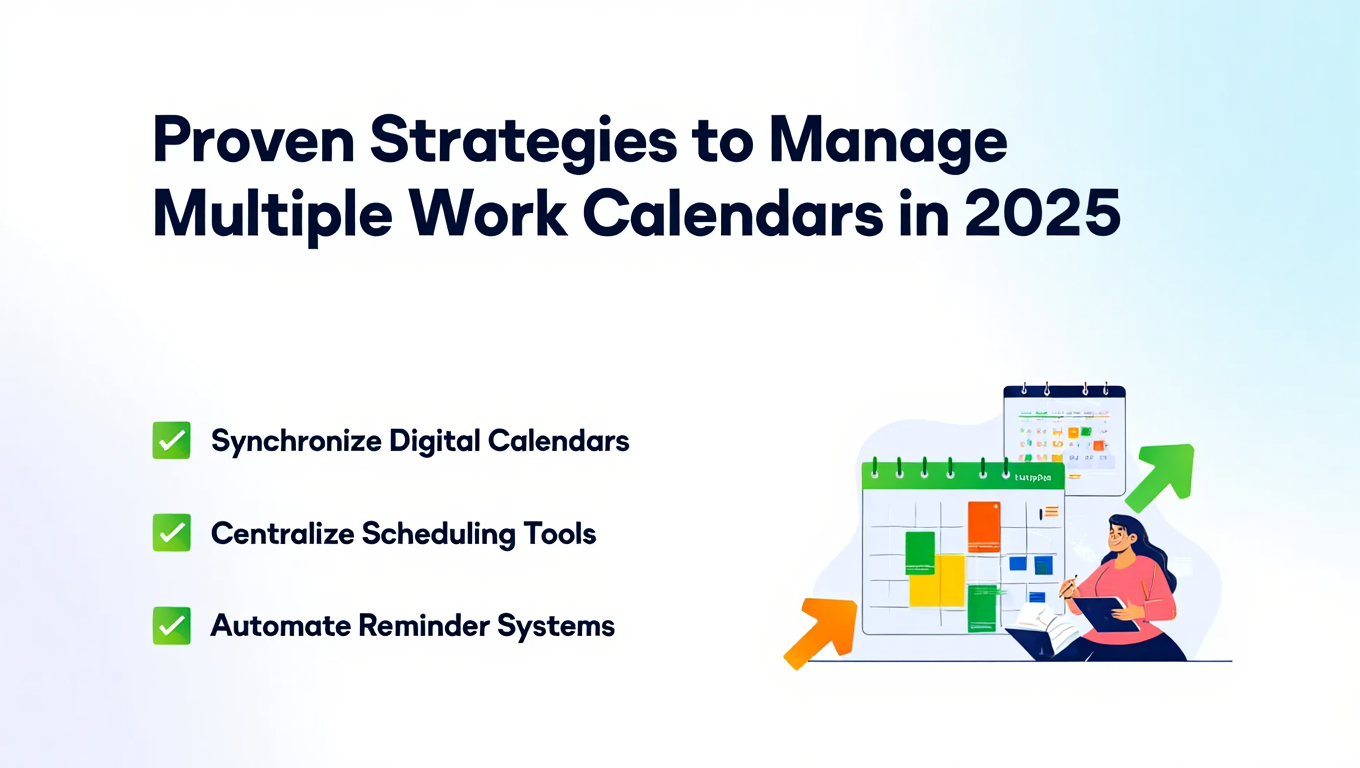
 Proven Strategies to Manage Multiple Work Calendars in 2025
Executive strategies for managing multiple work calendars effectively. Learn time management frameworks, calendar workflows, and professional best practices.
Jennifer serves as CEO of a growing technology company, sits on three corporate boards, advises two startups, and maintains an active speaking schedule. She manages nine different work calendars across these roles, each with distinct scheduling requirements, confidentiality considerations, and stakeholder expectations.
Six months ago, her calendar chaos reached a breaking point. She double booked a board meeting with a major client presentation, forcing her to send the CFO to represent her at the board while she handled the client call. She missed a keynote speaking engagement entirely because it existed only in the event organizer's calendar confirmation email, never making it to any of her nine tracking systems. Her executive assistant spent 15 hours weekly just managing calendar conflicts and reconciling scheduling across platforms.
Jennifer's challenge wasn't technology. She had access to excellent calendar tools. Her challenge was strategic. She lacked a coherent framework for how to approach multiple work calendar management, which calendars to prioritize, how to establish boundaries between roles, and what workflows would prevent chaos while accommodating her professional complexity.
This comprehensive guide provides proven strategic frameworks for managing multiple work calendars effectively, covering executive calendar management principles, time management strategies for complex portfolios, professional workflows that scale, and decision-making frameworks for calendar prioritization.
- Strategic frameworks for organizing multiple work calendar portfolios
- Executive calendar management principles from Fortune 500 practices
- Time blocking strategies adapted for professionals managing numerous calendars
- Decision frameworks for calendar prioritization and conflict resolution
- Workflow design that reduces calendar management time by 70%
- How to establish effective boundaries across different professional roles
What Are Calendar Management Strategies?
Calendar management strategies are systematic frameworks for organizing, prioritizing, and maintaining control over scheduling across multiple professional commitments while preventing conflicts, reducing administrative overhead, and ensuring alignment between calendar allocation and strategic priorities.
Effective strategies to manage multiple work calendars transform scheduling from reactive crisis management into proactive time allocation aligned with professional objectives. They provide decision-making frameworks for calendar conflicts, establish clear boundaries between different roles, and create workflows that scale as your professional portfolio expands.
Research from 2024 demonstrates that poor scheduling practices cost businesses $1.8 trillion annually in lost productivity. However, this staggering figure reflects not just bad tools but absence of strategic approaches to calendar management. Only 23% of professionals schedule everything systematically in calendars, while 82% lack coherent time management strategies entirely.
For executives and professionals managing multiple work calendars, developing strategic frameworks becomes essential rather than optional. Without strategy, you're constantly reacting to scheduling requests, fighting calendar conflicts, and letting urgent demands override important priorities.
The Strategic Calendar Hierarchy Framework
The foundation of effective multiple work calendar management starts with establishing a clear hierarchy organizing your calendar portfolio.
Tier 1: Master Calendar (Strategic Control)
Your master calendar represents unified visibility across all professional commitments. This isn't necessarily a separate physical calendar but rather a conceptual single source of truth showing comprehensive availability.
The master calendar serves strategic purposes. It prevents double bookings by reflecting every commitment regardless of source. It provides the foundation for confident scheduling without checking six different systems. It enables you to assess total calendar load and identify overcommitment before it becomes crisis.
Implement master calendar strategy by:
- Designating one calendar as your primary strategic view
- Synchronizing all other work calendars to this master calendar
- Making scheduling decisions based on master calendar availability
- Using master calendar for weekly planning and workload assessment
Platforms like CalendHub.com provide true master calendar functionality with unlimited connections, showing unified availability across extensive calendar portfolios without arbitrary limits.
Tier 2: Role-Specific Work Calendars (Tactical Organization)
Within your master calendar framework, maintain separate calendars for major professional roles. These provide tactical organization while feeding into strategic master calendar visibility.
Role-specific calendars might include:
- Primary company/employer calendar
- Board service calendars (one per board)
- Consulting or advisory client calendars
- Business venture calendars if you run multiple companies
- Speaking and conference calendar
- Professional development calendar
Separate role calendars provide several strategic advantages. They create clear visual distinction between different professional contexts. They enable role-specific sharing without exposing all professional activities. They facilitate focused time blocking for specific roles. They simplify transition when roles end or new ones begin.
Configure role calendars to sync with your master calendar while maintaining organizational separation. Events created in any role calendar automatically appear in master calendar, preventing conflicts while preserving tactical organization.
Tier 3: Project and Initiative Calendars (Operational Detail)
Below role calendars, create project-specific or initiative-specific calendars for operational detail that doesn't require master calendar visibility.
These might include:
- Major project milestone calendars
- Team sprint calendars
- Event planning calendars
- Specialized initiative tracking
Project calendars provide operational detail without cluttering strategic views. Configure selective synchronization where project deadlines appear in relevant role calendars and master calendar, but routine project meetings stay within project calendar only.
This hierarchical framework prevents calendar overload. Your master calendar shows strategic availability. Role calendars provide tactical context. Project calendars contain operational detail. You choose the appropriate tier for different scheduling contexts.
- Master Calendar: Shows all commitments, prevents double bookings, powers availability checking
- Role Calendars: Organize by company, board, client, venture - sync to master calendar
- Project Calendars: Operational detail - selectively sync deadlines only
- Result: Clear organization without complexity, strategic visibility without overwhelming detail
The Eisenhower Matrix Applied to Calendar Management
The Eisenhower Matrix, dividing tasks into urgent/important quadrants, provides powerful framework for strategic calendar management across multiple work calendars.
Quadrant 1: Urgent and Important (Crisis Management Calendar)
These commitments demand immediate attention and align with strategic priorities. Board meetings, critical client presentations, major deadlines, and time-sensitive decisions belong here.
Strategic Approach:
- These events take priority in calendar conflicts
- Schedule immediately when identified
- Protect aggressively from rescheduling
- Minimize time in this quadrant through better planning
Multiple Calendar Application: Tag or categorize Quadrant 1 events distinctly across all work calendars. When calendar conflicts arise, Quadrant 1 events automatically take precedence. If a double booking occurs, Quadrant 1 commitments remain while other quadrants reschedule.
Quadrant 2: Important but Not Urgent (Strategic Calendar)
This quadrant contains strategic work that drives long-term success but lacks immediate urgency. Strategic planning sessions, professional development, important relationship building, and proactive initiative planning belong here.
Strategic Approach:
- Schedule proactively before urgency develops
- Block time in advance to prevent Quadrant 1/3 tasks from consuming this space
- Protect these calendar blocks as vigorously as urgent commitments
- Increase time allocation here to reduce Quadrant 1 crises
Multiple Calendar Application: Executives managing multiple work calendars often let Quadrant 2 activities disappear entirely as different calendars fill with urgent demands. Combat this by scheduling Quadrant 2 time blocks first, before calendar requests arrive. If you need 4 hours weekly for strategic planning across your three board roles, block this time in relevant role calendars at the start of each month.
Research shows that executives who proactively block Quadrant 2 time reduce crisis management by 40% within three months, as strategic work prevents urgent problems from developing.
Quadrant 3: Urgent but Not Important (Delegation Calendar)
Activities that demand immediate attention but don't align with strategic priorities. Many meetings, interruptions, some emails, and routine requests belong here.
Strategic Approach:
- Delegate whenever possible
- Minimize time allocation
- Challenge whether urgency is real or perceived
- Create systems reducing Quadrant 3 volume
Multiple Calendar Application: When managing multiple work calendars, Quadrant 3 requests often masquerade as important because they come from legitimate professional roles. A meeting request from a board committee feels important due to the source, even if the meeting doesn't require executive-level participation.
Implement strict evaluation for all calendar requests. Does this truly require your participation or could someone else attend? Does this meeting have clear objectives or is it Quadrant 3 administrative theater? Can you decline or send a delegate?
Quadrant 4: Neither Urgent nor Important (Elimination Calendar)
Activities consuming time without urgency or strategic value. Time wasters, some routine meetings, and low-value commitments belong here.
Strategic Approach:
- Eliminate entirely
- Decline meeting invitations politely but firmly
- Unsubscribe from recurring commitments that no longer serve strategic purposes
Multiple Calendar Application: Quadrant 4 activities accumulate insidiously across multiple work calendars. A recurring monthly meeting that served purpose two years ago continues appearing across three different calendar systems. A board committee you joined out of politeness continues consuming time despite minimal contribution to strategic objectives.
Audit all recurring events across all work calendars quarterly. For each recurring commitment, explicitly answer whether this remains important and whether your participation remains necessary. Eliminate ruthlessly. The calendar space you reclaim can serve Quadrant 2 strategic priorities.
Time Blocking Strategies for Multiple Work Calendars
Time blocking, deliberately scheduling time for specific work categories, becomes exponentially more powerful when managing multiple work calendars strategically.
Role-Based Time Blocking
Allocate dedicated time blocks to major professional roles rather than allowing calendars to fill randomly across different commitments.
Implementation Strategy:
If you serve as CEO of a company, on two boards, and run a consulting practice, establish regular time blocks for each role:
- CEO role: Mondays, Wednesdays, Fridays 8am-5pm
- Board A: First and third Tuesday each month, 9am-3pm
- Board B: Second and fourth Tuesday each month, 9am-3pm
- Consulting practice: Thursdays 8am-5pm, Friday afternoons
These role-based blocks provide several strategic advantages. Stakeholders learn when you're available for each role, reducing scheduling conflicts. Context switching decreases as you batch similar work. Calendar requests automatically route to appropriate time blocks. You maintain clear capacity limits for each professional commitment.
Implement by creating "working hours" rules in calendar management platforms or blocking time proactively in role-specific calendars. When someone requests a meeting for Board A business, your calendar automatically shows only Board A time blocks as available.
Energy-Based Time Blocking
Align calendar demands with your personal energy patterns across the day and week.
Strategic Framework:
Map your typical energy levels:
- Peak cognitive performance (usually morning for most professionals)
- Moderate energy periods (early afternoon)
- Lower energy periods (late afternoon)
Then strategically allocate calendar activities:
- Peak energy: Strategic decisions, difficult conversations, critical presentations, complex analysis
- Moderate energy: Routine meetings, collaborative work, relationship building
- Lower energy: Administrative tasks, email, calendar planning, routine check-ins
Multiple Calendar Application:
When managing multiple work calendars, energy-based blocking prevents scheduling three high-stakes board meetings consecutively on the same day, leaving you mentally exhausted and performing below capability by the third meeting.
Review your master calendar weekly and assess energy allocation. If Tuesday contains four strategic decision meetings across different roles, that's poor energy management regardless of avoiding double bookings. Distribute high-energy demands across the week.
Deep Work Time Blocking
Protect extended uninterrupted time for focused work requiring deep concentration.
Research demonstrates that it takes 25 minutes to fully return to work following an interruption. Context switching can consume 40% of productive time. Deep work blocks eliminate these productivity drains.
Implementation for Multiple Work Calendars:
Schedule minimum 2-hour deep work blocks at least three times weekly in your master calendar before other commitments fill calendar space. Mark these blocks as "busy" across all work calendars so scheduling requests from any role can't fragment this time.
Different roles require different deep work. CEO role might need strategic planning time. Board service requires preparation time before meetings. Consulting demands client deliverable creation time. Schedule deep work blocks for each major role rather than hoping unscheduled time will magically appear.
Platforms like CalendHub.com enable sophisticated scheduling rules like "Mondays 9am-12pm are always deep work time for CEO role, show as unavailable across all other calendars," ensuring this strategic time remains protected regardless of calendar request volume.
Buffer Time Blocking
Schedule deliberate buffer time between meetings and commitments, especially when managing calendars across multiple professional roles.
Strategic Buffer Applications:
Transition Buffers: 15-30 minutes between meetings in different professional roles, allowing mental context switching. Meeting ending at 11am for Company A followed immediately by 11am meeting for Board B creates cognitive whiplash. Schedule 11am-11:15am transition buffer.
Preparation Buffers: Time before important meetings to review materials and prepare mentally. If board meetings start 2pm, block 1:30-2pm for preparation.
Recovery Buffers: Time after demanding commitments before scheduling next activity. After difficult client conversation, schedule 15-minute recovery buffer before next meeting.
Travel Buffers: If managing calendars requiring physical presence in different locations, travel time must appear as calendar blocks preventing double bookings.
Professionals managing multiple work calendars often ignore buffers, scheduling back-to-back commitments across different roles. This creates perpetual lateness, inadequate preparation, decision fatigue, and performance degradation.
Calculate realistic buffer requirements and implement them as calendar policy. If you need 15 minutes between meetings for different roles, configure calendar management tools to automatically insert this buffer rather than relying on manual scheduling discipline.
Decision Frameworks for Calendar Conflict Resolution
When managing multiple work calendars, scheduling conflicts inevitably arise despite synchronization. Strategic frameworks for resolving conflicts prevent reactive decision-making.
The Strategic Alignment Filter
When calendar conflicts occur, evaluate which commitment better aligns with strategic professional priorities.
Framework Questions:
- Which commitment advances primary career objectives more significantly?
- Which has greater long-term relationship impact?
- Which involves higher-level stakeholders or decision-makers?
- Which carries greater reputational risk if rescheduled?
- Which represents scarcer opportunity?
Apply this filter systematically rather than defaulting to "first scheduled wins" or "loudest stakeholder demands priority."
Example Application:
Calendar conflict between routine board committee meeting and important client presentation. Strategic alignment filter reveals client presentation advances business development objectives, involves potential contract renewal, and represents revenue impact. Committee meeting, while legitimate, doesn't compare strategically. Reschedule committee meeting, keep client presentation.
The Delegation Feasibility Test
Before accepting that you must resolve calendar conflicts through personal rescheduling, test whether delegation resolves the conflict better.
Framework Questions:
- Does this truly require my personal participation or can someone else attend?
- Could attending virtually rather than in-person resolve the timing conflict?
- Could I contribute to this commitment asynchronously rather than synchronously?
- Does this entire meeting need to happen or could email/brief document accomplish the objective?
Professionals managing multiple work calendars often assume every calendar request requires personal attendance. Delegation feasibility testing reveals that 30-40% of calendar conflicts resolve through delegation rather than rescheduling.
The Advance Notice Hierarchy
Establish clear policies about scheduling timeline and honor them consistently.
Need better calendar management? CalendHub unifies all your calendars with smart scheduling and video conferencing.
Framework Example:
- Emergency same-day requests: Only for true crises, requires explicit approval
- Short notice (1-3 days): Reserved for Quadrant 1 urgent/important only
- Standard notice (1-2 weeks): Normal scheduling window for most commitments
- Advance planning (1-3 months): Required for major commitments, speaking engagements, board meetings
When calendar conflicts involve different notice timelines, longer-advance commitments generally take precedence. Meeting scheduled three months ago trumps request arriving yesterday, except in genuine emergencies.
Communicating these policies to stakeholders across all professional roles prevents last-minute calendar chaos and trains people to plan appropriately.
The Stakeholder Impact Assessment
Evaluate calendar conflicts based on impact to stakeholders, not just personal preferences.
Framework Considerations:
- How many people does this commitment affect? (10-person meeting carries more impact than 1:1)
- What is the relative difficulty of rescheduling? (Client availability vs. internal team flexibility)
- What are the downstream consequences of rescheduling? (Does this create cascading schedule problems?)
- What relationship capital is at stake?
This framework prevents prioritizing personally convenient choices over stakeholder impact.
- Don't default to "first scheduled": Evaluate strategic importance instead
- Test delegation first: Many conflicts resolve without rescheduling
- Honor advance notice policies: Reward planning, discourage last-minute requests
- Consider stakeholder impact: Your convenience isn't the only factor
Professional Calendar Workflows That Scale
Effective workflows transform multiple work calendar management from daily firefighting into systematic processes.
The Weekly Calendar Planning Ritual
Establish a consistent weekly planning session reviewing all work calendars comprehensively and proactively managing the upcoming week.
Recommended Process (30-45 minutes, Friday afternoon or Sunday evening):
Step 1: Master Calendar Review (10 minutes)
- Review master calendar showing unified view of all work calendars
- Identify the upcoming week's major commitments across all roles
- Note which days are heavy vs. light scheduled time
- Flag any apparent conflicts requiring resolution
Step 2: Strategic Time Blocking (15 minutes)
- Block Quadrant 2 important/not urgent time before calendar fills
- Schedule deep work blocks for major deliverables
- Add buffer time around high-stakes commitments
- Reserve energy-appropriate time slots based on commitment demands
Step 3: Preparation Planning (10 minutes)
- Identify which commitments require advance preparation
- Schedule preparation time in calendar (not just mental note)
- Gather materials needed for upcoming meetings
- Confirm attendance/participation for each major commitment
Step 4: Capacity Assessment (5-10 minutes)
- Calculate total scheduled hours across all calendars
- Identify overcommitment before it becomes crisis
- Proactively reschedule or delegate if capacity exceeded
- Reserve contingency time for unexpected demands
This weekly ritual transforms calendar management from reactive scrambling to proactive control. The 30-45 minute investment prevents hours of downstream conflict resolution and crisis management.
The Daily Calendar Orientation
Begin each day with brief calendar orientation across all work calendars.
Morning Process (5-10 minutes):
- Review today's commitments in master calendar unified view
- Scan tomorrow and next 2-3 days for upcoming deadlines
- Verify preparation completed for today's meetings
- Identify highest-priority commitment requiring peak energy
- Note transition points between different professional roles
- Confirm no unexpected conflicts appeared overnight
This daily orientation provides mental framework for the day, reduces anxiety about forgotten commitments, and enables proactive adjustment if issues emerge.
The Calendar Access Management Protocol
Establish clear policies about who can schedule on your calendars and under what conditions.
Strategic Framework:
Direct Calendar Access (High Trust):
- Executive assistant or chief of staff
- Authorized to schedule without prior approval
- Operates with clear priority guidelines
- Reviews conflicts using your decision frameworks
Scheduling Link Access (Moderate Control):
- Specific professional relationships
- Can book within defined windows and calendar rules
- Subject to automatic buffers and time blocks
- Limited to appropriate calendars (clients don't book board calendar)
Request-Only Access (Maximum Control):
- General professional network
- Submit meeting requests for evaluation
- You retain full scheduling authority
- Appropriate for most stakeholders across most roles
Professionals managing multiple work calendars often grant inconsistent access across different roles. Your board executive assistant can schedule freely in board calendar but client teams can also book randomly in your master calendar, creating conflicts and undermining strategic control.
Audit calendar access permissions across all work calendars. Implement consistent access policies aligned with relationship type rather than ad hoc permissions.
The Recurring Calendar Audit Workflow
Schedule systematic calendar portfolio audits to prevent accumulation of obsolete commitments.
Quarterly Audit Process (60-90 minutes):
Recurring Commitment Review:
- List all recurring meetings across all work calendars
- Evaluate whether each still serves strategic purpose
- Assess whether your personal participation remains necessary
- Eliminate or delegate aggressively
Calendar Cleanup:
- Archive events older than 6-12 months
- Remove tentative meetings that passed without confirmation
- Delete placeholder events never finalized
- Clean up abandoned project calendars
Sync and Tool Verification:
- Verify all work calendars still synchronize correctly
- Test that conflict prevention works across calendars
- Update authentication credentials approaching expiration
- Review calendar management tool effectiveness
Policy Updates:
- Assess whether current calendar policies still work
- Update time blocking allocations based on role evolution
- Revise buffer time requirements based on experience
- Refine conflict resolution frameworks
Quarterly audits prevent calendar portfolio degradation that happens gradually without systematic maintenance.
Establishing Boundaries Across Multiple Professional Roles
Managing multiple work calendars inherently means managing multiple professional identities. Strategic boundary establishment prevents role bleed and calendar chaos.
Temporal Boundaries
Define when you're "on duty" for different professional roles.
Strategic Implementation:
Rather than being perpetually available for all roles simultaneously, establish role-specific availability windows:
- Company CEO role: Monday-Friday 7am-6pm
- Board service: Available for meetings first and third Tuesday monthly, urgent matters only other times
- Consulting practice: Thursday full day, Friday mornings
- Speaking engagements: Maximum one per month, scheduled 3+ months advance
Temporal boundaries enable you to say "I'm not available for consulting calls on Mondays as that's dedicated to my CEO responsibilities" without feeling guilty or unprofessional. You've established clear, communicated boundaries.
Implement through calendar working hours configurations. Your consulting calendar shows Thursday and Friday morning as available, other times as outside working hours. Scheduling requests automatically route to appropriate windows.
Informational Boundaries
Control what information crosses between different professional role calendars.
Privacy Framework:
Full Transparency: Some role combinations appropriately share complete calendar information. Your executive assistant managing both your CEO and board calendars operates with full visibility.
Availability Only: Other combinations should share availability without details. Client A doesn't need to see Client B meeting specifics. Configure synchronization to show "busy" blocks without event details.
Complete Separation: Some roles should remain entirely separate in calendar systems. Personal family commitments might sync availability to work calendars but never show details. Some confidential projects require isolated calendars.
Calendar platforms like CalendHub.com provide granular controls over what information syncs between calendars, enabling sophisticated boundary implementation across extensive portfolios.
Energy and Capacity Boundaries
Recognize that each professional role consumes limited energy and capacity resources.
Strategic Allocation:
If you commit to three board roles, consulting practice, and CEO position, you're managing five distinct professional identities. Each demands energy, preparation time, decision-making capacity, and emotional investment.
Establish explicit capacity boundaries:
- Maximum board meetings per month across all boards combined
- Maximum consulting client calls per week
- Maximum speaking engagements per quarter
- Reserved time blocks that remain unscheduled across all calendars
These boundaries prevent overcommitment that occurs when each calendar fills independently without regard for total capacity across all roles.
Implement by tracking total committed time across all work calendars weekly. If your capacity boundary is 50 hours weekly across all professional roles, your master calendar shows this capacity clearly. When approaching 50 hours, you automatically decline new commitments regardless of which role calendar they'd occupy.
Advanced Strategic Frameworks for Executive Calendar Management
Executives managing multiple organizational roles require sophisticated strategic approaches beyond basic calendar management.
The Portfolio Capacity Model
View your professional calendar as investment portfolio requiring strategic allocation across different assets.
Framework Components:
Time Asset Categories:
- Revenue-generating activities (client work, business development)
- Governance and oversight (board service, advisory roles)
- Strategic planning and development
- Relationship investment
- Personal development and learning
Strategic Allocation:
Define target allocation percentages:
- 40% revenue-generating
- 25% governance/oversight
- 20% strategic planning
- 10% relationship investment
- 5% development
Review master calendar monthly and calculate actual allocation across all work calendars. Compare actual to target. Adjust upcoming scheduling to realign when allocation drifts from strategic targets.
This prevents unconsciously allowing governance calendars to consume 60% of time when strategic targets allocated only 25%, or neglecting relationship investment entirely because revenue-generating calendars fill first.
The Calendar Succession Framework
For executives managing critical organizational roles, calendar continuity planning becomes strategic necessity.
Implementation Strategy:
Document calendar decision frameworks so deputies and successors can maintain scheduling effectiveness if you become unavailable. This includes:
- Priority hierarchies for conflict resolution
- Delegation authorities for different commitment types
- Recurring commitment purposes and which require personal participation
- Stakeholder relationship context informing scheduling decisions
Executives often treat calendar knowledge as implicit personal expertise. When unexpected absence occurs (illness, emergency, sabbatical), calendar chaos ensues because no one else understands the strategic logic behind scheduling patterns.
Succession frameworks also improve executive assistant effectiveness. Rather than needing to ask about every scheduling decision, assistants operate from documented frameworks matching your strategic judgment.
The Scenario-Based Calendar Modeling
Model how different strategic scenarios would affect calendar allocation across multiple work calendars.
Strategic Planning Applications:
Scenario: Taking on additional board role
- Model calendar impact before committing
- Identify which current commitments must reduce to accommodate new role
- Assess realistic capacity for additional governance responsibility
- Make data-informed acceptance/decline decision
Scenario: Scaling back consulting to focus on CEO role
- Model calendar reallocation from consulting to CEO responsibilities
- Plan transition timeline for existing consulting commitments
- Identify consulting calendar blocks becoming available for strategic work
- Communicate changes to stakeholders proactively
Scenario: High-growth period requiring intense company focus
- Model temporary calendar reallocation during growth period
- Identify which board/advisory commitments can temporarily reduce
- Plan recovery timeline returning to normal allocation
- Set expectations with stakeholders about temporary availability changes
Scenario modeling prevents reactive calendar chaos when professional circumstances change, enabling proactive strategic calendar management.
Measuring Calendar Management Strategy Effectiveness
Strategic frameworks require measurement to verify effectiveness and identify optimization opportunities.
Time Allocation Alignment Metric
Compare actual calendar allocation to strategic priorities.
Measurement Process:
Monthly review of master calendar showing all work calendars:
- Calculate hours allocated to each professional role
- Calculate hours in each Eisenhower quadrant
- Calculate time in deep work vs. meetings vs. administrative
- Compare actual allocation to strategic targets
Target Benchmarks:
- Quadrant 2 (important/not urgent): Minimum 30% of calendar
- Quadrant 1 (urgent/important): Maximum 40% of calendar
- Quadrant 3 (urgent/not important): Maximum 20% of calendar
- Quadrant 4 (neither): Zero tolerance, eliminate entirely
If measurement reveals Quadrant 1 consuming 70% of calendar, your strategic frameworks aren't working. Increase Quadrant 2 proactive time to reduce future crises.
Calendar Management Time Investment
Track time spent on calendar administration itself.
Baseline Measurement: Before implementing strategic frameworks, track weekly hours spent:
- Checking multiple calendars before scheduling
- Resolving conflicts and rescheduling
- Calendar coordination and communication
- Manual event duplication across calendars
Post-Implementation Measurement: After framework implementation, measure same activities.
Target Improvement: Effective strategies reduce calendar management time by 70-80%. If you previously spent 5 hours weekly, target should be under 1.5 hours with strategic frameworks and proper tools.
Professionals managing multiple work calendars with CalendHub.com's unlimited synchronization report 3-4 hour weekly time savings compared to manual calendar management or tools with restrictive connection limits.
Stakeholder Satisfaction Assessment
Calendar management effectiveness shows in stakeholder experience across different professional roles.
Qualitative Indicators:
- Reduced rescheduling requests across all calendars
- Faster response times to meeting requests
- Fewer complaints about scheduling difficulty
- Improved reliability and punctuality
- Positive feedback about availability and accessibility
Measurement Approach:
Quarterly stakeholder feedback across major roles:
- How would you rate scheduling efficiency? (1-10 scale)
- How often do scheduling conflicts require rescheduling? (frequency)
- How quickly do I respond to meeting requests? (timeline)
- How clear is my availability for this role? (1-10 scale)
Improved scores validate that strategic frameworks deliver external benefits, not just internal efficiency.
Personal Stress and Control Assessment
Effective calendar strategies reduce stress and increase sense of control.
Self-Assessment Questions (Weekly):
- How confident do you feel committing to new meetings? (1-10)
- How often do you worry about forgotten commitments? (frequency)
- How much control do you feel over your schedule? (1-10)
- How well does calendar allocation match priorities? (1-10)
Track trends over time. Effective strategies show increasing scores indicating reduced anxiety and greater control despite managing extensive calendar portfolios.
Conclusion: From Calendar Chaos to Strategic Calendar Mastery
Managing multiple work calendars strategically separates high-performing executives and professionals from those constantly fighting scheduling chaos. The difference isn't volume of commitments or complexity of professional portfolios. The difference is strategic frameworks transforming calendar management from reactive firefighting into proactive time allocation aligned with professional priorities.
Without strategy, multiple work calendars become fragmented systems fighting each other, consuming your time and energy reconciling conflicts, creating perpetual anxiety about forgotten commitments, forcing reactive scheduling undermining strategic priorities, and preventing confident professional decision-making.
With strategic frameworks, multiple work calendars become integrated systems supporting professional effectiveness, providing unified visibility across all roles and commitments, enabling proactive time allocation to highest-priority activities, reducing calendar administration time by 70% or more, and delivering confident scheduling without calendar anxiety.
Research demonstrates that 82% of professionals lack effective time management systems, and poor scheduling practices cost businesses $1.8 trillion annually. These staggering statistics reflect absence of strategic approaches to calendar management, particularly for professionals managing multiple roles and commitments.
Strategic Framework Summary:
Establish calendar hierarchy: Master calendar for strategic control, role calendars for tactical organization, project calendars for operational detail
Apply Eisenhower Matrix: Allocate calendar capacity strategically across urgent/important quadrants, not just accepting whatever fills the calendar first
Implement time blocking: Role-based blocks, energy-based allocation, protected deep work time, deliberate buffers
Deploy decision frameworks: Strategic alignment filter, delegation feasibility test, advance notice hierarchy, stakeholder impact assessment
Build systematic workflows: Weekly planning ritual, daily orientation, access management protocol, quarterly audits
Establish clear boundaries: Temporal boundaries defining role availability, informational boundaries controlling privacy, capacity boundaries preventing overcommitment
Measure effectiveness: Time allocation alignment, administrative time reduction, stakeholder satisfaction, personal stress and control
Strategic frameworks provide the governance structure. Technology platforms provide the execution capability. The combination delivers calendar mastery.
Your Next Steps:
Audit current state: Measure baseline time allocation, calendar management time investment, stress levels, and stakeholder satisfaction
Implement master calendar: Establish unified visibility across all work calendars using platforms that support your portfolio scale without artificial limits
Deploy time blocking: Schedule next week using role-based, energy-based, and deep work blocks before reactive requests fill calendar
Establish policies: Document conflict resolution frameworks, access management rules, and capacity boundaries
Measure and refine: Track effectiveness metrics monthly, adjust strategies based on results
For professionals managing 7+ work calendars, tool selection becomes strategic decision. Platforms like CalendHub.com eliminate the arbitrary 6-calendar limits that constrain scheduling-first tools, providing unlimited connections and interfaces designed for extensive portfolios. Strategic frameworks require strategic tools.
Don't let absence of strategy force you into perpetual calendar chaos. Stop reacting to scheduling requests and start allocating time strategically. Stop fighting conflicts and start preventing them through systematic frameworks. Stop accepting that multiple work calendars necessarily mean complexity and stress.
Implement strategic calendar management frameworks today and transform how you allocate your most precious professional resource. The 200+ hours you'll reclaim annually can advance strategic priorities instead of fighting calendar chaos. Your professional effectiveness, stakeholder relationships, and personal wellbeing will transform.
Ready to implement strategic calendar management without arbitrary tool limitations? Explore CalendHub.com's calendar-first platform built specifically for executives and professionals managing extensive calendar portfolios with strategic frameworks requiring unlimited calendar connections.
Ready to Simplify Your Schedule?
Join thousands of professionals who have unified their calendars and reclaimed their time with CalendHub's intelligent scheduling platform.
Related Articles
All Calendars in One Place: The Complete Solution for 2025
Discover how to consolidate all calendars in one place and eliminate scheduling chaos. Stop juggling multiple calendar apps with this complete guide.
How Consultants Should Merge Multiple Google Calendars in 2025
The complete guide for consultants managing 5-15+ client Google Workspace accounts. Learn calendar merging strategies that prevent double bookings across all clients.
Google Calendar Merge Not Working? Fix These 12 Common Problems
Troubleshoot Google calendar merge issues with expert solutions. Fix sync failures, duplicates, authentication errors, and Google Workspace restrictions.