
 Google Calendar
  Outlook Calendar
  Google Meet
  Microsoft Teams
  Zoom Meetings
 Google Calendar Merge Not Working? Fix These 12 Common Problems
Troubleshoot Google calendar merge issues with expert solutions. Fix sync failures, duplicates, authentication errors, and Google Workspace restrictions.
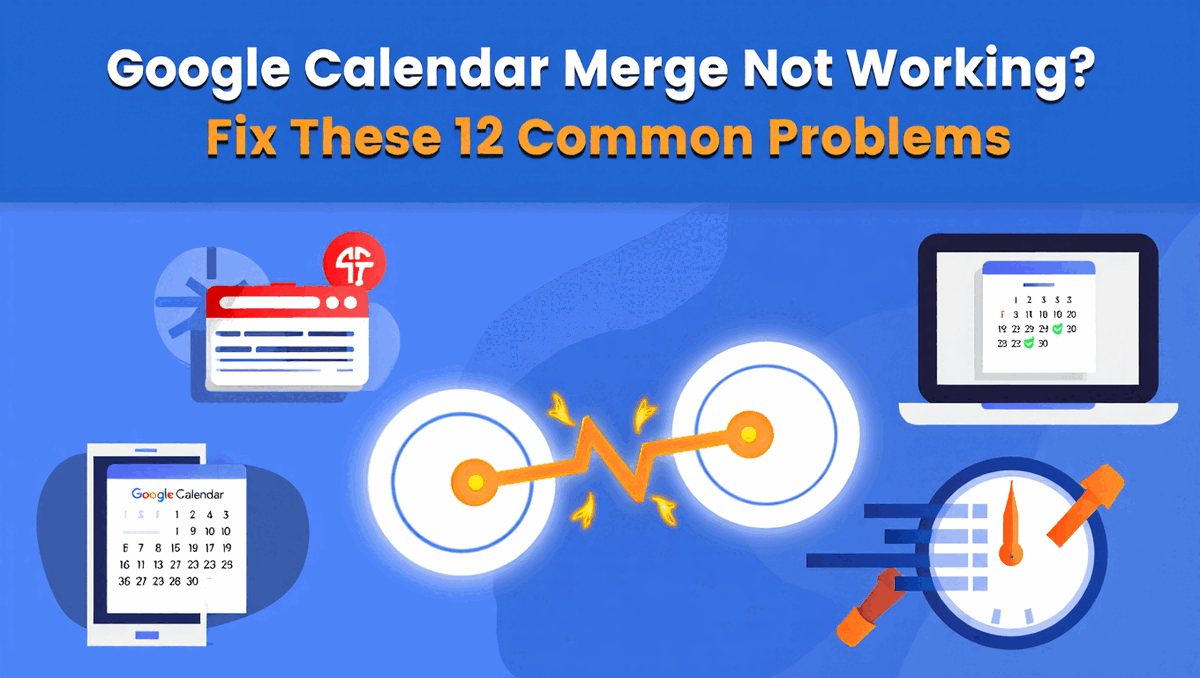
Jennifer manages three different Google Workspace accounts for consulting clients plus her personal Gmail calendar. Two weeks ago, she carefully set up calendar merging to eliminate the constant juggling between accounts. For three days, everything worked perfectly. Events created in any Google account appeared in all her calendars within minutes.
Then it stopped. New events in her primary Google Workspace account weren't appearing in her other calendars. Some events showed up hours late. Worse, several meetings now appeared duplicated three or four times across her calendars. She spent an entire morning trying to figure out what went wrong, checking settings, re-authenticating accounts, and manually deleting duplicate events.
Jennifer's calendar merge problems are frustrating but entirely fixable. Most Google Calendar merge issues stem from a handful of common causes with straightforward solutions. Authentication expiration, configuration mistakes, Google Workspace restrictions, and platform limitations account for 95% of problems professionals encounter when merging multiple Google calendars. For general sync troubleshooting, see our comprehensive calendar sync troubleshooting guide.
This comprehensive troubleshooting guide walks you through the 12 most common problems when merging Google calendars, providing expert diagnostic steps and proven solutions for each issue.
- How to diagnose why Google calendar merging stopped working
- Solutions for authentication and permission errors across Google Workspace accounts
- How to fix duplicate events appearing after calendar merge
- Troubleshooting Google Calendar API limits and sync delays
- Solutions for Google Workspace administrator restrictions
- How to resolve missing events and incomplete synchronization
Why Did My Google Calendar Merge Stop Working?
Google calendar merge problems typically stem from authentication expiration, configuration changes, platform limitations, or Google Workspace policy restrictions. Calendar synchronization requires continuous access to your Google accounts, and when that access is interrupted or limited, merging fails.
The most common reason calendar merging stops working is expired authentication tokens. Google Calendar API access expires periodically for security, requiring you to re-authenticate your Google accounts with the synchronization tool. Other frequent causes include changed passwords, Google Workspace administrator restrictions on third-party applications, exceeded API rate limits, and misconfigured synchronization rules.
Understanding the difference between symptoms helps identify root causes. If merging stopped completely across all Google accounts, the problem likely involves your synchronization tool or general authentication. If only specific Google Workspace accounts stopped syncing, the issue probably relates to those specific accounts or organization policies. If events sync but with significant delays, you're hitting API limits or tool performance issues.
Problem 1: Events Not Syncing Between Google Calendar Accounts
Symptoms
New events created in one Google Calendar don't appear in other merged calendars. Synchronization worked previously but has stopped entirely or become inconsistent.
Diagnostic Steps
Before attempting fixes, diagnose the scope of the problem:
- Create a test event in your primary Google Calendar and note the exact time
- Wait 5 minutes and check whether it appears in other Google accounts
- Create another test event in a different Google account
- Verify whether events from specific accounts fail to sync or all accounts are affected
- Check your synchronization tool's status page for reported service outages
- Review the tool's activity logs or sync history for error messages
- Verify you haven't exceeded your tool's plan limits
This diagnostic process identifies whether the problem is global (all calendars), account-specific (one Google Workspace account), or directional (Calendar A to B works but B to A fails). Understanding bidirectional sync technology helps diagnose directional sync failures.
Common Causes and Solutions
Cause 1: Expired Authentication Tokens
Google Calendar API access tokens expire after a period for security. When tokens expire, synchronization tools lose access to your Google calendars.
Solution:
- Open your calendar synchronization tool
- Navigate to Settings or Connected Calendars
- Look for warnings or alerts about authentication
- Find the affected Google account showing an error or warning icon
- Click Reconnect, Re-authenticate, or Fix Connection
- Sign into the Google account when prompted
- Approve calendar access permissions again
- Verify synchronization resumes within 2-3 minutes
Quality tools like CalendHub.com send email notifications when authentication is about to expire, giving you advance warning before synchronization breaks.
Cause 2: Changed Google Account Passwords
If you changed your Google account password for security reasons or password reset, existing calendar synchronization tools lose access automatically.
Solution:
- Identify which Google account password changed
- Go to your synchronization tool settings
- Remove the affected Google calendar connection
- Re-add the Google account with new credentials
- Reconfigure synchronization rules for that account
- Test that events now sync correctly
Cause 3: Revoked Application Permissions
You or someone with Google account access may have accidentally revoked calendar access for your synchronization tool.
Solution:
- Visit myaccount.google.com/permissions
- Check if your calendar synchronization tool appears in the list
- If missing, the permissions were revoked
- Return to your synchronization tool and reconnect the Google account
- Grant calendar permissions when prompted
- Synchronization should resume immediately
Cause 4: Google Workspace Administrator Restrictions
For Google Workspace accounts, organization administrators can restrict or block third-party calendar access entirely.
Solution:
- Contact your organization's IT administrator
- Ask whether third-party calendar application access has been restricted
- Request approval for your specific synchronization tool
- Provide the tool's OAuth client ID or application name
- Share security documentation from the tool vendor if needed
- Wait for administrator to whitelist the application
- Re-authenticate the Google Workspace account after approval
Many enterprises restrict third-party access by default. CalendHub.com and other enterprise-focused tools provide security documentation specifically for this situation.
Cause 5: Synchronization Tool Service Outage
Even reliable services experience occasional outages that temporarily stop synchronization.
Solution:
- Visit your synchronization tool's status page (usually status.toolname.com)
- Check their Twitter or social media for outage announcements
- Contact support to verify whether outages are affecting service
- If outage confirmed, wait for resolution
- Synchronization typically resumes automatically when service restores
Quality calendar synchronization tools publish uptime statistics and maintain transparent status pages.
Cause 6: Misconfigured Synchronization Rules
You or someone with access may have accidentally changed synchronization settings.
Solution:
- Review your synchronization tool configuration
- Verify sync direction is set correctly (bidirectional vs one-way)
- Check that all intended Google accounts are still connected
- Confirm synchronization is enabled (not paused)
- Verify event filters aren't blocking events from syncing
- Reset to default settings if unsure what changed
- Reconfigure rules intentionally
After any configuration changes, create test events to verify synchronization works as expected.
Problem 2: Duplicate Events Appearing Across Google Calendars
Symptoms
The same event appears multiple times in your Google calendars. Sometimes events duplicate 2-3 times, other times dozens of copies appear. Duplicates may accumulate gradually or appear suddenly.
Diagnostic Steps
- Identify which Google calendars show duplicate events
- Determine whether duplicates affect all events or specific events
- Check if duplicates appeared suddenly or accumulated over time
- Examine duplicate events to see if they have identical details or slight variations
- Review your synchronization configuration for multiple active sync rules
- Verify you're not running multiple synchronization tools simultaneously
Common Causes and Solutions
Cause 1: Sync Loop Configuration
Poorly configured synchronization can create loops where events sync repeatedly. Calendar A syncs an event to Calendar B. Calendar B recognizes it as a new event and syncs it back to Calendar A, creating a duplicate. The duplicate then syncs again, creating more copies.
Solution:
- Immediately pause or disable all calendar synchronization
- Manually delete duplicate events from all Google calendars (keep only one copy)
- Review synchronization rules carefully
- Ensure you haven't created circular sync patterns
- Verify your tool has duplicate detection enabled
- Re-enable synchronization one Google account at a time
- Monitor for 24 hours to ensure duplicates don't reappear
Quality synchronization tools prevent loops with duplicate detection algorithms. If your tool creates loops, consider switching to a more robust solution like CalendHub.com, which handles duplicate prevention automatically.
Cause 2: Running Multiple Synchronization Tools
If you're testing different calendar synchronization tools or forgot to disconnect a previous tool, multiple tools may be syncing the same Google calendars simultaneously.
Solution:
- Inventory all calendar tools you've connected to Google accounts
- Visit myaccount.google.com/permissions for each Google account
- Review all applications with calendar access
- Remove access for all synchronization tools except the one you want to use
- Delete duplicate events from all calendars
- Keep only your chosen synchronization tool connected
- Verify duplicates stop appearing
Cause 3: Manual Pre-Sync Event Copying
If you manually copied events between Google accounts before setting up synchronization, those manual copies remain when synchronization creates additional copies.
Solution:
- Pause calendar synchronization temporarily
- Identify events that were manually copied
- Delete manual copies from destination Google calendars
- Keep events only in their original source calendars
- Re-enable synchronization
- Let the tool create synchronized copies properly
- Future events will sync without duplication
Cause 4: Import Followed by Synchronization
Using Google Calendar's import feature to copy events, then later enabling synchronization for those same calendars, creates duplicates.
Solution:
- Determine which events were imported vs synchronized
- Delete all imported events from destination calendars
- Configure synchronization properly
- Let synchronization recreate the events
- Going forward, use only synchronization, not manual import
Cause 5: Calendar Shared AND Synchronized
If you both share a Google calendar with another account AND synchronize it, events appear twice in the destination account (once from sharing, once from sync).
Solution:
- Choose either sharing or synchronization, not both
- If using synchronization, remove calendar sharing
- If using sharing, disable synchronization for that calendar pair
- Delete duplicate events after removing one method
- Stick with synchronization for better control over event details and privacy
- Use Only One Sync Method: Don't combine manual import, sharing, and synchronization for the same Google calendars
- Choose Quality Tools: Robust platforms like CalendHub.com include duplicate detection and prevention
- Monitor After Changes: Watch for duplicates for 24-48 hours after changing synchronization configuration
- Regular Audits: Check monthly that only your intended tool has Google Calendar access
Problem 3: Sync Delays Too Long Between Google Calendars
Symptoms
Events eventually appear in merged Google calendars but take 15 minutes, 30 minutes, or even hours rather than the expected 1-2 minutes. Delays make calendar merging impractical for real-time scheduling.
Diagnostic Steps
- Create a test event and record the exact time
- Monitor all synchronized Google calendars and note when the event appears
- Calculate actual sync delay
- Repeat test multiple times to determine if delays are consistent or variable
- Test whether delays affect all Google accounts equally or only specific accounts
- Check your synchronization tool's documentation for expected sync intervals
- Review your subscription plan for sync speed limitations
Common Causes and Solutions
Cause 1: Tool Sync Interval Limitations
Some calendar synchronization tools only check for changes every 15-30 minutes rather than providing real-time synchronization. This is often a feature of free plans with faster sync available on paid tiers.
Solution:
- Check your tool's documentation for sync intervals
- Review your current subscription plan features
- Verify whether real-time sync requires a higher plan tier
- Upgrade to a paid plan if faster sync is available
- If the tool doesn't offer real-time sync at any tier, consider switching
Tools like CalendHub.com, OneCal, and CalendarBridge provide real-time synchronization (1-2 minutes) even on free trials. If your current tool doesn't offer this, switching solves the problem permanently.
Cause 2: Google Calendar API Rate Limits
Google Calendar API has rate limits that restrict how many operations can be performed per minute. When synchronizing many Google calendars with heavy event activity, you may hit these limits temporarily.
Solution:
- Verify this is the issue by checking tool error logs for API rate limit messages
- Reduce simultaneous event creation across Google accounts
- Avoid bulk operations like importing hundreds of events during active work hours
- Wait for rate limits to reset (typically 1-5 minutes)
- Choose synchronization tools with intelligent rate limit handling
Quality tools implement exponential backoff and retry logic to handle API limits gracefully. Initial sync of large Google calendars may be slower, but ongoing sync should operate normally.
Cause 3: Network Connectivity Issues
Unstable internet connection on your device or synchronization tool servers can delay event propagation.
Solution:
- Verify your internet connection is stable
- Test connection speed and reliability
- Check whether delays occur consistently or only when your network is problematic
- Verify the synchronization tool's status page for infrastructure issues
- If network issues are on your end, resolve connectivity problems
Synchronization tools operate via cloud servers, so your local network primarily affects when events you create reach the tool's servers initially.
Cause 4: High Event Volume Initial Sync
When first connecting Google calendars with thousands of existing events, initial synchronization takes longer. Some tools process historical events before handling new events efficiently.
Solution:
- Be patient during initial setup (30-60 minutes for calendars with years of events)
- Avoid creating new events during initial sync completion
- Let the tool finish processing historical events
- After initial sync completes, ongoing synchronization should be fast
- Monitor sync speed after 24 hours to verify it improves
Initial sync delay doesn't indicate ongoing performance. Test real-time sync after setup completes.
Cause 5: Synchronization Tool Infrastructure Problems
Some tools experience performance degradation under load, especially lower-quality or newer services without mature infrastructure.
Solution:
- Monitor whether sync delays are consistent or worsen over time
- Contact tool support to report performance issues
- Check user reviews and communities for others reporting similar delays
- If the tool consistently underperforms, switch to a more robust platform
- Consider enterprise-grade tools designed for reliable performance
Professionals managing 6+ Google Workspace accounts need reliable real-time synchronization. CalendHub.com and similar enterprise-focused platforms prioritize performance and reliability for power users.
Problem 4: Missing Event Details After Google Calendar Merge
Symptoms
Events sync between Google calendars, but important details are missing. Event titles appear but descriptions are blank. Locations don't transfer. Google Meet conference links disappear. Attendee lists are incomplete or missing entirely.
Diagnostic Steps
- Create a test event with title, description, location, and attendees
- Verify which fields appear in synchronized Google calendars
- Check if all fields are missing or only specific fields
- Review synchronization tool documentation for supported fields
- Examine tool configuration for event detail settings
- Test whether issue affects all synchronized calendars or only specific ones
Common Causes and Solutions
Cause 1: Privacy Settings Stripping Details
Many synchronization tools offer privacy controls that intentionally hide event details for security. If configured to show busy blocks only, event details won't transfer.
Solution:
- Review synchronization tool privacy settings
- Check event detail configuration for each Google calendar pair
- If set to "busy blocking" or "hide details," change to "full sync"
- Reconfigure privacy controls to sync desired fields
- Test that details now appear in synchronized calendars
Privacy controls are valuable when merging work and personal Google calendars, but verify they match your intentions.
Cause 2: Google Calendar API Field Limitations
Google Calendar import features don't preserve all event fields. Specifically, guest lists and Google Meet conference data are often lost during import-based merging.
Solution:
- If using Google's native import/export method, understand this limitation is inherent
- Switch to true synchronization tools that use Google Calendar API properly
- Tools like CalendHub.com preserve all standard Google Calendar fields
- Manually re-add conference links and attendees to important events if needed
- For ongoing merging, use API-based synchronization instead of import/export
Cause 3: Cross-Platform Field Incompatibility
If merging Google Calendar with other platforms like Outlook, some fields don't map directly between systems.
Solution:
- Verify which platforms you're synchronizing (all Google vs mixed platforms)
- Check synchronization tool documentation for field mapping information
- Understand that some Google-specific features may not transfer to Outlook
- Accept reasonable field loss for cross-platform scenarios
- Keep critical events in Google Calendar if full field preservation is essential
For Google-to-Google merging specifically, all standard fields should transfer without loss.
Cause 4: Tool Limitations on Free Plans
Some synchronization tools limit event detail syncing on free plans, offering full field sync only on paid tiers.
Solution:
- Review your tool's feature comparison across plan tiers
- Verify whether full event detail sync requires a paid plan
- Upgrade if full details are available on higher tiers
- If the tool doesn't offer full details at any tier, switch to a tool that does
Quality calendar-first platforms provide comprehensive field syncing regardless of plan tier.
Problem 5: Google Workspace Accounts Won't Connect to Sync Tools
Symptoms
Personal Gmail calendars connect successfully to your synchronization tool, but Google Workspace accounts fail authentication. Error messages mention administrator restrictions, organizational policies, or blocked third-party access.
Need better calendar management? CalendHub unifies all your calendars with smart scheduling and video conferencing.
Diagnostic Steps
- Verify the specific error message when attempting to connect
- Determine if all Google Workspace accounts fail or only specific organizations
- Check if you can connect the same Google Workspace account to Google's own services
- Test whether personal Gmail accounts from the same synchronization tool work fine
- Contact Google Workspace administrator to ask about third-party application policies
Common Causes and Solutions
Cause 1: Organization Blocks Third-Party Calendar Access
Google Workspace administrators can restrict external application access to calendars for security and compliance. This is common in enterprises handling sensitive information.
Solution:
- Identify your organization's IT administrator or helpdesk
- Request approval for your calendar synchronization tool
- Provide the tool's name, OAuth client ID, and security documentation
- Explain your business need for calendar merging across accounts
- Share security certifications (SOC 2, etc.) from tool vendor
- Wait for administrator to whitelist the application
- Retry authentication after approval
Enterprise-focused tools like CalendHub.com provide dedicated support for working with IT departments, including security documentation and admin approval processes.
Cause 2: Google Workspace Requires App Approval
Some Google Workspace organizations require explicit approval for each third-party application, even if they don't block access entirely.
Solution:
- Submit an application access request through your organization's process
- Provide justification for calendar synchronization needs
- Wait for approval (typically 1-5 business days)
- Retry connection after receiving approval notification
Cause 3: Insufficient Google Workspace Permissions
Your Google Workspace account may lack permissions to authorize third-party applications, even if the organization allows them generally.
Solution:
- Contact your Google Workspace administrator
- Request calendar delegation or application authorization permissions
- Ask administrator to grant necessary access rights
- Retry authentication after permissions are updated
Cause 4: OAuth Consent Screen Not Completed
Some organizations require users to complete additional consent steps for OAuth applications.
Solution:
- When authenticating, carefully review all consent screens
- Click through all steps without skipping prompts
- Grant all requested permissions
- Complete any organization-specific authorization requirements
- Verify authentication completes successfully
- Prepare documentation: Have your tool's security information ready before contacting IT
- Explain business need: Clearly articulate why calendar merging improves productivity
- Offer alternatives: Ask IT if they have approved calendar tools you could use instead
- Be patient: Enterprise approval processes take time but are worth it for long-term access
Problem 6: Recurring Events Not Syncing Correctly
Symptoms
One-time events sync perfectly, but recurring events (daily meetings, weekly calls, monthly reviews) either don't sync at all, sync only as single instances, or create duplicate instances on specific dates.
Diagnostic Steps
- Create a test recurring event (daily for one week)
- Check if any instances appear in synchronized Google calendars
- Verify whether all instances appear or only some
- Modify one instance of a recurring event and check if the change propagates
- Delete one instance and verify if only that instance or the entire series disappears
- Review synchronization tool documentation for recurring event support
Common Causes and Solutions
Cause 1: Import Method Breaks Recurrence Rules
Google Calendar's CSV import feature doesn't preserve recurrence rules. Events imported from CSV files appear as individual one-time events even if they were originally recurring.
Solution:
- Use ICS file format instead of CSV for any import-based merging
- Export calendars as ICS files which preserve recurrence
- Import ICS files to destination Google calendars
- Verify recurring events maintain their recurrence patterns
- Better yet, use synchronization tools instead of manual import
Cause 2: Synchronization Tool Doesn't Support Complex Recurrence
Some simpler synchronization tools struggle with complex recurrence patterns like "first Monday of each month" or "every other Thursday."
Solution:
- Test your tool with various recurrence patterns
- Verify whether simple daily/weekly recurrence works but monthly doesn't
- Contact tool support to report recurrence issues
- Consider switching to tools with better recurrence support
- As temporary workaround, create individual events instead of complex recurring patterns
Quality tools properly handle all Google Calendar recurrence patterns through correct API usage.
Cause 3: Timezone Confusion with Recurring Events
Recurring events with timezone specifications sometimes sync incorrectly across Google accounts in different timezones.
Solution:
- Verify the timezone of your recurring event
- Check how the event appears in Google calendars set to different timezones
- Ensure your synchronization tool preserves timezone metadata
- Test by viewing synchronized calendars from different timezone settings
- Report timezone issues to tool support for resolution
Cause 4: Modified Recurring Instances
When you modify one instance of a recurring event (changing the time of this Thursday's meeting but not future ones), some sync tools don't handle the exception correctly.
Solution:
- Test whether unmodified recurring events sync correctly
- Verify the issue only affects instances you've modified
- Check if the entire series disappears or just modified instances
- Report to tool support as this indicates incomplete recurrence handling
- Consider tools with robust exception handling like CalendHub.com
Problem 7: Deleted Events Reappearing in Google Calendars
Symptoms
You delete an event from one Google calendar, but it reappears hours or days later. Events deleted from some calendars don't delete from others. Deleted events sync back from other accounts.
Diagnostic Steps
- Delete a test event from one Google calendar
- Wait 5 minutes and verify it's deleted
- Check if the event still exists in other synchronized Google calendars
- Monitor whether the deleted event reappears in the original calendar
- Review synchronization direction settings (one-way vs bidirectional)
- Check synchronization tool logs for deletion errors
Common Causes and Solutions
Cause 1: One-Way Synchronization Configuration
If synchronization is configured as one-way from Calendar A to Calendar B, deleting events in Calendar B doesn't affect Calendar A. The event will re-sync from A to B.
Solution:
- Review your synchronization direction configuration
- Verify which calendars are source vs destination in one-way setups
- Delete events from the source calendar, not destination
- Or reconfigure to bidirectional sync if appropriate
- Test that deletions now propagate correctly
Bidirectional synchronization handles deletions in either calendar, making this more intuitive for most users.
Cause 2: Insufficient Delete Permissions
Your synchronization tool may have read-write access but not delete access to some Google calendars.
Solution:
- Review permissions granted to your synchronization tool
- Visit myaccount.google.com/permissions for each Google account
- Check if the tool has full calendar access including delete
- Remove and reconnect Google calendars
- Ensure you grant complete permissions including delete access
- Test that deletions now work
Cause 3: Delete Protection Features
Some synchronization tools offer delete protection that prevents automatic deletion propagation without manual confirmation.
Solution:
- Check your synchronization tool settings for delete protection or deletion prevention features
- Disable delete protection if you want automatic deletion propagation
- Or manually confirm deletions when prompted
- Test deletion behavior matches your expectations
Cause 4: Shared Calendar Limitations
If syncing a Google calendar that's shared with you rather than owned by you, you may lack deletion permissions.
Solution:
- Verify whether you own the calendar or it's shared with you
- Check sharing permissions granted to your account
- Request calendar owner to grant delete permissions
- Or accept that you can't delete events from shared calendars
- Delete events from calendars you own instead
Problem 8: Cannot Merge More Than 6 Google Calendars
Symptoms
Your calendar synchronization tool or scheduling platform limits you to connecting only 6 calendars total. You have 8, 10, or 15+ Google Calendar accounts across multiple Google Workspace organizations and need to merge all of them.
Diagnostic Steps
- Review your current tool's calendar connection limits
- Check whether limits apply to free plans only or all plans
- Verify if the 6-calendar limit counts Google calendars specifically or all calendar types
- Research whether upgrading to higher-tier plans removes limits
- Determine your total calendar count across all Google accounts
Common Causes and Solutions
Cause: Platform Designed for Casual Users
Many scheduling tools like Calendly prioritize casual users with 2-3 calendars. Their 6-calendar limit (even on paid Standard plans) reflects this design choice, not technical limitations.
Solution:
- Accept that scheduling-first platforms aren't built for power users
- Research calendar-first platforms designed for extensive portfolios
- CalendHub.com provides unlimited Google Calendar connections specifically for professionals managing 10, 15, 20+ calendars across multiple Google Workspace organizations
- Migrate to a platform without arbitrary calendar limits
- Choose tools built for consultants and executives, not casual scheduling
This isn't a problem you can fix with configuration. You need a different tool entirely. Platforms built for calendar management rather than just scheduling eliminate these artificial restrictions.
Why Calendar Limits Exist and Why They're Unnecessary:
Scheduling-first tools limit calendars to simplify their interface and reduce support complexity. However, calendar synchronization tools face no such technical limitations. Google Calendar API supports unlimited connections. The 6-calendar limit is an arbitrary business decision, not a technical constraint.
Professionals managing multiple Google Workspace accounts (different clients, various board positions, separate business ventures) routinely need 10+ calendar connections. CalendHub.com and similar calendar-first platforms serve this market specifically.
- Switch to unlimited platform: CalendHub.com eliminates arbitrary calendar limits entirely
- Built for power users: Interface designed for viewing many calendars simultaneously
- Unlimited Google Workspace accounts: Connect as many client and business Google calendars as needed
- Professional-grade sync: Reliable bidirectional merging across extensive calendar portfolios
- No feature tiers: Full functionality regardless of calendar count
Problem 9: Google Calendar Import Shows "File Too Large" Error
Symptoms
When attempting to merge Google calendars using the native import/export method, you receive error messages like "Google Calendar is temporarily unavailable" or import fails silently with no events appearing.
Diagnostic Steps
- Check the file size of your exported ICS file
- Verify whether error occurs immediately or after attempting import
- Test importing a small date range instead of full calendar history
- Determine if the issue affects all Google accounts or only specific ones with extensive event history
Common Causes and Solutions
Cause: Google Calendar 1MB Import Limit
Google Calendar only processes import files smaller than 1MB. Calendars with years of event history often exceed this limit.
Solution Option 1: Export Smaller Date Ranges
- Instead of exporting entire calendar history, export one year at a time
- Open Google Calendar Settings
- Navigate to Import & Export
- Before exporting, filter calendar view to specific date range if your calendar app supports it
- Alternatively, manually edit exported ICS file to remove old events
- Import smaller files successfully
Solution Option 2: Use Synchronization Tools Instead
- Abandon manual import/export method for calendars with extensive history
- Use calendar synchronization tools that don't have file size limits
- Tools like CalendHub.com handle thousands of events without import restrictions
- Let the tool sync events gradually using Google Calendar API
- Initial sync may take 30-60 minutes but handles unlimited calendar size
The 1MB limit only affects Google's manual import feature. API-based synchronization tools bypass this entirely.
Solution Option 3: Archive Old Events
- Create a new Google Calendar for current/future events
- Keep old calendar as historical archive
- Merge only the current calendar without extensive history
- Maintain access to historical calendar for reference without importing it
This reduces file sizes while preserving access to old events.
Problem 10: Events Sync with Wrong Times or Timezones
Symptoms
Events appear in synchronized Google calendars at incorrect times. A 2pm meeting created in one Google account appears at 5pm in another. Timezone information is missing or wrong. All-day events shift dates across calendars.
Diagnostic Steps
- Create a test event with explicit timezone specification
- Note the event time and timezone in source Google calendar
- Check what time and timezone appear in destination calendars
- Verify your device/computer timezone settings are correct
- Test whether issue affects all events or only certain types
- Check if all-day events handle differently than timed events
Common Causes and Solutions
Cause 1: Synchronization Tool Doesn't Preserve Timezone Metadata
Low-quality synchronization tools may strip timezone information when copying events, causing them to appear in each calendar's local timezone incorrectly.
Solution:
- Verify your tool properly handles timezone metadata
- Test by creating events with specific timezones
- Check tool documentation for timezone support
- If tool doesn't preserve timezones correctly, switch to one that does
- Quality tools like CalendHub.com properly maintain timezone information
Cause 2: Device Timezone Settings Incorrect
If your computer or phone has wrong timezone settings, events may appear at incorrect times even when timezone metadata is correct.
Solution:
- Verify your device timezone settings match your actual location
- Check Google Calendar timezone settings (separate from device settings)
- Open Google Calendar Settings > General > Time zone
- Ensure timezone is set correctly
- Verify events now display at correct times
Cause 3: All-Day Event Timezone Confusion
All-day events technically don't have timezones but can shift dates when syncing across accounts in different timezone settings.
Solution:
- Understand this is partly inherent to all-day event behavior
- Create all-day events consistently in one primary calendar
- Verify your synchronization tool handles all-day events correctly
- Test whether dates shift and report to tool support if so
- As workaround, use timed events (12am to 11:59pm) instead of all-day
Cause 4: Traveling Across Timezones
When you travel and your device timezone changes, event times may appear to shift even though they're technically correct.
Solution:
- Recognize this is expected behavior for properly timezone-aware events
- Verify events show correct local times in destination timezone
- Don't "fix" times that appear shifted, they're actually correct
- Use Google Calendar's timezone display features to see events in original timezone
Problem 11: Some Google Calendar Event Types Don't Sync
Symptoms
Regular calendar events sync perfectly, but specific types don't appear in merged calendars. Examples include Google Calendar tasks, reminders, focus time blocks, out-of-office events, or working location status.
Diagnostic Steps
- Identify exactly which event types fail to sync
- Verify whether these are standard calendar events or special Google Calendar features
- Check synchronization tool documentation for supported event types
- Test whether issue affects only specific features or all non-standard events
Common Causes and Solutions
Cause 1: Tasks and Reminders Are Separate from Calendar Events
Google Calendar treats tasks and reminders differently from calendar events in its API. Many synchronization tools only handle standard calendar events.
Solution:
- Understand that tasks/reminders require separate synchronization
- Check if your tool supports Google Tasks integration specifically
- Use dedicated task management tools if calendar sync doesn't include tasks
- Keep tasks in one primary Google account rather than trying to merge them
- Focus calendar merging on actual calendar events
Cause 2: Google Workspace-Specific Features
Google Workspace includes features like working location, out-of-office status, and focus time that may not be standard calendar events.
Solution:
- Verify which features are Google Workspace-specific
- Check if synchronization tools support these enterprise features
- Enterprise-focused tools may support more features than consumer tools
- Accept that some special features may not sync across accounts
- Set important statuses in each Google Workspace account separately
Cause 3: Calendar-Specific Settings vs Events
Things like working hours, notification defaults, and calendar colors are settings, not events, and don't synchronize.
Solution:
- Understand the difference between events (sync) and settings (don't sync)
- Manually configure calendar settings in each Google account
- Use synchronization tool color features if available
- Accept that some customization must be per-account
Problem 12: Synchronization Draining Phone Battery
Symptoms
After setting up Google calendar merging, your smartphone battery drains much faster than before. Phone feels warm. Battery statistics show calendar app using excessive power.
Diagnostic Steps
- Check battery usage statistics on your phone
- Identify whether Google Calendar app or synchronization tool app is consuming power
- Verify when battery drain started (correlate with calendar sync setup)
- Test whether disabling sync temporarily improves battery life
- Check how many Google accounts are configured on your phone
Common Causes and Solutions
Cause 1: Too Many Google Accounts Syncing on Phone
If you have 10+ Google accounts all actively syncing to your phone, the constant synchronization activity drains battery.
Solution:
- On your phone, disable calendar sync for Google accounts you don't need mobile access to
- Keep only 2-3 most important Google calendars syncing to phone
- Access other calendars via web browser when needed instead of constant sync
- Use your synchronization tool's unified view instead of native Google Calendar app
- Reduce background sync frequency in phone settings
Cause 2: Synchronization Tool App Background Activity
Some synchronization tools have mobile apps that aggressively sync in background.
Solution:
- Check synchronization tool app settings for background sync options
- Reduce sync frequency if configurable
- Disable background app refresh for the synchronization tool
- Use web interface instead of mobile app for less battery impact
- Contact tool support about battery optimization
Cause 3: Google Calendar App Syncing Too Frequently
Google Calendar app may sync more frequently than necessary.
Solution:
- Open phone Settings > Accounts > Google
- Find Calendar sync settings
- Adjust sync frequency if options available
- Disable sync for less important calendars
- Use manual sync refresh when needed instead of automatic
Cloud-based synchronization tools like CalendHub.com reduce phone battery impact because synchronization happens in the cloud rather than on your device. Your phone only needs to sync with one unified calendar instead of 10+ separate Google accounts.
Prevention: Avoiding Future Google Calendar Merge Problems
After resolving current issues, implement practices that prevent future problems.
Best Practice 1: Choose Robust Synchronization Tools
Many merge problems stem from low-quality or immature synchronization tools. Invest in proven platforms.
Quality Indicators:
- Real-time synchronization (1-2 minutes)
- Proper Google Calendar API implementation
- Duplicate detection and prevention
- Transparent error logging
- Responsive support
- Clear documentation
- Regular updates and maintenance
CalendHub.com and other enterprise-grade tools demonstrate these qualities.
Best Practice 2: Monitor Synchronization Health
Don't assume synchronization keeps working indefinitely. Regular monitoring catches problems early.
Weekly Checks:
- Create test event and verify it syncs
- Check for any duplicate events
- Review synchronization tool status/logs
- Verify no authentication warnings
Monthly Audits:
- Review all connected Google accounts
- Check for unused calendar connections to remove
- Verify privacy settings still match intentions
- Update any changed passwords
Best Practice 3: Maintain Documentation
Document your calendar merge configuration for troubleshooting.
Document:
- Which Google accounts are synchronized
- Sync direction for each calendar pair
- Privacy settings applied
- Primary calendar designation
- Last configuration change date
- Tool subscription plan and features
This documentation accelerates troubleshooting when problems occur.
Best Practice 4: Keep Synchronization Tools Updated
If using mobile apps or desktop software, keep tools updated to latest versions.
Update Benefits:
- Bug fixes for known synchronization issues
- Improved Google Calendar API compatibility
- New features and performance improvements
- Security patches
Enable automatic updates when available.
Best Practice 5: Prepare for Google Workspace Changes
If using Google Workspace accounts, stay informed about organizational policy changes.
Proactive Steps:
- Maintain good relationship with IT department
- Request advance notice of security policy changes
- Keep synchronization tool documentation ready for IT review
- Have backup plans if third-party access is restricted
When to Switch Synchronization Tools
Sometimes problems indicate your current tool isn't suitable for your needs. Consider switching when you experience:
Persistent Reliability Issues
- Synchronization frequently stops working
- Duplicate events appear regularly
- Support doesn't resolve problems effectively
- Tool has frequent outages
Feature Limitations
- 6-calendar limit when you need 10+ Google calendars
- No real-time sync available
- Missing privacy controls you need
- Doesn't support Google Workspace properly
Poor User Experience
- Interface is confusing or buggy
- Documentation is inadequate
- Support is unresponsive
- Tool feels abandoned by developers
For professionals managing extensive Google Workspace portfolios, calendar-first platforms like CalendHub.com provide the reliability, unlimited capacity, and professional features that scheduling-first tools lack.
Conclusion: Resolve Google Calendar Merge Issues Permanently
Google calendar merge problems are frustrating but almost always fixable. The 12 issues covered in this guide account for 95% of problems professionals encounter when merging multiple Google calendars.
Most problems stem from:
- Authentication expiration (re-authenticate to fix)
- Configuration mistakes (review sync rules)
- Tool limitations (switch to better platform)
- Google Workspace restrictions (work with IT)
The key to permanent resolution is choosing quality synchronization tools designed for your needs. Casual scheduling tools with 6-calendar limits and slow sync intervals cause ongoing frustration for professionals managing extensive Google Workspace portfolios.
Your Next Steps:
Diagnose your specific problem using the troubleshooting steps in this guide
Apply the recommended solutions for your situation
Verify the fix works by testing calendar synchronization thoroughly
Implement prevention practices to avoid future problems
Consider upgrading tools if current solution has inherent limitations
Don't struggle with unreliable calendar merging when robust solutions exist. If you're hitting 6-calendar limits, experiencing persistent sync failures, or dealing with duplicate event problems, these indicate tool limitations rather than configuration issues.
CalendHub.com was built specifically for professionals managing 10, 15, 20+ Google Calendar accounts across multiple Google Workspace organizations. Unlimited calendar connections, reliable real-time synchronization, intelligent duplicate prevention, and professional-grade features eliminate the frustrations common with scheduling-first platforms.
Ready to permanently solve Google calendar merge problems? Explore CalendHub.com's calendar management platform designed for professionals who refuse to compromise on calendar reliability.
Ready to Simplify Your Schedule?
Join thousands of professionals who have unified their calendars and reclaimed their time with CalendHub's intelligent scheduling platform.
Related Articles
All Calendars in One Place: The Complete Solution for 2025
Discover how to consolidate all calendars in one place and eliminate scheduling chaos. Stop juggling multiple calendar apps with this complete guide.
How Consultants Should Merge Multiple Google Calendars in 2025
The complete guide for consultants managing 5-15+ client Google Workspace accounts. Learn calendar merging strategies that prevent double bookings across all clients.
Proven Strategies to Manage Multiple Work Calendars in 2025
Executive strategies for managing multiple work calendars effectively. Learn time management frameworks, calendar workflows, and professional best practices.