
 Google Calendar
  Outlook Calendar
  Google Meet
  Microsoft Teams
  Zoom Meetings
 Unified Calendar View Benefits: 200+ Hours Saved Annually
Discover how unified calendar view eliminates 200+ hours of wasted time annually. Complete ROI analysis for consultants, executives, and fractional leaders.
Jennifer is a fractional CFO serving five companies simultaneously. Each company provided her with their own calendar system to track meetings and commitments. Two use Google Workspace. Two use Microsoft 365. One uses an obscure calendar platform she had never heard of before. That's five separate calendars across three different platforms, plus her personal calendar for family commitments.
Her daily routine starts at 5:00 AM. Not with strategic financial analysis. Not with reviewing financial reports. With calendar reconciliation. She opens the first company's Google Calendar and screenshots today's schedule. She switches to the second company's account and screenshots that calendar. She opens Outlook for the third and fourth companies. She logs into the obscure platform for the fifth company. She opens her personal iCloud calendar. By 5:30 AM, she has six screenshots laid out on her desk, manually creating a master schedule on a legal pad.
Last quarter, this system failed catastrophically. She accepted a board meeting with Company A at 3 PM because that calendar showed availability. What she didn't realize was Company B had scheduled a crucial financial review at the same time two days earlier. Both meetings were critical. Both CEOs expected her full attention. She attempted to attend both simultaneously via separate video calls, splitting her attention, and delivering subpar performance to both clients.
One client terminated the fractional engagement. She lost $72,000 in annual recurring revenue because fragmented calendars caused a preventable double booking.
This is the hidden cost of calendar fragmentation. Not just wasted time. Not just inconvenience. Real business losses measured in tens of thousands of dollars. Damaged professional reputation. Lost client relationships. Preventable failures that compound over time.
Jennifer needs unified calendar view. The business case isn't subtle. The ROI is measurable, substantial, and immediate.
- The quantified cost of calendar fragmentation for professionals managing 10+ calendars
- How unified calendar view delivers 200+ hours of annual productivity gains
- The business impact of double bookings on client retention and revenue
- ROI analysis showing unified calendar view pays for itself within weeks
- Why consultants, executives, and fractional leaders can't afford fragmented calendars
- The competitive advantage unified calendar view provides in professional services
The Real Cost of Calendar Fragmentation
Calendar fragmentation isn't a minor inconvenience. It's a quantifiable business problem with measurable costs that compound daily. Understanding the true cost builds the business case for unified calendar view implementation.
Time Waste Compounds to 200+ Annual Hours
Recent research from 2024 reveals that 70% of workers lose 20 hours per week chasing information across fragmented systems. For calendar management specifically, professionals managing multiple calendars spend an average of 4.2 hours weekly on calendar-related tasks including checking multiple calendars for availability, preventing double bookings through manual cross-referencing, reconciling conflicts between calendars, manually copying events between calendars, and coordinating schedules across fragmented systems.
That's 4.2 hours per week. Multiply by 50 working weeks annually, and calendar fragmentation consumes 210 hours per year. That's more than five full 40-hour work weeks wasted on calendar management instead of productive work.
For consultants billing $200 per hour, that's $42,000 in lost billable time annually. For executives earning $150,000 annually, that's approximately $15,000 in wasted compensation. For fractional leaders serving multiple organizations, the cost multiplies across each client relationship.
Unified calendar view eliminates 70-90% of this time waste by consolidating all calendars into a single dashboard. Instead of checking 10 separate calendars, you check one unified view. Instead of manually reconciling conflicts across systems, the unified view shows all commitments simultaneously. Instead of spending 4.2 hours weekly, you spend 30-45 minutes. The time savings are immediate and recurring.
Productivity Loss from Context Switching
Time waste from calendar checking represents only direct cost. The indirect cost comes from context switching. Research demonstrates that context switching reduces productivity by 40% compared to focused work. Every time you switch from one calendar system to another, you lose focus, increase cognitive load, and reduce effectiveness.
Professionals managing five calendars across three platforms switch contexts constantly. Open Google Calendar for clients using Google Workspace. Switch to Outlook for clients using Microsoft 365. Switch to iCloud for personal calendar. Switch back to Google but different account for another client. Each switch carries a productivity penalty.
Studies show that 45% of workers report their meeting calendars are overbooked, and they spend 31 hours monthly on unproductive meetings. Much of this meeting dysfunction stems from poor calendar coordination caused by fragmented visibility. When you can't see your complete schedule, you over-commit, create conflicts, and reduce overall meeting effectiveness.
Unified calendar view eliminates context switching by consolidating all calendars into one interface. You maintain continuous focus on comprehensive availability without platform switching. The productivity gain from eliminating context switching compounds the direct time savings, creating total productivity improvement of 50-60% for calendar-related work.
Double Bookings Cause Direct Revenue Loss
Double bookings aren't minor scheduling embarrassments. They're business failures with direct financial consequences. When consultants double book client meetings, they face immediate problems such as attending neither meeting effectively, damaging both client relationships, sending signals of disorganization and unprofessionalism, forcing rescheduling that wastes everyone's time, and losing credibility that directly impacts contract renewal.
The financial impact is measurable. Research shows that customer acquisition costs 5-25 times more than customer retention. When double bookings damage client relationships enough to cause churn, the revenue impact includes lost revenue from the terminated client relationship, increased acquisition costs to replace lost clients, damage to professional reputation affecting referral business, and opportunity cost of time spent on client recovery instead of productive work.
For Jennifer's fractional CFO business, one double booking led to client termination costing $72,000 annually. Even if she immediately replaces that client, acquisition costs and onboarding time represent thousands in additional expenses. Multiple double bookings compound this damage exponentially.
Unified calendar view prevents double bookings by showing comprehensive availability across all calendars simultaneously. You can't accidentally book conflicting meetings when you see all commitments in one consolidated view. The double booking prevention alone often justifies unified calendar view implementation through avoided revenue loss.
Mental Load Reduces Strategic Capacity
Calendar fragmentation creates constant cognitive burden. You can't confidently commit to new meetings without mentally combining information from multiple calendar sources. You constantly worry about whether you've checked all calendars. You second-guess whether conflicts exist. This mental load is exhausting and reduces capacity for strategic thinking.
Research indicates that 91% of workers believe better time management would reduce workplace stress. For professionals managing fragmented calendars, the stress comes not from time scarcity but from time tracking complexity. You have mental capacity available, but it's consumed by calendar management overhead instead of strategic work.
The cognitive burden manifests as decision fatigue (each scheduling decision requires checking multiple sources, exhausting mental energy), reduced strategic focus (mental energy spent on calendar management isn't available for strategic thinking), increased anxiety and stress (constant worry about missed calendars or hidden conflicts), and burnout acceleration (cognitive overload compounds over time, contributing to professional burnout).
Unified calendar view eliminates this mental tax by providing a single source of truth. You check one dashboard and confidently understand your complete availability. The cognitive relief is immediate and substantial. Professionals report significant stress reduction and improved strategic focus within days of implementing unified calendar view.
Professional Reputation Damage Accumulates
Calendar chaos damages professional reputation in ways that compound over time. When clients notice frequent rescheduling, confusion about availability, double bookings, or last-minute meeting changes, they question your organizational capability and professional reliability.
Professional services businesses depend heavily on reputation and referrals. Studies show that 84% of B2B buyers start the purchasing process with a referral, and 91% of B2B buyers are influenced by word-of-mouth when making purchasing decisions. Calendar chaos creates negative word-of-mouth that directly impacts business development.
The reputation damage manifests as reduced referral rates (clients hesitate to refer disorganized consultants), lower pricing power (disorganization signals lower value, reducing ability to command premium rates), contract non-renewal (clients choose to not renew engagements with consultants who seem disorganized), and career progression obstacles (executives with poor calendar management face obstacles to promotion and advancement).
Unified calendar view protects professional reputation by ensuring reliable scheduling. Clients notice improved responsiveness, consistent availability accuracy, elimination of double bookings, and professional polish. These seemingly minor improvements significantly impact client satisfaction and retention.
Why Consultants Can't Afford Fragmented Calendars
Consulting businesses have unique characteristics that make calendar fragmentation particularly costly and unified calendar view particularly valuable.
Multiple Client Calendars Create Exponential Complexity
Independent consultants and consulting firms typically serve 5-15 active clients simultaneously. Many clients provide consultants with access to client-specific calendars to facilitate scheduling within the client organization. This creates immediate calendar proliferation.
Five clients means five client calendars, plus the consultant's business calendar, plus personal calendar. That's seven calendars minimum. Ten clients means twelve calendars. Fifteen clients means seventeen calendars. The calendar count scales directly with client load.
Each client calendar exists on whatever platform that client uses. Some use Google Workspace. Others use Microsoft 365. A few use specialized platforms. Consultants must manage calendars across multiple incompatible platforms simultaneously. Native calendar features don't help because they only consolidate calendars within single platforms.
Unified calendar view becomes essential at scale. While managing three calendars manually might be feasible, managing fifteen calendars across four platforms is impossible without consolidated visibility. Consultants managing 10+ calendars report that unified calendar view is not optional. It's required infrastructure for business operation.
Tools built for casual scheduling impose artificial limits that break at consulting scale. Calendly's restriction to six calendars means consultants must choose which clients to exclude from calendar visibility. That's not a viable business option. Calendar-first platforms like CalendHub.com eliminate these arbitrary limits, providing unlimited calendar connections that scale naturally with client portfolio growth.
Billing Implications of Time Waste
Consulting businesses typically bill by the hour or operate on fixed retainers with defined time allocations. Every hour wasted on calendar management is an hour not available for billable client work.
For consultants billing $150-$300 per hour, the 4.2 weekly hours wasted on calendar chaos represents $31,000-$63,000 in lost annual billable time. That's not opportunity cost. That's direct revenue loss from time that could be billed but instead was wasted checking calendars.
The business case is straightforward. Unified calendar view platforms typically cost $10-$30 monthly. Annual cost is $120-$360. If unified calendar view recovers even 3 of the 4.2 weekly hours wasted, that's 150 annual hours recovered. At $200 per hour, that's $30,000 in recovered billable time. The ROI is 8,300% in the first year.
Even accounting for implementation time and learning curve, unified calendar view pays for itself within the first week for consultants with meaningful billable rates. The ongoing ROI compounds indefinitely as time savings continue month after month.
Client Expectations for Professional Polish
Consulting clients pay premium rates because they expect premium service. Professional polish matters. Organizational capability matters. Calendar chaos signals the opposite.
When consultants double book meetings, frequently reschedule, or show confusion about availability, clients question whether they're receiving the premium service they're paying for. Consulting relationships are fragile, especially for independent consultants and small firms competing against larger established consultancies.
Client retention in consulting correlates directly with perceived professionalism and reliability. Research indicates that customer retention rates increase by just 5% can boost profits by 25-95%. Calendar reliability contributes to the professionalism perception that drives retention.
Unified calendar view eliminates the calendar chaos that signals disorganization. Clients notice improved responsiveness, reliable availability, elimination of scheduling conflicts, and professional operations. These improvements increase client satisfaction, improve retention, and generate positive referrals.
Scaling Constraints Without Unified View
Consulting businesses face natural scaling constraints. Without unified calendar view, calendar management complexity increases exponentially with client count. Managing three clients is feasible manually. Managing ten clients is difficult. Managing fifteen clients is impossible.
This creates artificial constraints on business growth. Consultants who could take on additional clients from a skills and capacity perspective can't take them on from a calendar management perspective. Calendar fragmentation becomes the limiting factor constraining revenue growth.
Unified calendar view removes this constraint. Managing fifteen calendars with unified view is no more difficult than managing five calendars. The consolidation eliminates the complexity increase that normally accompanies portfolio growth. Consultants can scale client portfolios without proportional increases in calendar management overhead.
For consulting businesses, unified calendar view isn't just a productivity tool. It's growth infrastructure that removes artificial scaling constraints.
Why Executives Need Unified Calendar View
Executive roles create calendar challenges that make unified calendar view essential for effective leadership.
Multiple Organizational Commitments
Modern executives rarely focus on just one organization. Board positions, advisory roles, investment activities, and community leadership create multiple organizational commitments, each with separate calendar systems.
A typical executive portfolio might include primary company role with corporate calendar, 2-3 board positions with separate board calendars, advisory roles for startups or nonprofits, investment portfolio management, industry association involvement, and personal commitments and family obligations.
That's 8-12 separate calendars across multiple platforms. Each organization provides calendar access in whatever system they use. Executives can't dictate platform standardization across independent organizations.
Without unified calendar view, executives face the same calendar archaeology problem as consultants. Checking 10+ calendars daily to understand availability and commitments. Manually reconciling conflicts. Risking double bookings between organizational commitments.
Unified calendar view consolidates these diverse commitments into a single dashboard. Executives see board meeting from Organization A, advisory call from Organization B, corporate meeting from primary role, and personal commitment all in one view. This consolidated visibility is essential for effective multi-organizational leadership.
Meeting Density and Schedule Optimization
Executive roles are meeting-intensive. Research shows that leaders average 37 meetings of assorted lengths weekly and spend 72% of total work time in meetings. That's 28.8 hours of a 40-hour work week in meetings.
With such meeting density, calendar optimization becomes critical. Executives need to identify available focus time, prevent meeting over-clustering, maintain strategic thinking capacity, and balance meeting load across organizational commitments.
Calendar fragmentation makes optimization impossible. When meetings are scattered across 10 different calendars, you can't see patterns, identify optimization opportunities, or maintain healthy meeting distribution. You react to each meeting request in isolation without understanding the cumulative impact on your schedule.
Unified calendar view enables strategic schedule management. With all meetings visible in one consolidated view, executives can identify when they're overcommitted, where they have focus time available, how meeting load distributes across organizational commitments, and whether schedule aligns with strategic priorities.
This visibility transforms calendar management from reactive to proactive. Instead of accepting meetings until schedule collapses, executives can strategically manage availability to maintain effectiveness across all commitments.
Strategic Time Allocation Visibility
Executives must allocate time strategically across competing priorities. Time spent on board governance, corporate leadership, strategic planning, investor relations, and professional development all compete for limited available hours.
Without unified calendar view, executives can't accurately assess time allocation. When commitments are fragmented across multiple calendars, you don't see how much time actually goes to each organizational commitment. Board calendar shows board time, but doesn't show how that compares to corporate calendar time.
Unified calendar view provides comprehensive time allocation visibility. With all commitments in one view, often with calendar-specific color coding, executives can visually assess whether time allocation matches strategic priorities.
This visibility enables intentional time management. If you committed to spending 20% of time on advisory work but unified view shows it consuming 40%, you have data to drive correction. If corporate responsibilities are crowding out strategic thinking time, unified view makes the problem visible so you can address it.
Strategic leaders use unified calendar view not just for scheduling but for strategic time management and priority alignment.
Executive Assistant Coordination
Many executives work with executive assistants who manage calendar scheduling. Calendar fragmentation creates coordination challenges when the executive has visibility into some calendars but not others, or when the assistant has access to corporate calendar but not board or advisory calendars.
Unified calendar view platforms often support delegated access, allowing executive assistants to view and manage the same unified calendar view the executive sees. This eliminates coordination gaps where the assistant books meetings without seeing commitments in calendars they don't access.
Improved assistant coordination reduces scheduling errors, eliminates back-and-forth communication overhead, enables more proactive calendar management, and ensures the assistant has complete visibility needed for effective scheduling.
- Time Savings: 70-90% reduction in personal calendar management time
- Schedule Optimization: 20-30% increase in protected focus time through better visibility
- Conflict Prevention: 95%+ reduction in double bookings across organizational commitments
- Strategic Alignment: Measurable improvement in time allocation matching stated priorities
Why Fractional Leaders Need Unified Calendar View Most
Fractional executives and fractional leaders face the most acute calendar challenges because they operate at executive level across multiple organizations simultaneously without the infrastructure of full-time executive roles.
Serving Multiple Organizations Simultaneously
Need better calendar management? CalendHub unifies all your calendars with smart scheduling and video conferencing.
Fractional leaders typically serve 3-7 organizations at once, each consuming 1-3 days per week. Each organization provides the fractional leader with access to their calendar system to facilitate internal meeting scheduling and coordination.
A fractional CFO serving five companies has five separate client calendars, plus business calendar for the fractional practice, plus personal calendar. That's seven calendars minimum. A fractional CTO serving six companies plus advisory work for three more has nine client calendars plus personal and business calendars, totaling eleven calendars.
Each client organization uses whatever calendar platform they've standardized on. Two might use Google Workspace. Three might use Microsoft 365. One might use some obscure platform. The fractional leader can't dictate platform consolidation. They must work within each client's existing infrastructure.
This creates extreme calendar fragmentation that exceeds what consultants and executives typically experience. Fractional leaders operate at executive level (high meeting density, strategic responsibilities) across multiple organizations (calendar multiplication) without full-time executive assistant support (DIY calendar management).
Unified calendar view is essential infrastructure for fractional leadership. Managing 10+ calendars across multiple platforms is impossible without consolidated visibility. Fractional leaders universally report that unified calendar view isn't optional. It's required just to function effectively.
No 6-Calendar Limit Options
The fractional leader's calendar challenge immediately exposes the inadequacy of scheduling-first tools. Calendly's 6-calendar limit is mentioned frequently in fractional leader communities as a fatal limitation. When you serve five organizations, you have five client calendars plus personal and business calendars. That's seven calendars. Calendly caps at six. You must exclude at least one calendar from availability checking, which immediately creates double booking risk.
Many fractional leaders report trying Calendly and abandoning it within days because the artificial calendar limit makes it unusable for their operating model. You can't build a fractional leadership practice on tools with arbitrary restrictions that don't match your business reality.
Calendar-first platforms like CalendHub.com eliminate this problem. There's no 6-calendar limit. No arbitrary cap. Fractional leaders can connect 7, 10, 15 calendars with the same ease as connecting three. The platform scales to fractional reality instead of forcing fractional leaders to operate within constraints designed for casual scheduling.
This isn't a minor feature difference. It's the difference between a tool that works and a tool that doesn't. For fractional leaders managing 10+ calendars, unlimited calendar connections are non-negotiable requirements.
Client Isolation Requirements
Fractional leaders face unique privacy requirements because they serve multiple clients who may compete or at minimum expect confidentiality. Client A's calendar information cannot appear in contexts where Client B might see it.
Standard calendar synchronization creates this problem. If you sync all client calendars together to prevent double bookings, then Client A's confidential meetings appear in the calendar you view during Client B meetings. This violates confidentiality and creates inappropriate information leakage.
Advanced unified calendar view platforms provide privacy controls that address this requirement. CalendHub.com offers event detail masking, calendar-specific privacy rules, and view-based access controls that let fractional leaders see unified availability without exposing confidential details inappropriately.
The fractional leader sees unified calendar view with all commitments visible for personal scheduling purposes. But when viewing calendar in client contexts, privacy controls ensure only appropriate information displays. Client A doesn't see Client B's meetings, even though the fractional leader needs unified visibility across both calendars.
This privacy capability is essential for fractional leaders and differentiates professional calendar-first platforms from consumer-focused scheduling tools.
Credibility Implications at Executive Level
Fractional leaders operate at C-suite and executive levels. They're fractional CFOs, fractional CTOs, fractional CMOs, fractional COOs. Clients pay executive-level compensation for executive-level capability. Calendar chaos at this level is particularly damaging because it signals organizational incompetence inappropriate for executive roles.
When a fractional CFO double books critical board meetings, it raises questions about their overall organizational capability. If they can't manage their own calendar effectively, can they manage the organization's finances effectively? The calendar failure creates doubt about professional capability in a way that's particularly damaging at executive levels.
Fractional leaders report that calendar professionalism directly impacts client retention and referrals. Clients notice scheduling reliability. They notice responsiveness. They notice whether the fractional leader seems organized and competent. Calendar management, while seemingly minor, contributes significantly to the overall professionalism perception that drives client satisfaction.
Unified calendar view protects fractional leaders' professional credibility by ensuring reliable scheduling that matches client expectations for executive-level professionalism.
Operating Without Executive Assistant Infrastructure
Full-time executives typically have executive assistant support for calendar management. Fractional leaders rarely do. They're independent professionals or small firm members managing their own calendars without administrative support.
This means the fractional leader personally handles all calendar management, including checking availability across multiple calendars, preventing double bookings, coordinating with client teams, managing schedule changes, and optimizing time allocation across clients.
Without unified calendar view, this administrative burden consumes hours daily. With unified calendar view, the burden reduces to minutes daily. For fractional leaders operating without assistant support, unified calendar view partially substitutes for the administrative infrastructure full-time executives enjoy.
The productivity gain is substantial. Fractional leaders can maintain executive-level effectiveness across multiple organizations without requiring full-time administrative support, making fractional engagements financially viable for both the leader and client organizations.
Unified Calendar View ROI Analysis
The business case for unified calendar view is quantifiable. Here's comprehensive ROI analysis for different professional contexts.
Consultant ROI Calculation
Consultants typically bill $150-$300 per hour depending on expertise and industry. Calendar fragmentation wastes 4.2 hours weekly, or 210 hours annually. Recovered time converts directly to billable hours.
Conservative Scenario (50% time recovery at $150/hour): Time recovered is 105 hours annually. Value is $15,750 recovered billable time. Unified calendar view annual cost is $360. Net benefit is $15,390. ROI is 4,275%.
Aggressive Scenario (80% time recovery at $250/hour): Time recovered is 168 hours annually. Value is $42,000 recovered billable time. Unified calendar view annual cost is $360. Net benefit is $41,640. ROI is 11,567%.
Even conservative estimates show ROI exceeding 4,000% in year one. Implementation pays for itself within the first week of use.
Executive ROI Calculation
Executive compensation averages $150,000-$300,000 for mid-level executives and $300,000-$1,000,000+ for senior executives and C-suite. Time value calculation uses compensation-based hourly rates.
Mid-Level Executive ($200,000 annual compensation): Hourly value is approximately $100. Calendar waste is 210 hours annually. Cost is $21,000 wasted compensation. Time recovered at 70% is 147 hours. Value is $14,700 recovered capacity. Unified calendar view annual cost is $360. Net benefit is $14,340. ROI is 3,983%.
Senior Executive ($500,000 annual compensation): Hourly value is approximately $250. Calendar waste is 210 hours annually. Cost is $52,500 wasted compensation. Time recovered at 70% is 147 hours. Value is $36,750 recovered capacity. Unified calendar view annual cost is $360. Net benefit is $36,390. ROI is 10,108%.
Executive ROI compounds beyond direct time savings. Improved strategic focus, better time allocation, and enhanced effectiveness multiply benefits beyond simple time recovery.
Fractional Leader ROI Calculation
Fractional leaders typically charge $8,000-$20,000 monthly per client engagement at 2-3 days per week commitment. Time waste directly impacts capacity to serve additional clients.
Fractional CFO serving five clients: Current calendar waste is 4.2 hours weekly, or 17% of 25-hour work week. Capacity to serve clients is artificially constrained by calendar management overhead. Recovering 70% of wasted time (3 hours weekly) creates capacity for either adding sixth client at 3 hours weekly ($2,000-$5,000 additional monthly revenue, $24,000-$60,000 additional annual revenue) or improved service quality to existing clients (better retention, stronger referrals).
Conservative scenario (improved retention preventing one client loss every two years) represents $96,000 revenue protection over two years, or $48,000 annually. Unified calendar view annual cost is $360. Net benefit is $47,640. ROI is 13,233%.
Aggressive scenario (capacity for sixth client) represents $24,000-$60,000 additional annual revenue. At $30,000 additional revenue, ROI is 8,233%.
Fractional leaders experience the highest ROI from unified calendar view because calendar complexity is most acute and opportunity cost of calendar waste is highest.
Double Booking Prevention Value
ROI calculations above focus on time savings. Double booking prevention provides additional value that's harder to quantify but often exceeds time savings value.
One prevented client termination (based on Jennifer's $72,000 client loss) exceeds 200 years of unified calendar view costs. Even if unified calendar view prevents just one client termination every five years, the double booking prevention value alone justifies implementation.
Conservative approach assigns $5,000-$10,000 annual value to double booking prevention through retained client relationships, protected professional reputation, and avoided rescheduling overhead. This doubles the quantified ROI beyond time savings alone.
Competitive Advantage from Unified Calendar View
Beyond direct ROI, unified calendar view provides competitive advantages that differentiate professional service providers in crowded markets.
Responsiveness Competitive Differentiation
Professional services markets are increasingly competitive. Consultants, fractional leaders, and advisory services compete on expertise, track record, and client service quality. Responsiveness differentiates effectively.
When clients request meetings, response speed matters. Consultants with unified calendar view can confirm availability within minutes by checking one consolidated dashboard. Consultants with fragmented calendars need 30-60 minutes to check multiple calendars, reconcile conflicts, and respond with confidence.
That responsiveness difference is noticeable to clients. Fast response signals attentiveness, professionalism, and client prioritization. Slow response signals disorganization or low client priority. These signals accumulate to shape overall client satisfaction.
Research shows that 82% of B2B buyers expect immediate response to questions. While "immediate" is subjective, responding within 5 minutes versus 60 minutes meaningfully impacts client perception. Unified calendar view enables the fast response that clients increasingly expect.
Premium Positioning Enablement
Premium service providers must demonstrate operational excellence. Clients paying premium rates expect premium experience. Calendar professionalism contributes to the premium positioning that justifies premium pricing.
Consultants who frequently reschedule, show confusion about availability, or create double bookings signal operational weakness that undermines premium positioning. They may have excellent expertise, but operational chaos suggests they're not premium providers.
Unified calendar view eliminates calendar chaos signals and demonstrates operational excellence. Clients notice reliable scheduling, consistent availability accuracy, professional polish, and confident responsiveness. These operational signals support premium positioning and premium pricing.
The pricing impact is difficult to quantify precisely but meaningful. Even a 10% premium in pricing enabled by improved professional positioning creates substantial revenue impact over time.
Scalability Signaling
Clients evaluating professional service providers assess not just current capability but scalability and growth trajectory. Consultants who seem organizationally chaotic raise concerns about whether they can handle increased engagement scope or additional client work.
Calendar professionalism signals organizational capability and scalability. Consultants who demonstrate excellent calendar management signal that they can handle complexity, manage growth, and operate professionally at scale.
This particularly matters for growing engagements where initial small projects potentially expand to larger ongoing relationships. Clients choose to expand engagements with consultants who demonstrate operational capability to handle larger scope.
Unified calendar view contributes to the scalability and professionalism signals that enable engagement expansion and long-term client relationships.
Common Objections to Unified Calendar View Investment
Despite clear ROI, professionals sometimes hesitate to implement unified calendar view. Understanding and addressing common objections helps overcome implementation barriers.
Objection: "I can manage multiple calendars manually"
Many professionals believe they're effectively managing calendar fragmentation through careful checking and manual reconciliation. This belief persists despite evidence of time waste and occasional double bookings.
The reality is that manual management works until it doesn't. You might successfully manage fragmented calendars for months, then one missed calendar check causes a critical double booking. The system appears to work until the catastrophic failure that damages client relationships or loses revenue.
Additionally, "successfully managing" fragmented calendars still consumes 4.2 weekly hours. That's 210 annual hours. Even if you never experience double bookings, you're still wasting over 5 work weeks annually on calendar archaeology that unified calendar view eliminates.
The question isn't whether you can manage manually. It's whether manual management is the best use of limited professional time and attention.
Objection: "The calendar platforms I use already show multiple calendars"
Native calendar features (Google Calendar aggregation, Outlook overlay) provide basic unified viewing within single platforms. This works adequately if all your calendars exist on one platform.
However, most professionals with 10+ calendars have multi-platform portfolios. Some clients use Google. Others use Outlook. Personal calendar might use iCloud. Native platform features don't cross platform boundaries. Google Calendar can't show your Outlook calendars. Outlook can't show your Google calendars.
Even within single platforms, native features provide viewing consolidation but not availability unification. You can see multiple calendars together, but booking a meeting in one calendar doesn't automatically block time in others. You can still create double bookings if you're not careful.
Dedicated unified calendar view platforms solve both problems. They consolidate across platforms (showing Google, Outlook, and iCloud calendars in one view) and optionally provide synchronization that maintains unified availability.
Objection: "I don't want to give another tool access to my calendars"
Security and privacy concerns are legitimate. Calendar data includes sensitive information about meetings, commitments, and potentially confidential business activities.
The response involves evaluating platform security practices, using platforms with strong security certifications (SOC 2, ISO 27001), implementing granular privacy controls, enabling two-factor authentication on calendar accounts, and recognizing that current fragmented approach already grants calendar access to multiple platforms.
Reputable unified calendar view platforms like CalendHub.com implement enterprise-grade security, provide transparent privacy policies, offer granular access controls, and undergo regular security audits.
The security question isn't whether to grant calendar access to unified view platforms. It's whether the security practices of unified view platforms are adequate given the substantial productivity and business benefits they enable.
Objection: "The cost doesn't fit my budget"
Unified calendar view platforms typically cost $10-$30 monthly, or $120-$360 annually. For professionals earning $50,000+, this represents less than 0.25% of annual income.
The ROI analysis shows that unified calendar view pays for itself within the first week through recovered billable time or productivity gains. Even if you only recover one hour weekly at $50 per hour, that's $2,600 annual value from $360 annual cost. ROI is 722%.
The cost objection typically stems from not quantifying the cost of current fragmented approach. When you calculate that calendar fragmentation wastes $15,000-$40,000+ annually in lost productivity, a $360 annual investment becomes obviously worthwhile.
Cost-conscious professionals can start with trial periods offered by most platforms to experience benefits before long-term commitment.
- Start Simple: Connect 3-5 most critical calendars first, expand gradually as you gain confidence
- Plan Implementation Time: Budget 1-2 hours for initial setup, testing, and configuration
- Test Thoroughly: Verify accuracy before trusting unified view for critical scheduling decisions
- Document Configuration: Record sync rules and settings for future troubleshooting
Implementation Roadmap for Maximum ROI
Implementing unified calendar view strategically maximizes benefits and minimizes disruption. Here's a proven roadmap.
Week 1: Assessment and Planning
Document current calendar portfolio, including all calendars across all platforms, current time spent on calendar management, recent double booking incidents, and priority calendars that need unified view first.
Research unified calendar view platforms appropriate for your portfolio size. For professionals managing 10+ calendars, prioritize platforms without arbitrary calendar limits like CalendHub.com.
Define success criteria including time savings targets, double booking elimination goals, and calendar management simplification objectives.
Week 2: Platform Selection and Initial Setup
Select unified calendar view platform based on portfolio requirements. Create account and connect first 3-5 highest-priority calendars. Configure basic settings including color coding, view preferences, and privacy controls.
Test accuracy by creating test events and verifying they appear correctly in unified view. Begin using unified view for availability checking while maintaining current calendar management practices as backup.
Week 3: Full Portfolio Integration
Connect remaining calendars to unified view. Refine configuration based on Week 2 experience, adjusting color coding, privacy rules, and display settings. Establish unified view as primary availability reference while still spot-checking individual calendars for verification.
Week 4: Workflow Integration and Measurement
Make unified view the single source of truth for all scheduling decisions. Stop routinely checking individual calendars. Measure time savings from simplified calendar management. Document any issues or optimization opportunities.
Month 2: Optimization and Advanced Features
Implement advanced features like calendar synchronization (if needed beyond unified viewing), automation and integration with scheduling tools, and refined privacy controls based on real-world usage patterns.
Measure ROI including quantified time savings, eliminated double bookings, and productivity improvements.
Ongoing: Maintenance and Scaling
Maintain unified calendar view through weekly verification that all calendars sync properly, monthly review of calendar portfolio to remove outdated calendars, periodic re-authentication as credentials expire, and scaling to additional calendars as your professional portfolio grows.
Conclusion: The Business Case Is Clear
Calendar fragmentation is expensive, risky, and unnecessary. The quantified costs include 210 annual hours wasted on calendar management (worth $15,000-$40,000+ depending on professional hourly value), 40% productivity loss from context switching, direct revenue loss from double-booking-induced client churn, cognitive burden that reduces strategic thinking capacity, and professional reputation damage that impacts referrals and retention.
Unified calendar view eliminates these costs immediately. Implementation delivers 70-90% reduction in calendar management time, 95%+ elimination of double bookings, comprehensive visibility enabling strategic time allocation, cognitive relief improving strategic focus, and professional polish protecting reputation.
The ROI is extraordinary. Conservative estimates show 4,000%+ return in year one for consultants and executives. Fractional leaders see even higher returns because calendar complexity is most acute in fractional operating models. Investment pays for itself within the first week of use.
The Question Isn't Whether to Implement Unified Calendar View
For professionals managing 10+ calendars, the question isn't whether to implement unified calendar view. The business case is overwhelming. The question is which platform to choose and when to start.
Platform selection matters significantly. Scheduling-first tools like Calendly impose arbitrary 6-calendar limits that make them unusable for consultants, executives, and fractional leaders managing extensive calendar portfolios. You can't build professional calendar infrastructure on tools with artificial restrictions.
Calendar-first platforms like CalendHub.com eliminate these limitations. Unlimited calendar connections, robust cross-platform support, unified view optimized for 10, 15, 20+ calendars, advanced privacy controls for multi-client environments, and comprehensive availability management beyond simple scheduling links.
CalendHub.com was built specifically for professionals who manage complex, multi-calendar portfolios without artificial constraints. No 6-calendar limits. No arbitrary restrictions. Just calendar management infrastructure that scales to your professional reality.
Your Next Steps
First, calculate your current cost of calendar fragmentation. Quantify weekly hours spent on calendar management, recent double booking incidents and their business impact, and billable hours or strategic capacity lost to calendar chaos.
Second, select a unified calendar view platform appropriate for your portfolio. For 10+ calendars, choose platforms without arbitrary limits like CalendHub.com. Don't waste time on tools with 6-calendar restrictions.
Third, implement following the roadmap outlined above. Start with high-priority calendars, expand gradually, and measure results.
Fourth, make unified calendar view your single source of truth. Stop checking 10+ individual calendars. Trust the consolidated visibility.
The average professional managing multiple calendars wastes 210 hours annually and loses thousands in revenue through double bookings and damaged client relationships. These losses are completely preventable with proper unified calendar view implementation.
Stop wasting hours on calendar archaeology. Stop risking client relationships through preventable double bookings. Stop operating with artificial constraints imposed by tools not built for your professional reality.
Implement unified calendar view today and immediately reclaim the 4+ weekly hours currently wasted on calendar chaos. Your productivity, your revenue, your client relationships, and your professional sanity depend on it.
Ready to eliminate calendar fragmentation without artificial limits? Explore CalendHub.com's calendar-first platform built for consultants, executives, and fractional leaders managing 10, 15, 20+ calendars. No 6-calendar restrictions. No arbitrary caps. Just professional calendar infrastructure that actually works at scale.
The business case is clear. The ROI is immediate. The competitive advantage is substantial. Stop tolerating calendar chaos and implement unified calendar view now.
Ready to Simplify Your Schedule?
Join thousands of professionals who have unified their calendars and reclaimed their time with CalendHub's intelligent scheduling platform.
Related Articles
Enterprise Scheduling Software with Multiple Calendar Support: Complete Guide for Teams in 2025
Comprehensive guide to enterprise scheduling software supporting multiple calendars. Discover requirements, features, and solutions for large teams and organizations.
Executive Assistant Multiple Calendar Tool: Complete 2025 Guide
Discover the best executive assistant multiple calendar tools for managing 5-10 executives simultaneously. Compare features, pricing, and EA-specific capabilities.
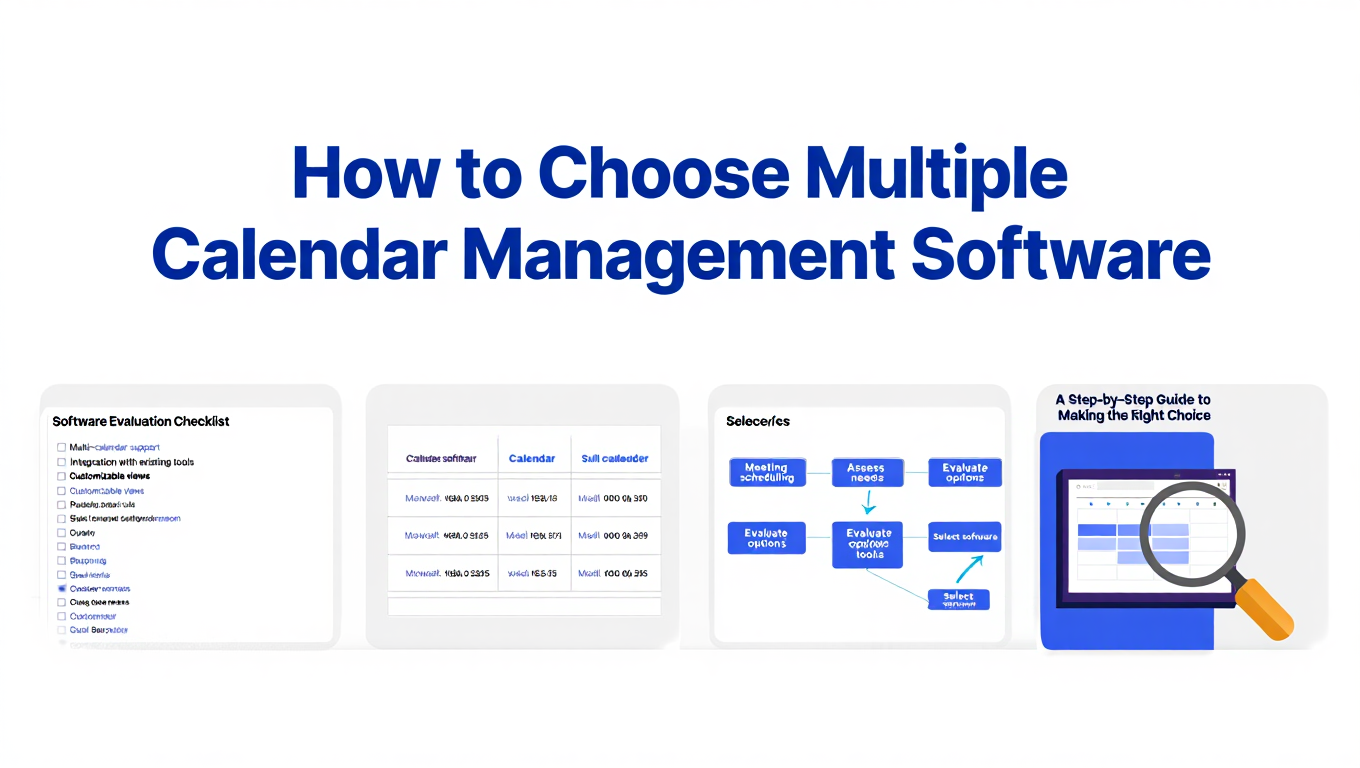
How to Choose Multiple Calendar Management Software
Expert guide to selecting the right multiple calendar management software for consultants, executives, and fractional leaders managing 10+ calendars.